The “best aussie online casino” page that won’t recommend a single brand
 Available in US
There’s no honest way to write a list of the best online casinos for Australians in 2026 without telling you, first, that none of them are allowed to operate in Australia at all. The Interactive Gambling Act 2001 makes it an offence to provide online casino games, online pokies or in-play betting to a person physically in Australia. No state or territory issues a licence for it. The Northern Territory Racing and Wagering Commission regulates 52 online bookmakers for tax reasons, and that licence covers racing and sport — never a roulette wheel or a slot reel. So the brands below exist because the ACMA, the regulator that actually has the power to act, has already issued formal warnings against each of them. This is a list of sites an Australian regulator has told to stop, sorted into the form a search engine expects, because anything else would pretend the question has answers it doesn’t.

Data current as of 23 September 2026, cross-checked against the Australian Communications and Media Authority’s published enforcement notices and against H2 Gambling Capital’s 2025 estimate of offshore losses.
Table of Contents
- What “best” can mean when the field itself is illegal
- The list of brands the ACMA has warned about
- Blocking at the network level — how the ACMA’s stop list grew
- Where the money side actually sits for Australians
- The bonus mechanics a comparison page usually hides
- Mobile and the apps that aren’t on the App Store
- “New” casinos in a market that doesn’t license them
- The legal shape of Australian online wagering
- The easiest path off this list
- What to do if the choice to play has started to feel heavy
- Frequently asked questions
What “best” can mean when the field itself is illegal
The word “best” presupposes a market you can win on or lose on, and a regulator keeping it honest. Australian online wagering has the first; online casino play, by design, has neither. The Interactive Gambling Amendment Act 2017 closed the door on new casino licences and made it easier to act against offshore ones. After that, the Australian Communications and Media Authority went from a regulator issuing advisories to one directing Australian internet service providers to block sites at the network level. By the regulator’s own count, 1,751 illegal gambling and affiliate marketing websites had been blocked since the first blocking request in November 2019, and more than 230 unlicensed gambling services had left the Australian market since enforcement was strengthened in 2017.

H2 Gambling Capital’s 2025 estimate puts what Australians lose to illegal sites at roughly A$3.9 billion a year. The share of gambling going through legal channels has fallen from 74% in 2021 to 64%, which means the offshore side has been growing while the legal side has been shrinking. That isn’t a market in which any operator deserves the word “best” — it’s a market in which the choice the page is offering you is between staying on the regulated side and stepping off it.
The shortlist this page will and won’t produce
This page will name eleven offshore brands the ACMA has issued a formal warning against in the last few years, ordered by the date of the most recent action, and will say what that action was. It will not rank them by payout speed, by bonus size, or by “user experience”, because the only sources for those numbers are affiliate marketing pages with a financial interest in the click. The differences between these brands, on the evidence the regulator publishes, are thinner than any list of theirs suggests, and they all share one feature the page should be plain about: there is no Australian complaints body, no Australian dispute resolution, and no Australian refund if a withdrawal is refused.

The list of brands the ACMA has warned about
The table below is built from the ACMA’s own formal warnings, not from operator websites. “ACMA action” is the regulator’s published step; “operator named” is the legal entity the regulator named when it took that step — which is often a parent company rather than the brand name on the homepage. A repeat warning against the same operator isn’t a stronger product, it’s a regulator coming back to the same address.
| Brand | ACMA action and date | Operator named by the ACMA | Subject support |
|---|---|---|---|
| RocketPlay | Formal warning, March 2026 | Pulsup Ltd | — |
| Jackbit | Formal warning, April 2026 | Ryker B.V. | — |
| Level Up Casino | Formal warning, May 2022 | Dama N.V. | — |
| Woo Casino | Formal warning, March 2025 | Dama N.V. | — |
| Spirit Casino | Formal warning, May 2025 | Dama N.V. | — |
| National Casino | Formal warning, July 2025 | Consolutetish S.R.L. | — |
| Bizzo Casino | Formal warning, July 2025; prior 2022 | Consolutetish S.R.L. / TechSolutions | — |
| Ignition Casino | Formal warning, July 2025 | Bamboo Media | — |
| Instant Casino | Formal warning, February 2025 | EOD Code SRL | — |
| Casino Intense | Formal warning, April 2025 | Sterplay Holding Ltd | — |
| Sky Crown | Formal warning (Hollycorn) | Hollycorn N.V. | — |
The “Subject support” column is empty on every row because no row carries a confirmed subject — payment method, licence, or otherwise — that the regulator’s own file backs up. Several affiliate pages list these brands alongside payment methods and game providers, but those listings aren’t independent verification; they’re the same marketing chain the ACMA’s warnings describe. RocketPlay and Level Up Casino carry a listing at one industry directory each, which isn’t a check, and National Casino, Casino Intense and Instant Casino show up alongside Australian payment-method articles — which tells you a writer somewhere mentioned them in the same paragraph, not that an Australian payment processor endorsed them. Across eleven brands, the only consistent endorsement is the ACMA’s.
The shape of the warnings themselves
A formal warning isn’t a prosecution and isn’t a fine. It’s a written notice that tells the operator the regulator believes the service is prohibited under the Interactive Gambling Act and that further action may follow. For Australians, the practical consequence usually comes later: the regulator asks Australian ISPs to block the site at the DNS level, and the site goes dark to anyone using a major Australian internet provider while continuing to operate elsewhere. A blocked site keeps accepting deposits until the block is enforced, and any balance held when the block lands is, in practice, gone.
The names repeat more often than the brands do. Dama N.V. has collected at least four formal warnings in the table above, covering RocketPlay (under earlier ownership), Level Up Casino, Woo Casino and Spirit Casino. Consolutetish S.R.L. has two: National Casino and Bizzo Casino. TechSolutions Group has two of its own from 2022, including an earlier warning over Bizzo Casino. Hollycorn N.V. has a single published warning covering Sky Crown and Blue Leo together, which is what an offshore operation with multiple skins looks like once the regulator writes the names down.
Blocking at the network level — how the ACMA’s stop list grew
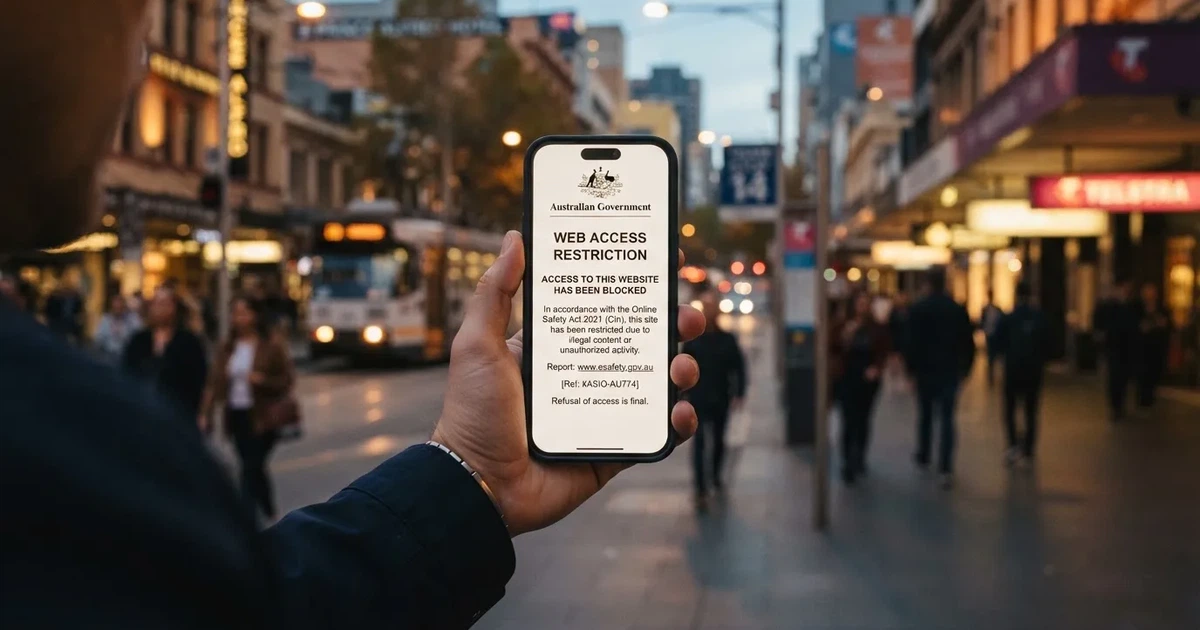
The blocking power sits in section 313 of the Telecommunications Act 1997, which lets the ACMA give Australian ISPs a written direction to take “all reasonable steps” to prevent access to a prohibited service. Once the direction is served, the site stops resolving for customers of Telstra, Optus, TPG and the other major providers within hours; smaller ISPs and mobile carriers follow suit on their own timelines. The site itself stays online for the rest of the world.
How fast the list has grown, and what that pace tells you
The cumulative total reached 1,751 by the end of June 2026, from the first blocking request in November 2019. That works out to a rough average of around 250 to 260 blocks per year across the period, with the early years slower as the regulator built the legal machinery and the more recent years faster as it built up the cases. The pacing is informative in itself: it’s the curve of a regulator catching up to a market that had years to grow unmolested, not the curve of a crackdown hitting fresh behaviour. New sites appear faster than old ones leave, and an “established” brand on this side of the industry is, by definition, a brand that hasn’t yet drawn a blocking request.
A single round reported on 26 June 2026 added twelve more sites to the list in one go: 7Signs, ChromaBet, Donbet, Duospin, Freshbet, Slots Gem, Jacks Club, Lucky Start, Pointsbetz, Spinrise, Vinyl Casino and Wildsino. None of those names overlap with the table above, which is the point — the regulator’s pipeline is full of brands the affiliate sites haven’t gotten around to writing about yet.
Why the regulator can name a brand in March and not block it until later
A formal warning is the regulator’s polite first step, and it usually precedes a blocking request by weeks or months. The gap is procedural: the warning is published, the operator is given a chance to respond, evidence is collected, and only then does the ACMA ask ISPs to act. Sites that rebrand or shift their domain during that window can restart the clock, which is part of why so many of the operators in the table above run more than one brand from the same corporate address. The regulator names one skin, the operator takes it down and raises another, and the next warning arrives six months later with a different logo on the letterhead.
Where the money side actually sits for Australians
The payments side of online casino play in Australia is, on the surface, the most ordinary thing about it: the same cards, the same bank transfers, the same digital wallets an Australian would use to pay a tradesperson. The deeper shape is unusual. Credit cards and credit-related products can’t be used to fund licensed online wagering at all — that ban came in on 11 June 2024 under amendments to the Interactive Gambling Act — and the same prohibition reaches digital wallets when they’re tied to a credit line. Apple Pay and Google Pay against a debit card remain common, and bank transfers through PayID, Osko or BPAY are the standard rails for the licensed bookmaker market.
PayID, Osko and the speed that’s actually available
PayID sits on the New Payments Platform, which went live on 13 February 2018 and is owned by New Payments Platform Australia Ltd, a non-profit whose thirteen shareholders include the Reserve Bank of Australia and the country’s major banks. By April 2025 more than 25 million PayID identifiers had been registered, and transfers to a PayID clear in under a minute through Osko, around the clock, every day of the year. The platform’s monthly outage allowance is capped at two minutes, which is why a PayID transfer rarely fails because the rails were down.
The catch sits in the name check. Paying to a PayID shows the account holder’s name before the transfer is sent, and the operator of PayID, Australian Payments Plus, warns that being asked to transfer money to a PayID on an illegal gambling site is “almost certainly” a sign of a scam. Australian Payments Plus operates both PayID and Osko, and the company is owned in roughly equal shares by the four major banks. The legal wagering market runs through these rails; the illegal market runs through them as well, because the rails don’t know which is which.
Cards, wallets and the bank-side blocks that exist whether or not the casino is legal
The bank has its own levers that don’t depend on whether the casino is licensed. Westpac’s gambling block operates at the card level by refusing any transaction tagged with the merchant category code “Betting/Casino Gambling” on eligible personal credit and debit cards. ANZ’s block, set up in the ANZ app, extends to gambling transactions made through a digital wallet such as Apple Pay on an eligible card. Commonwealth Bank offers the same control through its CommBank app as a “gambling lock”. Each of these blocks can be turned off, which is part of the design — they’re there for the player who wants them on permanently and for the player who wants to set them and forget them.
The Reserve Bank’s July 2025 review proposed removing surcharges on eftpos, Mastercard and Visa transactions, and explicitly left American Express outside that scope. That’s the card-network side of the picture; the consumer side is that none of these surcharging changes touch an offshore casino anyway, because the operator isn’t an Australian merchant and the surcharging rules don’t apply to a Curacao-registered entity.
What a payments page for an offshore casino actually delivers
An offshore casino page usually lists methods an Australian would recognise — Visa, Mastercard, sometimes a USDT or Bitcoin address — and then a withdrawal speed that varies from “instant” to a confident “within 24 hours”. Neither number means what an Australian customer would assume. The deposit goes through because the merchant code reads as a hotel or a software subscription rather than as gambling, which is the workaround every offshore operator runs to keep the card network from declining the transaction. The withdrawal comes back through the same workaround, sometimes for weeks, sometimes not at all, and the complaints body that would resolve a dispute is the licensing jurisdiction on the bottom of the homepage — Curaçao, Anjouan, the Comoros — which has no Australian office and no obligation to an Australian customer.
The bonus mechanics a comparison page usually hides
A welcome bonus is the most advertised feature of any offshore casino and the least explained. The headline “100% match up to A$500 plus 200 free spins” is a contract, and the contract has three clauses that decide what it costs the player: the wagering requirement, the maximum cashout, and the game weighting.
A wagering requirement of 40× the bonus, which is a common figure in this market, means a player who accepts A$500 in bonus money has to place A$20,000 in qualifying bets before any of it becomes withdrawable. Free spins attached to the bonus usually carry their own multiplier, often 40× the spin value, on top of the wagering on the bonus itself. Game weighting is where most players lose without realising it: pokies usually contribute 100% of each bet to the wagering requirement, but table games often contribute 10% or less, and a few games are excluded entirely. A player who puts A$500 through roulette at 10% weighting has to do A$200,000 worth of qualifying bets to clear the same bonus. None of this is hidden — it sits in the terms and conditions, in the small print most players skip.
Maximum cashout caps are the second clause. A “no deposit” bonus of A$20 with a 50× wagering requirement and a maximum cashout of A$100 means a player has to wager A$1,000 before any withdrawal, and even then can’t take more than A$100 out, regardless of how much they actually won. The clause exists because no-deposit bonuses would otherwise be cheap money for bonus abusers, and it’s enforced by the operator because the operator sets it. The Australian player who sees “free A$20 to try” sees a gift; the operator sees a marketing cost with a ceiling.
What the calculation says about a typical bonus
The arithmetic on a representative bonus — A$500 at 40× wagering, on pokies contributing 100% — works out to A$20,000 in qualifying bets. A pokies spin at A$1 a spin runs through that volume in 20,000 spins, or about 27.8 hours at a five-second interval. The expected loss over those 20,000 spins, at a typical pokies RTP of around 96%, is A$20,000 × 4% = A$800. The bonus nominally paid A$500. The expected cost of clearing it, in pure statistical terms, is A$300 more than the bonus is worth. None of this guarantees a particular player will lose that much — variance swings both ways over 20,000 spins — but it’s the average, and it’s what an offer like this actually trades at.
The figure is also contingent on the bonus being played in isolation, with no deposits added and no real-money play mixed in. Once a player tops up with their own money — which the wagering usually requires before withdrawal — the calculation changes, and the change rarely favours the player.
Mobile and the apps that aren’t on the App Store
Australian licensed bookmakers can’t promote themselves through inducements, and the major ones don’t have native casino apps. The offshore casino market fills that gap with mobile-optimised websites that work in Safari and Chrome, and with Android APK files that have to be side-loaded because Google Play doesn’t accept real-money gambling apps in Australia. iPhone users have no sideload option, so an offshore casino on an iPhone is always a browser tab.
The difference matters for one reason above all: a browser tab doesn’t ask the operating system for the permissions a native app does, and it doesn’t update through an app store. There’s no automatic check that the site is still who it claims to be. The “mobile casino” experience an offshore operator advertises is a responsive website with the marketing wrapped around it, and the “Aussie casino app” the search results promise is, on iOS, the same responsive website with a home-screen icon. A player who downloads an APK from the casino’s own site is also taking the casino’s word that the file is what it says it is.
The consumer-side controls that exist whether or not the app is licensed
The same bank-level blocks that work at the checkout on a desktop work on a phone. ANZ’s gambling block covers Apple Pay transactions on an eligible card. Westpac’s merchant-code filter doesn’t care whether the transaction was placed through an app or a tab. Commonwealth Bank’s CommBank app lock runs in the same way. There’s no “use the app to bypass the bank block” trick, because the block sits on the card, not on the casino.
“New” casinos in a market that doesn’t license them
A “new” online casino in the Australian search results is a freshly branded offshore site, not a freshly licensed one. The licence on the bottom of the homepage is from Curaçao, Anjouan, the Comoros or Costa Rica, and the licence was issued in the last year or two because that’s when the brand launched. None of those licences adds anything the operator didn’t already have, and none of them constrains the operator in the way an Australian licence would.
The marketing pitch for newness usually leans on three claims: a bigger welcome package, a wider game library, and a “modern” platform. None of those are quality signals in an unregulated market. A bigger welcome package usually means a heavier wagering requirement and a tighter max cashout. A wider game library means more providers the player has never heard of, which in this market means studios with no published RTP audit. A modern platform means a slightly fresher skin over the same back-end template the operator’s other three skins run on.
The regulator’s pattern fits this picture. The 12-site blocking round in June 2026 named several brands that hadn’t been on the radar a year earlier, including 7Signs, Duospin and Wildsino — names built to look current and disposable, which is exactly what they are.
The legal shape of Australian online wagering
The Interactive Gambling Act 2001, as amended in 2017, makes it an offence to provide a prohibited interactive gambling service — which covers online casino games, online pokies and in-play betting — to a person in Australia. The 2023 amendments added the credit-card ban that came into force on 11 June 2024, with penalties up to A$247,500 for operators. The 2026 reform package — the Interactive Gambling Amendment (Gambling Reform) Bill 2026, passed on 19 August 2026 — adds advertising and inducement restrictions that commence on 1 January 2027, and that’s the law with a start date still ahead of it.
What the Act allows is wagering on racing and sport placed before the event, lotteries and keno. Sportsbet, Bet365 and Ladbrokes are licensed in the Northern Territory for tax reasons, through the NTRWC, and the commission has no full-time staff and meets once a month in Darwin. The 52 licensed bookmakers it oversees are a wagering industry, not a casino industry, and they sit on a side of the law that everything in the table above doesn’t.
What the regulator can and can’t do to an Australian player
The IGA targets the provider. An Australian who plays at an offshore casino isn’t prosecuted, fined or approached by the ACMA, because the Act is built around stopping the supply rather than prosecuting the demand. The consequence for the player is what happens to the money: if the operator refuses a withdrawal, or if the site is blocked at the network level with a balance on it, the player has no Australian complaints body to contact. BetStop, the National Self-Exclusion Register, has been live since August 2023 and binds Australian-licensed online and phone wagering services — it does not bind offshore casinos, because those services aren’t connected to it.
The easiest path off this list
For someone who wants the casino night without the offshore site, the legal Australian options are limited but real. Crown Melbourne, Crown Perth, The Star Sydney, The Star Gold Coast and Jupiters on the Gold Coast run table games under state casino licences, with identity checks at the door and the Australian consumer protections that come with a domestic licence. Adelaide Casino and the Country Club in Launceston do the same. The minimum age across all of them is 18.
For someone whose interest has shifted toward online wagering rather than away from gambling, the licensed bookmakers list is the only Australian-legal counterpart to the brands above. They’re licensed to take bets on races and sport before the event, not to run a roulette wheel, and the marketing and inducement regime they operate under is the one the offshore operators have spent fifteen years routing around.
What to do if the choice to play has started to feel heavy
Gambling Help Online runs free confidential support around the clock, by phone on 1800 858 858 and by online chat. BetStop, the National Self-Exclusion Register, lets a person exclude themselves from every Australian-licensed online and phone wagering service in one registration; it doesn’t cover offshore casinos, but most Australian banks will honour the intent by extending their gambling blocks. The relevant ATO position is that recreational gambling winnings aren’t assessable income and losses aren’t deductible, unless gambling is being carried on as a business — which is the rare case, not the common one, and worth checking with a tax agent rather than assuming.
Frequently asked questions
Is there a licensed online casino based in Australia that Australians can legally join?
No. The Interactive Gambling Act 2001 prohibits the supply of online casino games and online pokies to anyone in Australia, and no state or territory issues a licence for them. The Northern Territory Racing and Wagering Commission licenses online bookmakers for racing and sport, never for casino games. Anything presenting itself as an Australian-licensed online casino is either a licensed bookmaker mislabelling its product or an offshore site, and offshore sites are precisely what the ACMA’s enforcement targets.
What does “best” mean when every option being compared is an offshore, unlicensed site?
It doesn’t mean what the search results imply. On the evidence the Australian regulator publishes, the differences between the brands in the table above are mostly the date of the most recent warning and the legal entity named in it. The features a typical comparison site advertises — payout speed, bonus size, game library — are reported by affiliate marketing pages whose revenue depends on the click, not by an Australian regulator. Treating the question as one with a real answer is part of how the offshore market keeps pulling Australian players.
How does the ACMA decide which offshore casino sites to warn about or block?
The regulator investigates, usually in response to complaints or its own monitoring, and publishes a formal warning when it believes the service is prohibited under the Interactive Gambling Act. The operator is given a chance to respond before a blocking request is issued to Australian ISPs, who are then directed under section 313 of the Telecommunications Act 1997 to take reasonable steps to prevent access. The site stays online for the rest of the world. The cumulative count reached 1,751 blocked sites by the end of June 2026, from the first blocking request in November 2019.
Can an offshore casino site legally register an Australian-style web address and call itself Aussie?
The .au domain space is regulated by auDA and is not generally available to entities without an Australian presence, but the offshore brands in this market use .com, .com.au through related local front companies, and other top-level domains in their URLs. A .com.au registration doesn’t mean a brand is Australian-licensed; in several recent ACMA cases the regulator has named a local marketing entity alongside the offshore operator. The word “Aussie” on a homepage is marketing language, not a licence status, and the ACMA’s enforcement record shows it has been used by exactly the brands on the published warnings list.
What legal, licensed alternative exists for someone wanting a casino night in Australia?
State-licensed land-based casinos operate in every mainland state and in the Northern Territory, with table games, pokies and identity checks at the door. They are licensed and regulated by state authorities, the minimum age is 18, and consumer protections are Australian. The selection is smaller than what an offshore casino offers, and the locations are limited, but for a player who wants the experience under Australian law, that’s the only path the IGA leaves open.
Does any state or territory issue online casino licences to operators serving Australians?
No. The IGA prohibits the supply of online casino games anywhere in Australia, and the state and territory casino regulators license land-based venues, not online products. The NTRWC licenses online wagering — racing and sport before the event, with the 2024 credit-card ban and the upcoming advertising restrictions under the 2026 reform bill — but it does not license online casino games. Any site claiming an Australian online casino licence is misrepresenting what it has.
Created by the ”Casino Venues Info” editorial team.