
$1 minimum deposit casinos in Australia, read against the law
 Available in US
A $1 minimum deposit at an Australian online casino is one of those offers that does not exist in the form its marketing copy suggests. The Interactive Gambling Act 2001 prohibits supplying online casino games to anyone in Australia, so any site quoting a $1 floor is, by definition, an offshore operator working outside the local regime. The page below sets out what that means in practice: which operators the ACMA has actually warned by name, what an Australian bank rail would do with a $1 transfer, where the legal alternative does sit, and where the framework a player can rely on stops.
Data current as of 23 September 2026 · checked against the ACMA’s register of formal warnings and the Interactive Gambling Act 2001 as it stood at the time of research.
Table of Contents
- How a fair comparison of $1 minimum-deposit casinos would actually weigh
- The fundamentals a $1 deposit sits on top of
- The prohibition that frames a $1 deposit
- Where to turn if a $1 deposit starts to feel compulsory
- Settlement timing for a $1 transfer, in plain banking language
- Eleven ACMA-warned brands a $1 deposit would lead to
- What the ACMA’s blocking rate actually means
- Frequently Asked Questions
How a fair comparison of $1 minimum-deposit casinos would actually weigh
A “top” list in this market is not the document the reader’s search suggests. A reader searching for the best $1 minimum deposit casino in Australia is searching in a market where the legal answer to the question is that there is no such thing. Online casino games cannot be licensed anywhere in the country; the minimum stake is irrelevant to that prohibition. What changes from one offer to the next is not who pays out fastest, but who the regulator has put on the record, who runs the brand, and what an Australian can actually recover if a withdrawal stalls.
A fair weighting leans on five things, in this order. The first is the regulator’s record. The Australian Communications and Media Authority publishes formal warnings by named operator and date, and the names repeat across brands more often than the marketing pages would have a reader believe. The second is the operating entity: Dama N.V., Hollycorn N.V., Ryker B.V. and the rest of the corporate shells recur because the same group often runs several brands at once. The third is the payment path — what an Australian would actually have to use to clear a $1 deposit, what the merchant code on the card will say, and whether the bank’s gambling block will refuse it. The fourth is the dispute path. An offshore licence does not put the player inside the eSafety or Australian Competition and Consumer Commission complaint systems. The fifth is the responsible-gaming reach. BetStop, the National Self-Exclusion Register, binds Australian-licensed services only, so an offshore site is by definition outside it.
A “ranking” in this market is therefore not a leaderboard. It is a record of the eleven brands the ACMA has put on the file in recent years, in the order the regulator itself acted. The list tells the reader where the regulator has been, not where to send a dollar. A reader using the list as a shortlist to play at is using it for a purpose the regulator’s file cannot endorse.
The shift that makes the list useful at all is the one between the marketing page and the regulator’s record. The marketing page advertises a $1 minimum and a game library. The regulator’s record names the operator, the date, and the section of the Interactive Gambling Act 2001 the regulator says has been breached. A reader who weighs only the first has no picture. A reader who weighs both has the only picture the available data allows.
The fundamentals a $1 deposit sits on top of
The pitch of a $1 minimum deposit leans on a misreading. A reader sees a low number and assumes the rule that governs everything else still applies. It does not. In Australia, the Interactive Gambling Act 2001 makes it an offence for a provider to supply online casino games — slots, blackjack, roulette, live-dealer tables — to a person who is physically in Australia, whatever the minimum stake is. The minimum is a marketing number the operator chose; the prohibition is a statutory one that sits above it.

The scale of the offshore side is not small. H2 Gambling Capital’s 2025 estimate put Australian losses to illegal offshore gambling sites at about A$3.9 billion a year. The legal channel’s share of total gambling fell from 74 per cent in 2021 to 64 per cent in 2025, on the same estimate — a ten-point drop in four years. The trend is the easier story to verify than any one operator’s claim, and the regulator’s blocking record lines up with it.
The other fundamental is the licensed alternative. Sports and race wagering is licensed, mostly through the Northern Territory Racing and Wagering Commission, which authorises 52 online bookmakers including Sportsbet, Bet365 and Ladbrokes. Keno and lotteries are licensed at state level. The NTRWC has no full-time staff and meets once a month in Darwin, a fact that has surfaced in recent parliamentary debate over its remit and over whether the de facto regulator has the resources to do the job. That question is upstream of any discussion of offshore casino enforcement.
The shape of the offshore side has been laid out by the ACMA in waves. In July 2025 the regulator issued formal warnings over Ignition Casino, National Casino and Bizzo Casino, the last of which had already been the subject of a 2022 warning to TechSolutions Group. Bamboo Media was named over Ignition Casino. Consolutetish S.R.L. was named over National Casino and Bizzo Casino. The point of reciting these names is not to catalogue companies the reader has never heard of. It is to show that the same operators cycle back into the market under related brand names, and that a “new” $1 deposit casino is more often than not a corporate repeat in fresh packaging.
The arithmetic that an Australian reader is sitting on top of, then, is a negative one. There is no Australian consumer protection in the offer. There is no local dispute body if a withdrawal stalls. There is no requirement that the operator hold player funds in segregated accounts. The “1 dollar” in the marketing line is a register entry on the operator’s own page; everything that follows the deposit sits outside Australian law.
The prohibition that frames a $1 deposit
The Interactive Gambling Act 2001, as tightened by the Interactive Gambling Amendment Act 2017, makes it an offence to provide online casino games or in-play betting to a person in Australia. The offence sits on the provider, not the player. The player is not prosecuted for depositing, but the player also gets nothing the law would otherwise give them — no right of action under the Australian Consumer Law, no recourse to AFCA, no recourse to the eSafety Commissioner. In February 2025 the ACMA issued a formal warning to EOD Code SRL over Instant Casino. The warning itself is a public artefact; the binding consequence is what the regulator can then do.

What the regulator does, increasingly, is block. The ACMA asks Australian internet service providers to block illegal sites at the DNS level. By June 2026, the ACMA had asked ISPs to block 1,751 illegal gambling and affiliate marketing sites since the first blocking request in November 2019. The June 2026 round alone added twelve names: 7Signs, ChromaBet, Donbet, Duospin, Freshbet, Slots Gem, Jacks Club, Lucky Start, Pointsbetz.com, Spinrise, Vinyl Casino and Wildsino. More than 230 unlicensed services had left the Australian market since the 2017 enforcement ramp-up. The pace has been steady, and the names tend to rhyme across rounds.
The 2026 reform picture is one law with a start date, not yet in force. The Interactive Gambling Amendment (Gambling Reform) Bill 2026 passed Parliament on 19 August 2026, with its advertising and inducement measures to commence on 1 January 2027. On a page read in 2026 that is the frame: the prohibitions are already operative, and the inducement side is being closed down the year after. A reader comparing what the law does now to what the law will do then should not treat the 2027 measures as live. They are law with a delayed commencement, not the law as it stands today.
A small, useful clarification: licensed wagering on sport and racing is not what this page is about. Sportsbet, Bet365 and Ladbrokes hold Northern Territory licences and can offer pre-event betting on races and sporting events. They cannot offer online casino games. A reader who sees a Sportsbet or Bet365 logo on a casino page is looking at a different corporate entity from the one their licence covers, almost certainly an offshore one using the trade dress of a familiar brand without holding the Australian right to do so. The brand familiarity is the trap, not the protection.
The payment side of the prohibition is sharper than the marketing side. Since 11 June 2024, Australian-licensed online wagering services cannot accept payment by credit card or other credit-related products, with operator penalties up to A$247,500. The rule constrains gambling use of linked digital wallets such as Apple Pay on licensed services. None of this stops an offshore site from asking an Australian for a credit card. The offshore side sits outside the rule, and the licensed-side ban does not extend to it. A reader who sees a credit card deposit field on an offshore casino is being asked to do something the licensed side is forbidden to offer.
Where to turn if a $1 deposit starts to feel compulsory
The framework for an Australian who feels a $1 deposit slipping into something else is real, free and confidential. Gambling Help Online is the national counselling service, online chat and phone, twenty-four hours a day. The National Gambling Helpline is 1800 858 858. Both are free and not connected to any operator on this page. BetStop, the National Self-Exclusion Register, has been live since August 2023. Its reach matters: BetStop binds Australian-licensed online and phone wagering services, not offshore casinos. Signing up to BetStop will not stop a $1 deposit at an ACMA-warned offshore site from clearing. What it does is close the licensed side, and from there a reader who wants a fuller break should ask their bank about a gambling transaction block.
Australian banks offer them. ANZ’s gambling transaction block, switched on in the ANZ app, refuses gambling transactions on eligible cards and on linked digital wallets such as Apple Pay. Removing the ANZ block once it is on requires a 48-hour cooling-off period, and the bank warns that not all gambling transactions will be blocked and some non-gambling transactions might be blocked in error. Westpac’s block works at the card level, by refusing authorisation of transactions registered under the merchant category code “Betting/Casino Gambling” on eligible personal credit and debit cards. Commonwealth Bank lets customers apply a gambling lock to eligible cards via the CommBank app, with the same caveat that the bank cannot guarantee every gambling transaction will be stopped. The Reserve Bank of Australia’s July 2025 review proposes removing surcharges on eftpos, Mastercard and Visa transactions, leaving American Express outside the scope of the proposed surcharge ban — a small but instructive gap in the cost-of-payment picture.
The blocks are not perfect. Every bank says so. They are a real friction in front of an offshore deposit that no Australian licence can stop, and they are the most direct tool a bank can put between a player and a $1 minimum-deposit page.
The hardest message here is also the one most worth keeping. A reader who finds themselves hiding a deposit, chasing a loss, or borrowing to top up is no longer in the marketing picture the $1 minimum is selling. They are in a different one, with a different set of phone numbers. Gambling Help Online, 1800 858 858. The fact that the offshore side sits outside BetStop is not a defence against a habit that has already taken hold.
Settlement timing for a $1 transfer, in plain banking language
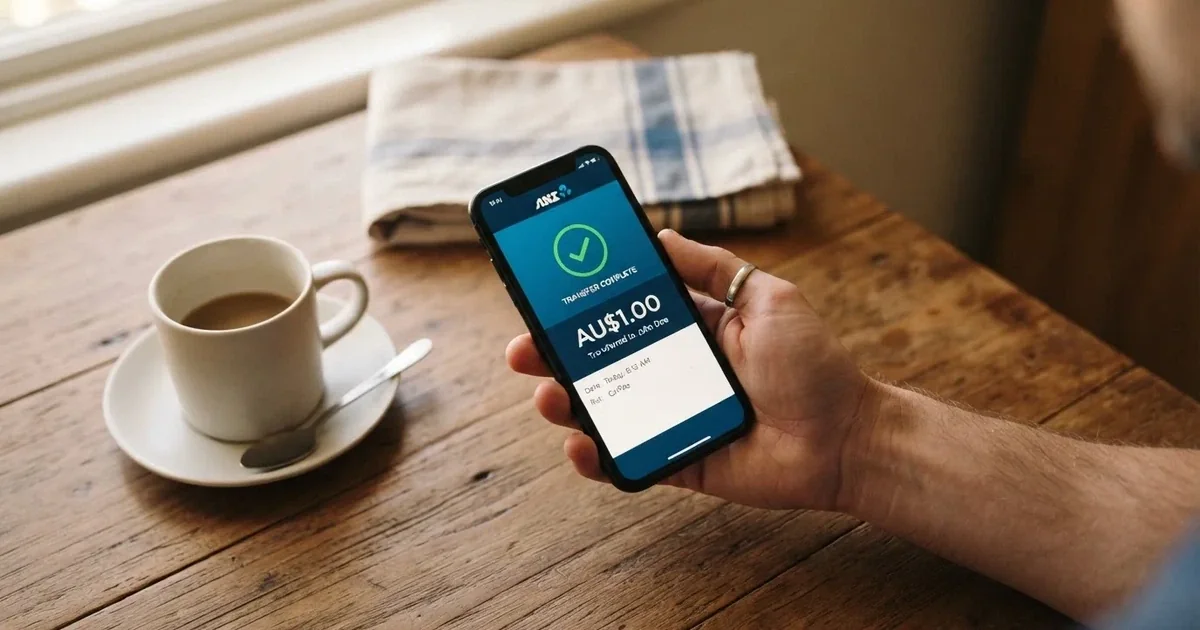
What happens to a $1 transfer if it ever reaches an Australian bank account is a question the offshore side has no incentive to answer clearly, because the answer is the same regardless of the operator. The relevant Australian rails are Osko, BPAY, PayID and direct entry, and none of them are owned by any casino on this page. The Dama N.V. group, which the ACMA warned over Woo Casino in March 2025 and Spirit Casino in May 2025, runs on the same Australian payment rails every other business runs on, and on the same processing windows. The minimum deposit the marketing page advertises is unrelated to the rail.
Osko moves a bank transfer between participating Australian banks in under a minute, twenty-four hours a day, weekends included, addressed to either a BSB and account number or to a PayID. The first version of the New Payments Platform that carries Osko became accessible to the public on 13 February 2018 and is owned by New Payments Platform Australia Ltd, a non-profit whose thirteen shareholders include the Reserve Bank of Australia and the country’s major banks. The ACCC authorised the merger of NPP Australia with BPAY and eftpos into a single company, Australian Payments Plus, in 2021. By April 2025 more than 25 million PayID identifiers had been registered on the platform.
PayID adds a check before the transfer is sent: the name of the account holder appears on screen before the customer confirms. AP+ warns, plainly, that being asked to transfer money to a PayID on an illegal gambling site almost certainly means a scam site. That warning is not specific to a $1 deposit; it is the general rule the system was built around, and it is the same warning the system gives regardless of whether the brand on the other side is one the ACMA has named or one that has not yet appeared on the regulator’s file.
BPAY is the bill-payment rail the licensed wagering market leans on. The payer enters a Biller Code and a Customer Reference Number from the bill. BPAY has operated since 18 November 1997, is available in the online banking of more than 140 Australian institutions and is offered by over 95,000 businesses. It is owned, through Cardlink Services Limited, equally by ANZ, Commonwealth Bank, NAB and Westpac. The licensed bookmakers route deposits through BPAY; the offshore casinos cannot, because they are not Australian billers, and they fall back to direct bank transfer or to a PayID under a name that may or may not match the trading brand.
AUSTRAC’s threshold transaction report rule requires reporting of transfers of A$10,000 or more — but the rule applies only to physical cash. An ordinary electronic bank transfer is not subject to it at any amount. A reader who has been told that “transfers over $10,000 are reported” has been told a rule that does not apply to the rail a casino deposit would actually use. The minimum that triggers reporting is a separate matter from the minimum that gets a game round started, and conflating them is a mistake the marketing page leaves a reader free to make.
Apple Pay, Google Pay and Samsung Pay together accounted for around 45 per cent of all card payments in Australia by number at the end of 2025. The interaction with gambling blocks is uneven: ANZ’s block, when activated, also blocks gambling transactions made through a digital wallet on an eligible card. Apple itself does not charge fees to consumers for using Apple Pay — any surcharge comes from the merchant’s card-processing fees — and Apple states that transaction limits and PIN requirements are set by the card issuer or merchant, not by Apple. The credit-card ban that has applied to Australian-licensed online wagering since 11 June 2024 also constrains gambling use of linked digital wallets. None of this protects an Australian who tries to deposit at an offshore site — the offshore side does not see the licensed-wagering rules — but it shapes what the bank on the other side will let through. A reader who has turned on their bank’s gambling block may find that the merchant code “Betting/Casino Gambling” is refused before any minimum is even assessed.
Eleven ACMA-warned brands a $1 deposit would lead to
The brands below are not a shortlist to play at. They are the brands the ACMA has issued a formal warning about under the Interactive Gambling Act 2001 in recent years, each named with the entity the regulator recorded and the date the warning was published. The product — online casino games — cannot be licensed anywhere in Australia, so the table’s first column is what the regulator said, the second is who the regulator said it to, and the third is what independent listings actually document about the brand beyond the regulator’s file. The fourth column shows the listings coverage: where the brand shows up in third-party indexes, in regulator files, or in self-exclusion registers. Where the column reads “—”, the research uncovered no independent listings trail beyond the regulator’s file.
| Brand | ACMA action and date | Operator named by the ACMA | Coverage in third-party listings |
|---|---|---|---|
| RocketPlay | Formal warning, March 2026 (earlier May 2022) | Pulsup Ltd over Rocketplay.com.au; earlier Dama N.V. | Listings only — Gamblinginsider.com |
| Level Up Casino | Formal warning, May 2022 | Dama N.V. | Listings only — Westpac.com.au |
| Woo Casino | Formal warning, March 2025 | Dama N.V. | — |
| Spirit Casino | Formal warning, May 2025 | Dama N.V. | — |
| National Casino | Formal warning, July 2025 | Consolutetish S.R.L. | Listings only — acma.gov.au, austrac.gov.au, betstop.gov.au |
| Bizzo Casino | Formal warning, July 2025 (earlier 2022) | Consolutetish S.R.L.; earlier TechSolutions | Listings only — Gamblinginsider.com |
| Ignition Casino | Formal warning, July 2025 | Bamboo Media | — |
| Instant Casino | Formal warning, February 2025 | EOD Code SRL | Listings only — Ecopayz.com, Payid.com.au |
| Jackbit | Formal warning, April 2026 | Ryker B.V. | — |
| Casino Intense | Formal warning, April 2025 | Sterplay Holding Ltd | Listings only — austrac.gov.au, betstop.gov.au, Gamblinginsider.com |
| Sky Crown | Formal warning | Hollycorn N.V. | — |
1. RocketPlay
RocketPlay sits on the regulator’s record twice, in two different corporate hands. In May 2022 the ACMA issued a formal warning to Dama N.V. that named Rocketplay among six brands, alongside Bambet, Dazard, Level Up, Wild Tornado and Cobra Casinos. In March 2026 the ACMA issued a further formal warning, this time to Pulsup Ltd over Rocketplay.com.au, the brand’s Australian-facing domain. The brand’s life as a regulator’s file therefore straddles at least two distinct operators and one rebrand, and the second warning does not retire the first.
What independent listings carry beyond the regulator’s file is the marketing surface rather than any Australian compliance trail. The third-party listings that name RocketPlay are Gamblinginsider.com and similar trade indexes — the pages an Australian reader would find if they searched the brand directly, not the pages an Australian regulator would audit. There is no entry in BetStop, because BetStop binds only Australian-licensed services. There is no segregated funds statement an Australian reader could verify, and no Australian complaints body the brand has elected to answer to.
The verdict for a reader comparing options: weigh the four-year file before the deposit button, and weigh the two-operator history as one file rather than two. The minimum is the marketing number; the file is the record of enforcement.
2. Level Up Casino
Level Up Casino is the second Dama N.V. brand named in the May 2022 warning, alongside RocketPlay, Bambet, Dazard, Wild Tornado and Cobra Casinos. The May 2022 warning is the earliest formal action on this page that names a Dama N.V. brand, and the cluster is the cleanest example of how a single operator runs multiple brand fronts through the regulator’s file. Five of the eleven brands on this page trace back to Dama N.V. across different warning dates.
Independent coverage of Level Up Casino in the listings trail is thin. The brand shows up in Westpac’s gambling-block documentation as one of the merchant codes a blocked card will refuse — a data point that confirms the operator exists in the Australian payments environment but adds nothing about whether it complies with Australian consumer law. There is no Australian responsible-gaming register entry. There is no Australian complaints body to take a dispute to. There is no segregated funds statement an Australian could verify.
The verdict for a reader comparing options: the May 2022 warning is the oldest on this page, and what it does not show is the absence of a follow-up. The ACMA does not warn brands twice to clarify that the first warning still stands. A reader weighing Level Up against the others should weigh the May 2022 file first.
3. Woo Casino
Woo Casino is one of two Dama N.V. brands the ACMA named in the 2025 window, with the Woo Casino warning published in March 2025. The pattern repeats across the cluster: Dama N.V. running multiple brand fronts, with the regulator naming them in close succession rather than as a single grouped warning. The Dama N.V. cluster of formal warnings now spans May 2022, March 2025 and May 2025, and the cluster is the cleanest example on this page of how a corporate entity cycles its brands through regulator action without ever resolving the underlying offering.
Third-party coverage of Woo Casino in independent listings is thin. The brand shows up in trade indexes and affiliate marketing pages, which is the listings surface this page is built to read against — and what those listings cover is the marketing pitch, not the Australian regulatory standing. There is no BetStop entry to verify, no entry in the National Gambling Helpline’s referral list, and no segregated funds statement an Australian reader could check. The minimum deposit is the only number a reader can verify against the brand’s own page, and that page is the brand’s own page.
The verdict: Woo Casino sits in the middle of the Dama N.V. cluster, between the 2022 batch and the May 2025 Spirit Casino warning. It adds no signal of its own beyond the date. The minimum is the marketing number. The file is the operating number.
4. Spirit Casino
Spirit Casino is the second of the two Dama N.V. brands the ACMA named in 2025, with the formal warning published in May 2025. The pair of 2025 warnings, March and May, came from the same Dama N.V. corporate entity and on the same Australian-facing offering. The pattern is consistent with how the operator group has run its brand portfolio since at least 2022: separate brand names, single operator entity, separate regulator warnings rather than one bundled action.
The independent listings trail for Spirit Casino in the research is even thinner than for Woo Casino. Spirit Casino’s footprint in these indexes remains identical to its counterparts. There is no BetStop entry to look up, nor an Australian complaints body the brand has elected to answer to. Beyond the standard offshore boilerplate, there is no verified responsible-gaming disclosure. The $1 deposit is merely a marketing figure on the brand’s landing page.
The verdict: weigh the May 2025 file before the deposit button, and weigh the two 2025 Dama N.V. warnings as one file under one operator. Two warnings in two months, under one shell, do not constitute progress on the underlying regulatory objection. Marketing pages present one number; the regulator presents the rest.
5. National Casino
National Casino is one of two Consolutetish S.R.L. brands the ACMA named in the same July 2025 round, alongside Bizzo Casino. The third brand named in the same round was Ignition Casino, under Bamboo Media, which is a separate corporate entity. National Casino’s listing is therefore paired with Bizzo Casino in the regulator’s record, under a single operator shell that had not previously appeared as Consolutetish S.R.L. on the Australian-facing record.
What independent listings cover for National Casino is wider than for the Dama N.V. brands. The listings trail includes the ACMA’s own register, AUSTRAC’s enforcement register, and BetStop’s National Self-Exclusion Register — three Australian regulatory and consumer-protection lists, none of which is a marketing page. Their appearance on those lists is not an endorsement; it is documentation that the brand operates within reach of Australian regulatory machinery, even if only as a subject of action rather than a participant in a licensed scheme.
The verdict: visibility in three Australian-facing registers is not the same as compliance with Australian law. The brand is the more visible of the two Consolutetish S.R.L. entries. The minimum is the marketing number; the file is the record of enforcement.
6. Bizzo Casino
Bizzo Casino is the second Consolutetish S.R.L. brand in the July 2025 round, and the only brand on this page with two ACMA warnings under two different operators. The first warning, in 2022, was issued to TechSolutions (CY) Group Limited and TechSolutions Group N.V. The second, in July 2025, was issued to Consolutetish S.R.L. The two warnings bracket a rebrand or a corporate transfer that the regulator recorded but that did not resolve the underlying offering.
The independent listings trail for Bizzo Casino is thin in the trade-index sense — Gamblinginsider.com and similar affiliate-marketing surfaces — but the brand’s earlier 2022 warning means it has a longer regulator history than most on this page. There is no Australian responsible-gaming disclosure that an Australian reader could rely on. There is no BetStop entry and no segregated funds statement. The $1 deposit figure remains an unverified marketing claim on the site’s own page.
The verdict: Bizzo Casino is the brand on this page with two ACMA warnings under two different corporate shells, three years apart. A reader weighing this brand against the others should weigh both files, not the most recent alone. Regulatory history is the only number that matters here.
7. Ignition Casino
Ignition Casino is the third brand in the ACMA’s July 2025 round, named under Bamboo Media rather than under Consolutetish S.R.L. The three-brand July 2025 round — Ignition, National, Bizzo — covers two operator entities and three brand fronts. Ignition Casino’s separate corporate shell is the marker that distinguishes it from the Consolutetish S.R.L. pair, and it is the only one of the three brands whose operator had not previously appeared in the Australian regulator’s record before that round.
Independent coverage of Ignition Casino in the listings trail is thin. There is no BetStop entry, no segregated funds statement, and no Australian complaints body. The site’s advertised $1 minimum is solely an internal register entry on the brand’s own site, with no external verification available.
The verdict for a reader comparing options: a first warning is not softer than a repeat, and the brand’s first appearance on the ACMA’s file is the standing objection from here on. The minimum is just a marketing lure; check the regulator’s file instead.
8. Instant Casino
Instant Casino is the EOD Code SRL brand the ACMA named in February 2025, several months before the July 2025 round that pulled in Ignition, National and Bizzo. The February 2025 warning is the regulator’s first formal action against EOD Code SRL on the Australian-facing record, and Instant Casino is the brand front under which the warning was published. The 2025 warning sits early in a year that became one of the regulator’s busiest.
Independent coverage of Instant Casino in the listings trail leans on payment-method listings — Ecopayz.com and Payid.com.au — rather than on regulator or self-exclusion registers. That shape is informative: the brand’s visibility in Australian-facing listings is on the payment rails, not on the responsible-gaming or regulator side. AP+ warns, plainly, that being asked to transfer money to a PayID on an illegal gambling site almost certainly means a scam site. The warning applies regardless of which brand is asking.
The verdict: Instant Casino’s payment-rail visibility is not Australian protection, and the February 2025 warning is the regulator’s standing objection regardless of which listing page documents the rails. Do not mistake payment availability for a safe harbor.
9. Jackbit
Jackbit is one of two Ryker B.V. brands the ACMA named in the same April 2026 round, the other being CasinOK. The pattern repeats: a single operator entity running multiple brand fronts, with the regulator naming them together. The April 2026 round sits among the most recent ACMA formal warnings on this page, and the Jackbit and CasinOK pair is the cleanest example of the corporate cluster pattern in 2026.
Independent coverage of Jackbit in the listings trail is thin. There is no BetStop entry, no segregated funds statement, and no Australian complaints body to resolve disputes. The $1 minimum deposit mentioned in marketing copy is an internal figure, unrelated to any external auditing or Australian compliance measure.
The verdict: the Jackbit and CasinOK pair is the regulator’s clearest cluster pattern in the most recent round on this page. A reader who treats the two as separate undercounts the single Ryker B.V. shell behind them. Check the operator entity, not the brand’s marketing surface.
10. Casino Intense
Casino Intense is the Sterplay Holding Ltd brand the ACMA named in April 2025. The April 2025 warning predates the May 2025 Spirit Casino warning by a month and the July 2025 round by three months. Sterplay Holding Ltd is not a corporate entity that recurs elsewhere on this page; the brand sits alone in the regulator’s record under its own operator shell.
Independent coverage of Casino Intense is wider than for most of the brands on this page. The listings trail includes AUSTRAC’s enforcement register, BetStop’s National Self-Exclusion Register and Gamblinginsider.com — three Australian-facing reference lists covering regulation, self-exclusion and trade coverage. None of them is an endorsement. The visibility of the brand in these lists is documentation that the brand is a known entity in the Australian-facing space, not a sign that it complies with Australian law.
The verdict: the visibility in three Australian-facing registers is documentation of the brand’s existence, not evidence of compliance. The April 2025 warning is the standing objection. Weigh the file before the deposit button.
11. Sky Crown
Sky Crown is one of two Hollycorn N.V. brands the ACMA named in a single formal warning — the other is Blue Leo. The formal warning predates most of the warnings on this page, with the regulator publishing the Sky Crown and Blue Leo document in September 2022. Hollycorn N.V. is therefore the oldest corporate shell on this page that still has its brands on the regulator’s record, and the Sky Crown file has been continuous for almost four years.
Independent coverage of Sky Crown in the listings trail is thin. There is no BetStop entry, no segregated funds statement, and no Australian complaints body for players. The advertised $1 minimum is a company-controlled figure rather than an independently verified stake.
The verdict: Sky Crown has the longest regulator history on this page, and the Hollycorn N.V. shell has been consistent across the regulator’s record. A reader weighing Sky Crown against the others should weigh the four-year file first. Regulator history is the real metric.
What the ACMA’s blocking rate actually means
The arithmetic that puts the regulator’s work into proportion is simple. The ACMA had asked Australian ISPs to block 1,751 illegal gambling and affiliate marketing websites since the first blocking request in November 2019. The figure is current as of the June 2026 reporting round. From November 2019 to June 2026 is roughly six years and seven months, or about seventy-nine months. Dividing the running total by the months elapsed gives an average blocking rate of roughly twenty-two sites per month, or around two hundred and sixty-five sites per year on a steady-state read.
The band matters. The headline rate flattens the ramp-up. Enforcement was strengthened in 2017, two years before the first blocking request in November 2019, and the regulator’s later rounds have been denser than its earlier ones. The June 2026 round alone added twelve names — 7Signs, ChromaBet, Donbet, Duospin, Freshbet, Slots Gem, Jacks Club, Lucky Start, Pointsbetz.com, Spinrise, Vinyl Casino and Wildsino. The trailing rate sits closer to three hundred sites a year than to the long-run average of two hundred and sixty-five. A reader weighing the band should hold the steady-state average and the trailing rate side by side: between roughly twenty and twenty-five sites blocked per month, with the higher end reflecting the post-2017 ramp-up rather than a slowing of the regulator’s work.
The condition behind the band is the same one that decides what any of these numbers mean for a player. The blocking action targets the operator’s domain. A balance held on a site that gets blocked can become inaccessible. An Australian who has deposited on a site before a blocking round finds that the page may still load but the operator behind it has been cut off from new Australian sign-ups, and any withdrawal that was already pending is at the operator’s discretion. The blocking rate is not a statistic about player safety; it is a statistic about how often the regulator has had to ask ISPs to cut the wire. The two are related, but they are not the same.
The corollary for a reader weighing what a $1 minimum deposit would lead to is straightforward. The regulator’s blocking work is steady. The brand turnover under the warnings is steady. The offering on either side of the regulator’s file is the same offering. The arithmetic that puts the regulator’s work into proportion is the same arithmetic that puts the offshore side’s offering into proportion.
Frequently Asked Questions
Is there a $1 minimum deposit at any Australian-licensed online casino?
No. Online casino games and online pokies cannot be licensed anywhere in Australia. The Interactive Gambling Act 2001 prohibits supplying them. Any site quoting a $1 minimum is operating offshore, outside the Australian licensing regime, and the deposit the marketing copy names is not bound by any Australian rule.
Why does every $1 minimum-deposit casino pitch Australian players anyway?
Because the operator sits outside Australian law and outside the credit-card ban that has applied to Australian-licensed wagering since June 2024. Offshore sites can ask for cards, crypto or wallets. The Australian player is the customer the offshore side is built around. The $1 figure is the bait.
How fast would a $1 bank transfer clear if it went through Osko?
Under a minute, twenty-four hours a day, weekends included, when sent between participating Australian banks to a BSB and account number or to a PayID. The name of the PayID account holder appears before the transfer is sent. The settlement speed is the same regardless of who the payee turns out to be.
What protection does a player get when an offshore casino refuses a $1 withdrawal?
None under Australian law. The Australian Consumer Law, the eSafety Commissioner and AFCA do not reach an offshore operator. The IGA targets the provider, not the player, and there is no Australian complaints body to take the dispute to. The only practical recourse is the operator’s own terms page.
What can an Australian legally play for a $1 stake in person?
Pokies at a licensed pub or club, keno at a licensed venue, and table games at the licensed casinos in the ACT or Northern Territory. The minimum stake varies by machine and venue, and is set by the venue itself. Online casino play for any stake is not licensed in Australia.
Written by the editors at Casino Venues Info.