
Best RTP Pokies Australia 2026: What the Return Number Actually Buys You
A punter chasing a high return-to-player figure on a poker machine in Australia is chasing a number that, depending on the state, sits somewhere between 85 and 90 percent as a legal floor. The other thing worth knowing first: an Australian cannot legally be offered an online pokie at all. The Interactive Gambling Act 2001 prohibits it, and any site claiming a 97 or 98 percent RTP for an online pokie to an Australian address is offering something no Australian licence covers, no Australian regulator watches, and no Australian consumer law reaches when the withdrawal stalls. This page works through the licensed onshore picture first, then through the offshore marketing that sits on the other side of the line, and then through the brands the Australian Communications and Media Authority has already moved against.
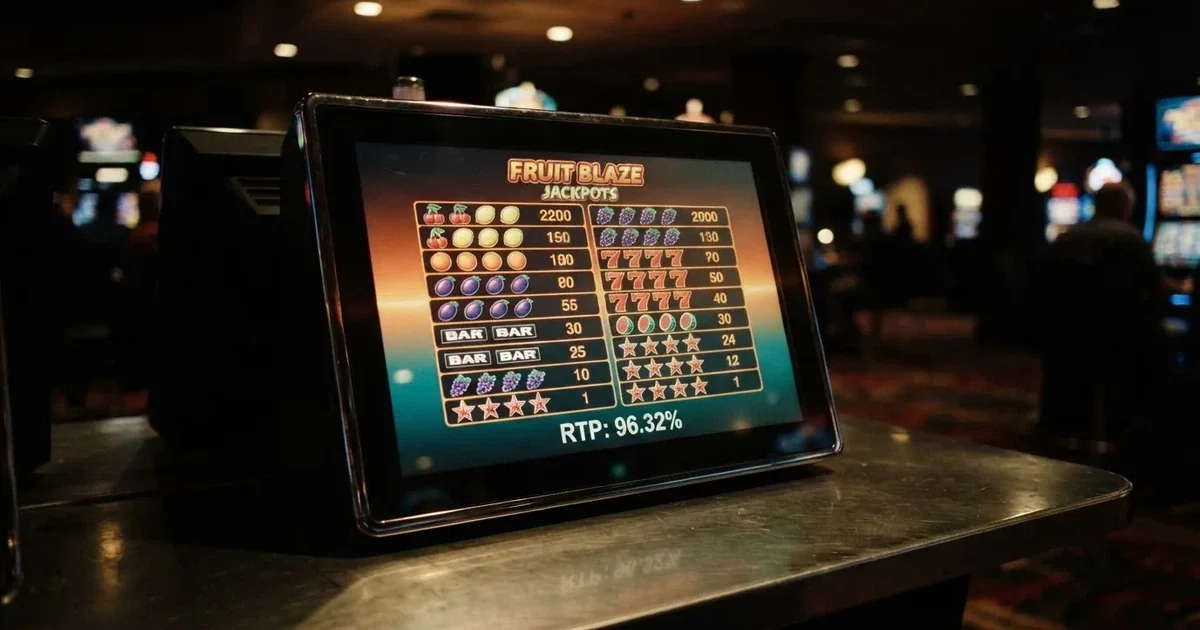
The data in this page is current as of 29 October 2026 and the licence claims and ACMA actions have been checked against the regulator’s published register.
Table of Contents
- The Australian RTP Floor, State by State
- What RTP Actually Is, and What It Is Not
- Online Pokies Are Prohibited for Australians
- What the Offshore Marketing Promises Versus What It Offers
- BetStop, the National Self-Exclusion Register
- How an Australian RTP Shortlist Is Built
- The ACMA’s Brand-Level Record
- Reading the Cluster Together
- How RTP Numbers Compare Across the Live Casino Floor
- What the Northern Territory Racing Commission Actually Does
- Tax on What a Pokie Pays Out
- The 2026 Reform That Has Not Started Yet
- Putting the Numbers Together
- Frequently Asked Questions
The Australian RTP Floor, State by State
Poker machines in Australia — the term is “pokies” in everyday speech — are licensed state by state, and each state has set its own minimum theoretical return-to-player. That floor is the lowest percentage the machine is allowed to pay back over its full program, calculated across millions of spins. A machine that pays back 87 cents in the dollar over its full cycle is one a venue cannot legally set below 87 percent in Tasmania; in New South Wales the same machine is illegal.

| State or territory | Minimum RTP | Notes |
|---|---|---|
| New South Wales | 85% | The loosest minimum of the eastern mainland states |
| Northern Territory | 85% | Applies to the small number of licensed venue machines |
| Queensland | 85% | Venues and casinos subject to separate approval |
| Victoria | 85% (general); 87% at Crown Melbourne | Crown’s machines sit under a tighter floor |
| Australian Capital Territory | 87% | Club machines only |
| Tasmania | 87% | Mandatory pre-commitment cards delayed until late 2025 |
| South Australia | 87.5% | |
| Western Australia | 90% | Poker machines effectively confined to Crown Perth |
The pattern: where a state caps the number of machines tightly (Western Australia, with pokies only inside the one casino) the floor is highest; where the machine population is largest (NSW at 87,298 outside casinos as of June 2023, Victoria outside Crown at 26,380 in 488 venues in 2021–22) the floor tends to be lower. Queensland sits between them at 21,122 machines across 351 venues as of October 2023. The floor is a regulatory compromise between revenue for the state and harm minimisation, not a ceiling on how generous a venue can choose to be.
A venue can, with regulator approval, run a machine at a higher RTP than the floor — many clubs and casinos do, particularly at the higher end where competition for players is real. The disclosed figure is usually printed on the machine’s help screen or paytable, and the rule that it must be disclosed exists in every jurisdiction.
What RTP Actually Is, and What It Is Not
Return-to-player is a long-run statistical average, calculated across the full cycle of a machine’s program — often millions of simulated spins. A 90 percent RTP means that, on average, ninety cents of every dollar fed into the machine is returned to players as prizes over that full cycle. It is not a guarantee for any session, and it is not a description of how any single spin will land.
Two practical consequences follow from that definition. First, RTP does not predict the size of an individual win. A 95 percent machine can hand out a thousand-dollar jackpot on spin twelve, then run cold for the next five hundred. What it means is that over enough spins the machine tends to its stated percentage. Second, RTP is the same number regardless of stake size on a given machine — the percentage is calculated as a proportion of money in versus money out, not a fixed payout per spin. A player betting two dollars a spin on a 90 percent machine is statistically losing two cents per spin, the same percentage as a player betting fifty cents.
The house edge — the figure a casino publishes to its accountants — is simply one minus the RTP. A 90 percent RTP is a 10 percent house edge. The house always has an edge on a poker machine, and “high RTP” in marketing language is a relative term: high against other machines in the same venue, or high against the state floor, not high in some absolute sense that favours the player.
Online Pokies Are Prohibited for Australians
Whatever an offshore site’s banner says about 96 or 98 percent RTP, the underlying service cannot be lawfully supplied to a person physically in Australia. The Interactive Gambling Act 2001 (IGA), strengthened by the Interactive Gambling Amendment Act 2017, makes it an offence to provide online casino games — including online pokies — or in-play betting to a person in Australia. The IGA targets the provider, not the player: no Australian punter has been prosecuted for playing an online pokie, but the offshore site itself is committing an offence by offering one.
Enforcement is the Australian Communications and Media Authority’s job. The ACMA investigates complaints, issues formal warnings to the operators it identifies, and can direct Australian internet service providers to block the offending sites. As reported in June 2026, a total of 1,751 illegal gambling and affiliate marketing websites had been blocked since the first blocking request in November 2019, and more than 230 unlicensed gambling services had left the Australian market since enforcement was strengthened in 2017. A single blocking round that month added twelve more sites — 7Signs, ChromaBet, Donbet, Duospin, Freshbet, Slots Gem, Jacks Club, Lucky Start, Pointsbetz.com, Spinrise, Vinyl Casino and Wildsino.
That number — 1,751 — is the running total of blocked sites across roughly seven years of enforcement. Set against the November 2019 starting point, that is a blocking rate somewhere in the range of 250 sites per year on average, accelerating materially after 2022 as the ACMA moved to formal warnings and ISP-level directions rather than relying on voluntary operator withdrawals. The actual yearly rate has not been steady; some rounds block a handful, others a dozen, and the 2026 figure is the cumulative count rather than a year-on-year comparison. What the band shows is that the ACMA has been consistent in using the blocking power, not that it has caught up with the supply.
The legal gap matters for a reader comparing a real-world pokie at the local RSL to a 97 percent online slot. The RSL pokie is licensed, its RTP is regulated, the machine is audited, and the venue is subject to state harm-minimisation requirements. The offshore slot is none of those things.
What the Offshore Marketing Promises Versus What It Offers
An offshore casino promoting a 97 percent RTP to an Australian player is selling a figure the Australian law says cannot lawfully be sold. The site itself is offering an illegal service, which means:
- No Australian regulator is auditing the figure. A 97 percent claim on an unlicensed site is whatever the operator publishes on its own help page.
- No Australian complaints body is reachable if a withdrawal stalls. An Australian consumer law claim is theoretical at best against a Curaçao- or Costa Rica-incorporated entity that has no Australian presence.
- The site can be blocked while a balance remains. The ACMA’s blocking power does not pause to consider pending withdrawals; the player loses access along with everyone else.
- The credit card and crypto ban on Australian-licensed wagering does not bind the offshore site, which is why many of them prefer those rails. A credit card deposit at an Australian-licensed bookmaker is a criminal offence for the operator from 11 June 2024; at an offshore casino it is just a transaction.
H2 Gambling Capital’s 2025 estimate is that Australians lose about A$3.9 billion a year to illegal gambling sites, and that the share of gambling going through legal channels fell from 74 percent in 2021 to 64 percent. The marketing reach of the offshore sector is large enough to move a national percentage. That reach does not change the legal status of any individual offer.
BetStop, the National Self-Exclusion Register
BetStop went live in August 2023 as the National Self-Exclusion Register, and it binds only Australian-licensed online and phone wagering services. A player who registers with BetStop is excluded from licensed wagering for a minimum period, and the operator is required to close the account and not market to the player during the exclusion.
The register does not connect to offshore casinos. A punter who wants to step away from an unlicensed site has no Australian register to register with; the only tools are the site’s own self-exclusion feature (which the operator is under no obligation to honour once the ACMA moves against it) and the practical step of refusing new deposits. The National Gambling Helpline on 1800 858 858 is free, available 24/7, and has a chat function through Gambling Help Online. It is the one Australian-funded support that works whatever the venue.
How an Australian RTP Shortlist Is Built
A ranking of high-RTP pokies in Australia starts from machines a player can actually sit down at. The criteria that separate one option from another are:
- The disclosed RTP figure on the machine’s help screen. State floors are minimums; many machines run at or near 90 percent, a few run higher.
- Volatility, which is the spread of payouts. A low-volatility machine pays smaller amounts more often; a high-volatility machine pays less often and larger when it does. Two machines at 92 percent RTP can feel completely different at the session level because of volatility.
- Game features that change the effective RTP for the player — bonus buy options, gamble features, free-spin retriggers. These have their own RTP impact, sometimes reducing it, sometimes leaving it unchanged.
- The venue’s own harm-minimisation settings — the maximum bet per spin, the time-on-machine display, the pre-commitment card where the state requires one.
The number of machines per state is the headline reality behind any “best pokies” claim. New South Wales has more machines than the rest of the country combined; Western Australia has one venue. A national ranking that treats both states as a single market is averaging a population where the choice is one casino in Perth against 87,000 machines across 2,195 NSW venues.
The ACMA’s Brand-Level Record
The brands below are not ranked, not recommended, and not offered as a place to play. They are the operators the ACMA has itself identified in formal warnings as offering prohibited interactive gambling services to people in Australia. The list is organised by the regulator’s own record, in the order research provides.
| Brand | ACMA action and date | Operator named by the ACMA | Subject support |
|---|---|---|---|
| RocketPlay | Formal warning, March 2026 | Pulsup Ltd | — |
| Jackbit | Formal warning, April 2026 | Ryker B.V. | — |
| Woo Casino | Formal warning, March 2025 | Dama N.V. | — |
| Spirit Casino | Formal warning, May 2025 | Dama N.V. | — |
| National Casino | Formal warning, July 2025 | Consolutetish S.R.L. | — |
| Bizzo Casino | Formal warning, July 2025 | Consolutetish S.R.L. (earlier TechSolutions, 2022) | — |
| Ignition Casino | Formal warning, July 2025 | Bamboo Media | — |
| Instant Casino | Formal warning, February 2025 | EOD Code SRL | — |
| Casino Intense | Formal warning, April 2025 | Sterplay Holding Ltd | — |
| Sky Crown | Formal warning, September 2022 | Hollycorn N.V. | — |
| Level Up Casino | Formal warning, May 2022 | Dama N.V. | — |
Reading the table column by column shows the shape of enforcement. Eleven brands, ten distinct operators behind them (Dama N.V. accounts for three of the entries), and a date range from May 2022 through April 2026. The “Subject support” column carries an em dash across the board — research gives no ground to attach a high-RTP pokies claim to any of these names, and the page does not attach one either.
RocketPlay — Pulsup Ltd, March 2026
The most recent formal warning on the list, and the one tied to the .com.au domain that the operator used to target Australian traffic directly. The ACMA’s action against Pulsup Ltd was published in March 2026, naming Rocketplay.com.au as the prohibited service. Rocketplay had previously been the subject of a May 2022 warning to Dama N.V. across six brands; the 2026 warning suggests the operator behind the brand changed hands while continuing to offer the same prohibited product.
There is no RTP figure worth quoting for a service the ACMA has just told Australians not to use. The interest of the entry is the warning itself — that an operator willing to operate under a .com.au address is willing to push past the regulator’s earlier action and do it again under a new corporate name.
Jackbit — Ryker B.V., April 2026
The April 2026 formal warning covered Jackbit alongside CasinOK, both attributed to Ryker B.V. The combined warning is the ACMA’s standard practice when one operator runs multiple brands off the same platform — a single finding can name several front names. Jackbit is a crypto-first casino, which fits the offshore pattern of preferring rails the Australian credit-card and crypto-wagering ban does not touch.
The “high RTP” pitch on Jackbit’s own help pages is not auditable in Australia. It is the same pitch every offshore casino runs, and the ACMA’s April 2026 finding is the regulator’s answer to it.
Woo Casino — Dama N.V., March 2025
Dama N.V. is the operator that has attracted the most ACMA attention of any on the list. The March 2025 warning over Woo Casino was the second Dama N.V. action in 2025 — the May 2022 warning covered six brands at once, the March 2025 warning was for one. The pattern is a brand-level cycle: the operator rebrands or shifts resources and the ACMA picks the next target.
Spirit Casino — Dama N.V., May 2025
Two months after the Woo Casino warning, the same operator drew a formal warning for Spirit Casino. The volume of Dama N.V. action makes the operator the closest thing the ACMA has to a repeat target. Spirit Casino is the operator’s third entry on this page alone, after RocketPlay and Woo Casino.
National Casino — Consolutetish S.R.L., July 2025
National Casino was named in the same July 2025 round as Bizzo Casino and Ignition Casino. Three operators, three warnings, one month — the ACMA was not spreading its actions thin. The regulator named Consolutetish S.R.L. as the entity behind National Casino.
Bizzo Casino — Consolutetish S.R.L., July 2025
Bizzo has been on the ACMA’s list before. The July 2025 warning to Consolutetish S.R.L. followed a 2022 formal warning to TechSolutions (CY) Group Limited and TechSolutions Group N.V. for the same brand. Two operators, two warnings, four years apart — a clear case of an offshore brand being re-launched under a new corporate entity after the earlier warning.
Ignition Casino — Bamboo Media, July 2025
Ignition Casino is the third brand in the July 2025 round, attributed to Bamboo Media. The Ignition brand has run under multiple operators over the years, which is itself an indication of how little the front name tells an Australian reader about who is actually running the site.
Instant Casino — EOD Code SRL, February 2025
Instant Casino draws the line on EOD Code SRL, an operator that does not appear elsewhere on the ACMA’s list as far as research records. The February 2025 warning is an isolated entry rather than part of a multi-brand round.
Casino Intense — Sterplay Holding Ltd, April 2025
Sterplay Holding Ltd picked up a warning in April 2025 over Casino Intense. The brand is small relative to the Dama N.V. portfolio, and the warning is its only ACMA action on record.
Sky Crown — Hollycorn N.V., September 2022
The earliest ACMA action on the list by date, and the one tied to Hollycorn N.V. alongside its sister brand Blue Leo. Hollycorn is a Curaçao-based operator that ran a cluster of small casino brands through 2022; Sky Crown was one of two the ACMA named.
Level Up Casino — Dama N.V., May 2022
Level Up was one of the six brands in the May 2022 Dama N.V. warning — Bambet, Dazard, Level Up, Rocketplay, Wild Tornado and Cobra Casinos all in the same finding. The cluster explains why Dama N.V. accounts for three entries on the page’s table: the operator ran multiple brands at once, the ACMA acted against the cluster, and individual brands continued to surface in later years.
Reading the Cluster Together
The eleven warnings are not eleven separate offences; they are the surface of a single pattern. An operator offers online pokies to Australians, the ACMA moves, the operator either rebrands or pushes another brand, and the cycle continues. The table shows the dates clustering in 2025 and 2026, which is consistent with a regulator that has shifted from warning to warning-plus-blocking as its standard response. The “no-data” reading on the subject support column across the board reflects the underlying point: research does not give the page an audited RTP figure for any of these brands, because the regulator does not audit them either.
For an Australian reader comparing options, the cluster is the answer in itself. The RTP figure these brands publish is a marketing number, the brand itself is in the ACMA’s register, and the legal route to any of them runs through the same enforcement the IGA empowers. The cluster is what a high-RTP online pokies page in Australia looks like when the page is built from the regulator’s record rather than from the brands’ own pages.
How RTP Numbers Compare Across the Live Casino Floor
Outside the offshore cluster, an Australian player sitting at a live pokie machine sees RTP figures in the 87–92 percent band at most venues, with a small number of higher-paying machines in the 92–95 percent range at the larger clubs and at Crown Melbourne. The published help-screen figure is the number to work from; the marketing at the venue entrance is not.
A practical comparison: a machine at 90 percent RTP returns ten cents less per dollar than a machine at 95 percent. On a session of A$200 fed through the machine, that is A$10 in expected additional loss at the lower-paying machine. Over a year of weekly sessions, the difference between two machines a venue offers at 90 and 95 percent is more than the cost of a meal out per session. The figure is statistical, not guaranteed, but the long-run math is what makes the higher-RTP machine the rational pick.
Volatility layers on top. A 95 percent low-volatility machine pays smaller amounts more often — the session feels busy and the balance moves slowly. A 95 percent high-volatility machine pays rarely and large — the session feels quiet until it doesn’t. A punter chasing a single big win will choose differently from a punter who wants the balance to last two hours.
What the Northern Territory Racing Commission Actually Does
The Northern Territory Racing and Wagering Commission regulates 52 of Australia’s online bookmakers — Sportsbet, Bet365 and Ladbrokes among them — under Territory licences taken out for tax reasons. The commission has no full-time staff and meets once a month in Darwin. That is the full-time regulator behind most of Australia’s licensed online wagering. A bill to reform the commission was the subject of a 7 April 2026 ABC report; the underlying issue is the mismatch between the regulator’s actual footprint and the volume of betting it authorises.
The minimum age to place a bet with an Australian-licensed operator is 18. The credit-card ban applies to those same operators from 11 June 2024; legal deposit rails are debit card, bank transfer, PayID/Osko and BPAY. A licensed operator offering a credit card deposit or a crypto deposit is in breach; an offshore casino offering either is just offshore.
Tax on What a Pokie Pays Out
Gambling winnings of a recreational player are not assessable income in Australia, by virtue of section 6-5 of the Income Tax Assessment Act 1997, and losses are not deductible. The exception is a person who carries on a business of gambling, which most pokies players are not and which the Australian Taxation Office treats case by case. The modelling assumption for any punter reading this page is recreational play, no tax liability, no deduction. Anyone whose gambling income rises to a level that may be a business should check with the ATO directly.
The 2026 Reform That Has Not Started Yet
The Interactive Gambling Amendment (Gambling Reform) Bill 2026 passed Parliament on 19 August 2026. Its advertising and inducement measures commence on 1 January 2027 — the law is passed, the commencement date is in the future. For an Australian reading this page before the start date, the bill is on the books but not yet binding; for a reader after the start date, the measures are live. The page treats it as a law with a commencement date, not as an active enforcement tool, because that is what the Parliament’s own status shows.
Putting the Numbers Together
A punter who chooses a 92 percent machine over an 87 percent machine at the same venue has chosen a machine that returns five cents more per dollar over its full cycle. On a session of A$100, that is A$5 in expected additional retention. The figure is not a promise — it is the long-run average that the regulator audited and the machine’s program delivered.
A punter who chooses an offshore 97 percent machine has chosen a service that is illegal to supply in Australia, that no Australian regulator audits, that may be blocked while the balance sits in it, and that is not connected to BetStop or any other Australian harm-minimisation tool. The 97 percent is the marketing number on an unlicensed page. The licensed 92 percent is a regulator-audited average on a machine in a venue the player can walk into.
The licensed number is the one a player can use to compare options. The offshore number is the one an operator would like the player to act on.
Frequently Asked Questions
What counts as a ‘high’ RTP figure on an Australian pokies machine?
High is relative to the state floor and to the machine population the player has access to. Anything above 90 percent is at the upper end of the typical licensed range; 95 percent is rare and usually a feature of specific titles at larger clubs or at Crown Melbourne. A machine at the state floor is not “high” by any meaningful reading.
Is RTP the same thing as the chance of winning on any single spin?
No. RTP is a long-run average across the full cycle of the machine’s program — typically millions of simulated spins. Any individual spin’s outcome is independent of every other spin, and the machine does not “owe” a win because the average is X percent. The figure answers the question “over enough spins, what fraction of money in comes back as prizes?” and nothing else.
Where is a pokies machine’s RTP figure legally required to be disclosed in Australia?
On the machine itself, in every Australian jurisdiction. The help screen or the paytable screen of a licensed machine carries the disclosed RTP, and venue staff can direct a player to it. There is no Australian jurisdiction that allows a licensed venue to keep the figure off the machine.
Can a venue change a machine’s RTP setting after it’s installed?
Only with regulator approval. The state or territory gaming authority approves the RTP setting at the point of installation, and any change to the setting requires a further approval. The setting is part of what the regulator audits, not something the venue can adjust in the back office. A change without approval puts the venue in breach of its licence.
Does a high RTP figure mean smaller or larger individual wins?
Not directly. RTP is a percentage of money in versus money out, not a description of win sizes. The size of individual wins is set by volatility — high-volatility machines pay rarely and large, low-volatility machines pay more often and smaller. Two machines at 95 percent RTP can feel completely different at the session level because of volatility. The RTP tells the player what the long-run return is; volatility tells the player what the ride looks like.
How does the number of pokies machines vary between Australian states?
By an order of magnitude. New South Wales has 87,298 machines outside casinos across 2,195 venues (June 2023), Victoria has 26,380 outside Crown in 488 venues (2021–22), Queensland has 21,122 machines in 351 venues (October 2023). Western Australia has poker machines effectively confined to Crown Perth — about 2,500 machines, all approved by the state’s Gaming and Wagering Commission, and no machines at all in pubs and clubs. The state with the highest minimum RTP is the state with the fewest machines.