
Best Casino Sign Up Bonus in Australia
Anyone who has typed “best casino sign up bonus Australia” into a search bar already knows what shows up offshore brands, deposit-match percentages and the promise of free spins. What the search results rarely say up front is that offering those products to Australians is prohibited, has been for years, and is being actively enforced in 2026. This page is the missing piece: the legal frame, the ACMA’s record against specific brands, the payments that survive that frame, and the lawful alternatives a reader in Australia can actually use.
Current as of 29 October 2026; verified against the Australian Communications and Media Authority’s published warnings and blocking rounds, the Reserve Bank of Australia’s card-surcharging review and Australian Payments Plus’ PayID and Osko product pages.
Table of Contents
- Best Casino Sign Up Bonus Australia: Offer Breakdown
- Comparing the Brands the ACMA Has Acted Against
- The Legal Frame Around Online Casino in Australia
- Responsible Gambling: The Tools That Actually Bind in Australia
- Crypto, Bitcoin and Anonymity: Where the Prohibition Meets the Wallet
- Payments and Payout Speed: What Actually Works, and What the Banks Now Block
- Payment Methods
- What a Reader in Australia Can Actually Do
- Frequently Asked Questions
Best Casino Sign Up Bonus Australia: Offer Breakdown
A “casino sign up bonus” is the marketing name for the package an online casino hands a new account holder on first deposit, and often on registration alone. Across the international market the term covers several distinct mechanics, and a reader comparing them needs to know which is which before any number on a promo page means anything.

The first split is between a cash bonus and free spins. A cash bonus is a matched percentage of the deposit, paid as bonus money the casino holds separately from real cash. Free spins are a fixed number of rounds on a named slot, with whatever they pay out credited as bonus money subject to its own turnover rule. A “package” is almost always a stack: a percentage on the first deposit, sometimes a second and third, plus a bundle of free spins bolted on the side. The headline figure sums the cash and the spin value into one number to make the package feel larger than it is.
The second split is deposit-gated versus no-deposit. A no-deposit bonus is paid simply for opening an account, before any money changes hands. It is small, typically a handful of free spins or a token cash amount, and it is the most aggressively marketed offer online, because registration is free and the casino collects a customer. A deposit-gated bonus is paid only after the player funds the account, and it is where the larger headline figures live.
The third split is what the player has to do to actually walk away with anything. The marketing pages call this “wagering requirements” or “turnover”; the rules say the bonus, and sometimes the deposit, must be wagered a stated multiple of times before withdrawal is permitted. A 35x turnover on a A$100 bonus means A$3,500 of qualifying bets before the bonus balance becomes withdrawable cash. Most packages also cap the maximum single bet while a bonus is active (a figure that almost always appears in the small print rather than the headline), restrict which games count toward turnover, and put a ceiling on how much of a no-deposit bonus can ever be cashed out.
Turnover is the lever that turns a generous-looking number into a small one. A 100% match up to A$500 with a 40x wagering requirement on the bonus produces A$20,000 of qualifying bets before a cent can be withdrawn. Even on a high-return slot, the expected cost of grinding through that turnover eats most of the headline value. The arithmetic is covered below; the point here is structural — what a casino sign up bonus actually is, in the mechanical sense, before any brand is named.
What a reader cannot do is shop this market in the usual way. Online casino games cannot be licensed anywhere in Australia, so every “best casino sign up bonus Australia” list in circulation is built from offshore brands that the ACMA has, in many cases, already told to stop. The rest of this page closes the gap: how the prohibition is enforced, what tools exist for problem gambling, how crypto and the payments stack interact with the frame, what the ACMA’s record actually looks like against specific operators, and what a reader in Australia can lawfully do with a betting budget instead.
Comparing the Brands the ACMA Has Acted Against
Eleven brands appear in this section, not because they are recommended and not because they are “the best casino sign up bonus” in any commercial sense, but because the ACMA itself has published a formal warning over each one for offering prohibited interactive gambling services to Australians. The table lines them up side by side so the reader can see, at a glance, which operators the regulator has named, when it named them and what entity sits behind them. A column is dropped entirely where the ACMA’s published record does not cover it.
Comparison Table
| Brand | ACMA action and date | Operator named by the ACMA | Subject support |
|---|---|---|---|
| RocketPlay | Formal warning, March 2026 | Pulsup Ltd | listings-only |
| Level Up Casino | Formal warning, May 2022 | Dama N.V. | listings-only |
| Woo Casino | Formal warning, March 2025 | Dama N.V. | — |
| Spirit Casino | Formal warning, May 2025 | Dama N.V. | — |
| National Casino | Formal warning, July 2025 | Consolutetish S.R.L. | listings-only |
| Bizzo Casino | Formal warning, July 2025; earlier 2022 warning to TechSolutions | Consolutetish S.R.L. (2025); TechSolutions (2022) | listings-only |
| Ignition Casino | Formal warning, July 2025 | Bamboo Media | — |
| Instant Casino | Formal warning, February 2025 | EOD Code SRL | listings-only |
| Jackbit | Formal warning, April 2026 | Ryker B.V. | — |
| Casino Intense | Formal warning, April 2025 | Sterplay Holding Ltd | listings-only |
| Sky Crown | Formal warning (September 2022) | Hollycorn N.V. | — |
The pattern behind the table is what a reader should take from it. Three of the eleven warnings name Dama N.V. — a Curaçao-based operator that runs Level Up, Woo and Spirit under different brand fronts. Two warnings, in 2022 and again in 2025, target the same brand under different parent companies: Bizzo Casino was warned once in 2022 over TechSolutions and again in 2025 over Consolutetish S.R.L. The ACMA’s record is the same story told with different corporate names. Switching the shell does not switch the prohibition.

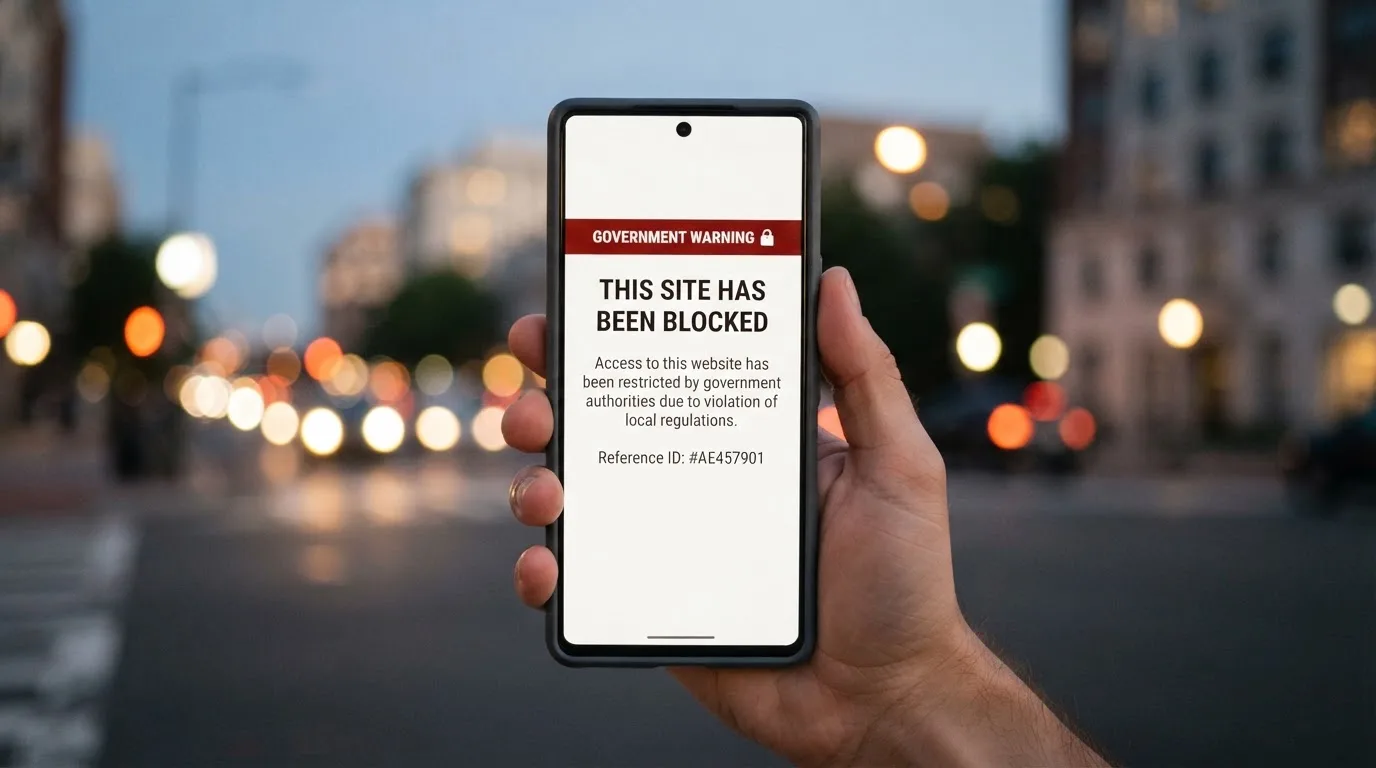
A second pattern sits in the dates. Of the eleven warnings, eight were issued in 2025 or 2026, and four of those in the last twelve months. Enforcement has not slowed; it has accelerated. A formal warning is the ACMA’s first public step; what follows, if the operator keeps taking Australian customers, is a request to Australian ISPs to block the site under section 313 of the Telecommunications Act 1997. The same authority had, by June 2026, asked ISPs to block 1,751 illegal gambling and affiliate sites since the first blocking request in November 2019, and more than 230 unlicensed services had left the Australian market since the 2017 strengthening of the Interactive Gambling Act. These are not theoretical numbers. They are the running count of a prohibition being applied.
RocketPlay
The ACMA’s most recent formal warning over RocketPlay was issued in March 2026 to Pulsup Ltd, over the domain RocketPlay. It was not the first warning on the brand: in May 2022 the ACMA named Dama N.V. over a batch of six brands that included Rocketplay alongside Bambet, Dazard, Level Up, Wild Tornado and Cobra Casinos. That a single corporate parent sat behind six of the names a casual reader might treat as competing operators is the single most useful fact in the warning list. Where the brand surfaces in third-party marketing listings, those listings describe it; they do not speak for the operator’s current status. The verdict a reader should carry from this entry is the simplest one: this brand is one the ACMA has named, and any reader in Australia is the person the warning is addressed to.
Level Up Casino
The May 2022 ACMA warning over Level Up Casino sits inside the same Dama N.V. cluster as RocketPlay. The corporate parent is the link; the brand surface is what a player sees first. Any sign-up bonus attached to Level Up is therefore bonus money paid by an operator the Australian regulator has already told, in writing, to stop offering its product here. That is the line a reader needs to weigh, because it is the line no marketing page draws.
Woo Casino
Dama N.V. was warned over Woo Casino in March 2025, after the earlier 2022 batch. Two warnings to the same parent, on two different brands, two and a half years apart, is the regulator’s working definition of “we have already told you once.” The corporate group’s response to the first round does not appear to have covered its full brand portfolio, and the ACMA’s response is the second round. A reader who finds Woo Casino in a comparison list should read that history, not the deposit match.
Spirit Casino
Spirit Casino carries the same Dama N.V. parent and a May 2025 warning. Three warnings, three brand names, one operator: that is the shape of the record a reader should hold onto. The brand names are the surface; the warning belongs to whoever runs them.
National Casino
National Casino was named in the ACMA’s July 2025 formal warning to Consolutetish S.R.L., the same operator named over Bizzo Casino at the same time. Consolutetish S.R.L. is a different corporate vehicle from Dama N.V., but the regulatory outcome is identical: the ACMA has formally warned the parent, and the brand sits on the wrong side of the prohibition regardless of which entity actually answers the email.
Bizzo Casino
Bizzo Casino is the only brand in the table with two ACMA warnings attached to it, and the second is the more interesting one. In 2022 the ACMA warned TechSolutions (CY) Group Limited and TechSolutions Group N.V. over Bizzo Casino, among other brands. In July 2025 it warned Consolutetish S.R.L. over the same brand surface. Two operators, three years apart, one domain. The brand has either changed hands or operated under successive parents; either way, the ACMA has named it twice, which is twice the formal record of any other entry in the table.
Ignition Casino
The ACMA’s July 2025 warning named Bamboo Media as the operator behind Ignition Casino. Bamboo Media is a smaller entity than Dama N.V. or the TechSolutions group, but the prohibition applies identically. A reader who lands on Ignition through a search for a casino sign up bonus is being offered a product by an operator the Australian regulator has formally told to stop.
Instant Casino
Instant Casino was named in the ACMA’s February 2025 warning to EOD Code SRL, one of the earlier warnings in the 2025 cluster. The brand sits in a list of “instant” themed offshore casinos marketed heavily on speed of withdrawal; that is also the marketing claim an Australian reader is least able to enforce, because the ACMA cannot compel an offshore operator to honour a payout and an Australian court cannot easily reach one. The brand’s own promo pages describe the bonus terms; the ACMA’s record describes the legal status.
Jackbit
The ACMA warned Ryker B.V. over Jackbit and CasinOK in April 2026. Jackbit is one of the better-known crypto-first casinos in the offshore market, and the brand’s marketing leans on that. A reader looking specifically at crypto casino sign up bonus offers will find Jackbit in the comparison lists; that same reader should find the ACMA’s April 2026 warning before any deposit.
Casino Intense
Sterplay Holding Ltd was named in the ACMA’s April 2025 warning over Casino Intense. The brand sits in the same general category of offshore casinos marketing a deposit-match welcome package. The ACMA’s warning is the part the marketing omits.
Sky Crown
Sky Crown carries the ACMA’s formal warning over Hollycorn N.V., the same corporate parent named over Blue Leo in the same period. Hollycorn N.V. is a frequent subject of regulator action across multiple jurisdictions, and its appearance in the ACMA’s record is consistent with that broader pattern. The brand’s marketing presents a sign up bonus; the regulator’s record presents the prohibition.
The Legal Frame Around Online Casino in Australia
The reason every operator in the table above sits where it sits is the Interactive Gambling Act 2001, as amended by the Interactive Gambling Amendment Act 2017. The Act makes it an offence to provide online casino games, online pokies or in-play betting to a person physically in Australia. No state or territory issues a licence for those products, because the Act does not provide for one to be issued. What can be licensed is wagering on racing and sporting events placed before the event starts, lotteries and keno, and the practical licensing regime is run by the Northern Territory Racing and Wagering Commission, which regulates 52 of Australia’s online bookmakers — including Sportsbet, Bet365 and Ladbrokes — for tax reasons and meets once a month in Darwin with no full-time staff.
The minimum age for any form of licensed gambling in Australia is 18.
The Act targets the provider, not the player. No Australian has been prosecuted for placing a bet with an offshore casino, and the regulator does not pursue individual customers. What an Australian does lose by playing offshore is the consumer protection that comes with a domestic licence: a complaints body, a regulator that can compel a payout, a deposit held in an Australian account. None of those apply to a Curaçao-licensed brand, and the ACMA can block the site while a balance is still on it.
How the ACMA Enforces
The ACMA’s enforcement runs in three escalating steps. First, a formal warning is issued to the operator named in the publication, naming the brand and the parent company and citing the relevant provisions of the Interactive Gambling Act. Second, if the operator continues to accept Australian customers, the ACMA asks Australian internet service providers to block the site under section 313 of the Telecommunications Act 1997. Third, civil penalty proceedings can follow, with penalties up to A$247,500 per offence for the operator.
In June 2026 the ACMA asked ISPs to block 12 more illegal gambling and affiliate sites: 7Signs, ChromaBet, Donbet, Duospin, Freshbet, Slots Gem, Jacks Club, Lucky Start, Pointsbetz, Spinrise, Vinyl Casino and Wildsino. The total of blocked sites stood at 1,751 since the first blocking request in November 2019, with more than 230 unlicensed services having withdrawn from the Australian market since enforcement was strengthened in 2017. The pace has not diminished over the seven years since the 2017 amendment; it has, if anything, accelerated.
The 2026 Reform Package
The Interactive Gambling Amendment (Gambling Reform) Bill 2026 passed Parliament on 19 August 2026. Its advertising and inducement measures — the part that touches most directly on the marketing of a casino sign up bonus — commence on 1 January 2027. As of 2026 the Bill is law but those provisions are not yet in force. A reader looking at a sign up bonus offer today is looking at marketing that will, from the start of 2027, face tighter inducement rules. None of that changes the underlying prohibition on the product itself, which has been in force since 2017.
Tax Treatment of Gambling Winnings
Gambling winnings of a recreational player are not assessable income in Australia under section 6-5 of the Income Tax Assessment Act 1997, and losses are not deductible. A player whose gambling amounts to a business, with systematic effort aimed at producing assessable income, sits in a different category and should confirm the position with the Australian Taxation Office. For the vast majority of readers, the short answer is: winnings are tax-free, losses cannot be claimed.
Responsible Gambling: The Tools That Actually Bind in Australia
The responsible gambling frame around licensed wagering in Australia is built on three things: a national self-exclusion register, a national helpline and a set of in-app card blocks that the major banks now offer. None of those tools bind an offshore casino, which is the gap a reader needs to know about before relying on any of them.
BetStop, the National Self-Exclusion Register, went live in August 2023. Registering with BetStop excludes the person from every Australian-licensed online and phone wagering service for a chosen period of between three months and a lifetime. BetStop is binding on the licensed operators it covers; an offshore casino is not connected to BetStop and is not obliged to honour an exclusion. A self-excluded Australian who then opens an account with an offshore brand has excluded themselves from the lawful market only, which is the opposite of what most readers expect.
The National Gambling Helpline is 1800 858 858. It is free, operates 24 hours a day, and connects to Gambling Help Online, which also offers web chat. The helpline is the right first call for anyone who feels their gambling is becoming a problem; it is staffed by counsellors who can talk through BetStop, financial counselling and treatment options.
The major banks now offer gambling transaction blocks at card level. Westpac’s gambling block refuses authorisation on transactions tagged under the merchant category code for betting and casino gambling on eligible personal credit and debit cards. ANZ’s equivalent, set up in the ANZ app, blocks gambling transactions made through a digital wallet such as Apple Pay on an eligible card, not just the physical card; once activated, removing the block requires a 48-hour waiting period, and the bank warns that not all gambling transactions will be blocked and some non-gambling transactions might be blocked in error. Commonwealth Bank offers a similar lock in the CommBank app. None of these blocks reach an offshore casino that accepts cryptocurrency or an alternative payment rail outside the card network.
A reader who combines a bank-level gambling block with BetStop registration has closed the lawful side of the market to themselves and substantially reduced the accidental side. The deliberate side — opening an offshore account, funding it through a method the bank block does not catch, claiming a casino sign up bonus anyway — is what no Australian tool can prevent, because no Australian regulator has jurisdiction over the operator.
Crypto, Bitcoin and Anonymity: Where the Prohibition Meets the Wallet
The crypto side of the “casino sign up bonus” market — bitcoin casino sign up bonus, crypto casino no deposit sign up bonus and their variants — is where the marketing is loudest and the regulatory gap is widest. A crypto deposit is a transfer of funds from the reader’s wallet to an address the casino controls, and once that transfer is on the blockchain it cannot be reversed by the sender’s bank or by an Australian regulator.
The Interactive Gambling Act’s 2024 amendment, in force from 11 June 2024, makes it an offence for an Australian-licensed wagering service to accept payment by credit card, credit-related product or digital currency. Penalties run to A$247,500 per offence for the operator. The restriction binds Australian-licensed services only. An offshore crypto casino is not licensed in Australia, so the prohibition on accepting digital currency from an Australian does not apply to it under the Act; what does apply is the broader prohibition on offering online casino games to Australians at all, and the ACMA’s enforcement record against crypto-facing brands in the table above (Jackbit in particular) shows the regulator has not been shy about applying it.
A reader who funds an offshore casino with bitcoin is, in practical terms, outside the Australian payments system. There is no chargeback, no bank dispute process, no AUSTRAC transaction-reporting trigger to lean on, and no PayID name-check to catch a typo. AUSTRAC’s threshold-transaction-report rule, which requires reporting of transfers of A$10,000 or more, applies only to physical cash; ordinary electronic transfers are not subject to it, and cryptocurrency transfers fall outside AUSTRAC’s per-transaction reporting regime entirely. That is the regulatory vacuum the marketing is built on, and it is also why the ACMA’s enforcement against crypto-first brands matters: it is the only Australian agency with a usable tool against them, and that tool is a website block, not a recovery.
The anonymity claim in the crypto-casino marketing is overstated. Blockchain transactions are pseudonymous rather than anonymous; every transfer is permanently recorded on a public ledger, and a determined counterparty can trace funds through a chain of wallets with off-chain attribution. The practical anonymity is the operational kind: there is no Australian body that will investigate a disputed crypto deposit at an offshore casino, and no bank to file a chargeback with. The marketing says “anonymous”; what it means is “no Australian recourse.”
Payments and Payout Speed: What Actually Works, and What the Banks Now Block
The payments shelf for any sign-up bonus is the deposit method on the way in and the payout rail on the way out, and the Australian frame rules out most of what the offshore marketing assumes is available.
On the way in, an Australian-licensed wagering service cannot accept credit cards, credit-related products or digital currency, and cannot accept payments via linked digital wallets like Apple Pay where those are funded by a credit card. ANZ’s gambling block extends to Apple Pay transactions on an eligible card, not just the physical card. Debit card, bank transfer, PayID/Osko and BPAY are the lawful deposit routes for licensed wagering; credit, crypto and most e-wallets are not.
On the way out, the same rails run in reverse for a winning withdrawal. Osko, operated by Australian Payments Plus, settles bank-to-bank transfers in under a minute, 24/7 including weekends, whether addressed by BSB and account number or by PayID. PayID-based instant transfers are available at over 100 Australian financial institutions, and more than 25 million PayID identifiers had been registered on the New Payments Platform as of April 2025. The New Payments Platform went live to the public on 13 February 2018 and is owned by NPP Australia Ltd, whose 13 shareholders include the Reserve Bank of Australia and the major banks; in 2021 the ACCC authorised its merger with BPAY and eftpos into the single holding company now called Australian Payments Plus. Participants in the platform must keep monthly outages to under two minutes.
BPAY, the other rail under the same Australian Payments Plus umbrella, is a bill-payment service rather than a person-to-person transfer: the payer enters the Biller Code and the Customer Reference Number from the bill. BPAY has run in Australia since 1997, is available in the online banking of over 150 banks and credit unions and is used by over 95,000 businesses; it is owned equally, through Cardlink Services Limited, by ANZ, Commonwealth Bank, National Australia Bank and Westpac.
PayID carries a name-check that the other rails do not: paying to a PayID shows the name of the account holder before the transfer is sent, and Australian Payments Plus warns that being asked to transfer money to a PayID on an illegal gambling site almost certainly means a scam site. For a reader deciding whether to fund an account, the PayID name check is one of the few hard stops in the system that triggers before the money moves.
The card network itself is tightening around gambling. The Reserve Bank of Australia’s July 2025 review of merchant card payment costs and surcharging proposes removing surcharges on eftpos, Mastercard and Visa transactions only — explicitly leaving American Express outside the scope of the proposed ban, on the basis that Amex’s higher wholesale rate is passed through to merchants and ultimately to cardholders. American Express itself operates as a three-party scheme that issues cards and processes transactions itself, rather than as a four-party network like Visa or Mastercard; the structural difference is why the RBA’s surcharge reform stops where it does.
Mobile wallet uptake is the background to all of this. By the end of 2025, Apple Pay, Google Pay and Samsung Pay transactions collectively accounted for around 45% of all card payments in Australia by number. Any policy that aims at the card side of gambling has to land in that wallet context, which is why ANZ extends its gambling block to Apple Pay on an eligible card. Apple itself does not charge consumers to use Apple Pay — any surcharge comes from the merchant’s processing fees, not from Apple — and Apple states that transaction limits and PIN requirements are set by the card issuer or merchant, not by Apple. The wallet is plumbing; the policy lives in the issuing bank.
The payout speed claim that does the most marketing work — “instant withdrawals” — has to be read against this rail. On the Australian side, Osko can deliver in under a minute to a PayID. On the offshore side, “instant” usually means “we have queued your payout into our internal processing and will release it once our fraud team has signed off,” and the bottleneck is internal to the operator. An Australian reader who has been paid into a PayID via Osko from a licensed wagering service has seen what instant actually looks like, and the comparison is unflattering to most offshore brands.
Payment Methods
| Method | Type | Availability |
|---|---|---|
| Osko | Instant Bank Transfer | 24/7, <1 minute |
| PayID | Instant Transfer | Name-verified |
| BPAY | Bill Payment | 95,000+ businesses |
| Credit Card | Prohibited | Blocked by major banks |
The blocking record the ACMA has built up since 2017 is the most concrete measure of how the prohibition is biting. The arithmetic is simple: 1,751 sites blocked since November 2019, against more than 230 operators that have withdrawn from the Australian market over the same period. The rate at which the ACMA is moving through the list is the part worth pausing on.
Between November 2019 and June 2026 the ACMA’s running total grew from zero to 1,751 blocked or requested-to-be-blocked sites and 230-plus withdrawals. Over that stretch the rate is roughly 260 blocking requests a year, and roughly 26 operator withdrawals a year, with the recent rounds sitting at 12 sites per published round and an accelerating warning rate (eight of the eleven warnings in the operator table above were issued in 2025 or 2026, four in the last twelve months). The headline number understates the picture, because the ACMA also pulls affiliate-marketing pages, not just brand sites, and an operator can sit behind a rotating set of brand surfaces after the first round.
What the rate does not measure is the warning-to-block conversion. A formal warning is the first step; a block request is the second. The proportion of warned operators that subsequently have their sites blocked, or that withdraw voluntarily, is the gap between the warning list in the table above and the running blocked-sites total. The cluster of Dama N.V. brands — three warnings across three brands to the same parent — is the clearest evidence that a warning does not reliably convert into withdrawal, and that the regulator’s escalation path matters.
What a Reader in Australia Can Actually Do
The honest answer to the search query this page is built around is that there is no Australian-licensed casino sign up bonus to collect, because there is no Australian-licensed online casino to collect one from. The lawful alternatives sit in three buckets.
The first bucket is licensed wagering on racing and sport, placed before the event. The major Australian-licensed bookmakers — Sportsbet, Bet365, Ladbrokes and the rest of the Northern Territory-regulated set — run sign-up offers of their own kind, in the form of bonus bets, deposit matches and odds boosts. The wagering is on the event before it starts; in-play betting is prohibited, and the casino games and online pokies that a “casino sign up bonus” implies are not part of the product. The Interactive Gambling Act treats these as different products, and the licensing regime treats them as different products, and a reader who wants to bet within the law is buying from this bucket or not at all.
The second bucket is land-based casinos and licensed pokies venues in the Australian states and territories. Crown Melbourne, The Star Sydney and the smaller state-based casinos run table games and poker machines under state-level licensing, with the responsible gambling safeguards that come with it: a pre-commitment system, on-site intervention, a complaints body, and a regulator that can act on a disputed payout. The product is the closest legal equivalent to “online casino” for a reader who actually wants to play casino games, and it is not what the offshore marketing is selling.
The third bucket is to take the budget and do something else with it. A reader who arrived at this page because they were looking for a casino sign up bonus and discovered, in reading it, that the products they wanted are not lawfully available to them, has a few choices. They can register with BetStop and close the lawful market to themselves for a chosen period, which is the right call for anyone who felt the search was becoming a compulsion. They can call the National Gambling Helpline on 1800 858 858 for a confidential conversation about what is driving the search. Or they can decide the budget would be better spent somewhere the prohibition does not apply.
The page does not recommend any of the eleven brands in the operator table above. They are there because the ACMA has named them, and a reader who arrives at one through a comparison site deserves to know that before they deposit. The page also does not recommend any offshore brand not in the table, because the same prohibition applies and the same warning could be issued tomorrow.
Frequently Asked Questions
What is the difference between a sign-up bonus and a no-deposit bonus?
A sign-up bonus is the broad term for the package a casino offers a new account holder, almost always on first deposit; it can be a cash match, free spins or both. A no-deposit bonus is a smaller subset paid for registration alone, before any money changes hands, usually a handful of free spins or a token cash amount. The same turnover rule applies to both; the no-deposit version is smaller but more aggressively marketed, because registration costs the player nothing.
What does turnover, or wagering requirement, mean for a sign-up bonus?
Turnover is the multiple of the bonus (and sometimes the deposit) that must be wagered before the bonus balance converts to withdrawable cash. A 35x requirement on a A$100 bonus means A$3,500 of qualifying bets before withdrawal; most packages also cap the maximum single bet while the bonus is active and restrict which games count. Turnover is the lever that turns a generous-looking headline into a smaller real number.
Is it legal for an online casino to offer a sign-up bonus to players in Australia?
No. The Interactive Gambling Act 2001 prohibits offering online casino games to anyone in Australia; no state or territory licenses them. The prohibition targets the provider, not the individual player, but an Australian has no consumer protection against an offshore operator, no complaints body, and a balance that can be stranded if the site is blocked. The ACMA’s enforcement record, with 1,751 blocking requests since 2019, shows how that prohibition is applied.
Can a sign-up bonus be claimed using a cryptocurrency deposit?
An offshore casino may accept it, and the marketing will frame it as a feature; an Australian-licensed wagering service cannot, since the 2024 amendment to the Interactive Gambling Act. A crypto deposit puts the reader outside the Australian payments system entirely: no chargeback, no bank dispute, no AUSTRAC reporting trigger, and no regulator with a recovery tool. The marketing’s “anonymous” claim is operational, not technical: blockchain transfers are pseudonymous and permanently recorded.
Why do sign-up bonus terms usually cap the maximum bet allowed?
The cap protects the bonus from being cleared in a single large spin. If a player could bet the whole bonus on one spin of a high-variance slot, the casino’s exposure to a lucky outcome would be unbounded; the cap forces turnover to happen across many smaller bets, which is the model the wagering requirement is built around. The cap is almost always in the small print, not the headline, which is the point of reading the terms before claiming.
What happens to an unused sign-up bonus if the wagering period expires?
It is forfeited, along with any winnings tied to it. The wagering period is set in the bonus terms, typically between 7 and 30 days; if the turnover is not completed inside that window, the bonus balance and any associated winnings are removed from the account. This is the cleanest reason the wagering period matters: it is the deadline by which the bonus either becomes cash or ceases to exist.