
NDB Casinos in Australia
When a search for “NDB casino Australia” returns a wall of bonus tiles and chip counts, the punter lands in a marketplace that does not exist under Australian law. No state or territory licenses online casino games, online pokies or in-play betting for Australians, and no offshore site offering those products sits within any Australian regulatory framework. What the marketing calls a “free” no-deposit bonus is built around turnover, withdrawal caps and game restrictions. What the regulator calls a prohibited service is the same offer, with no Australian complaints body to appeal to and no guarantee the site will still be reachable by the time the punter asks for a withdrawal.

Current as of 29 October 2026 · licence claims and ACMA enforcement actions cross-checked against the Australian Communications and Media Authority’s formal warning register.
NDB Casino Australia: Understanding IGA Prohibitions
The Interactive Gambling Act 2001, tightened by the Interactive Gambling Amendment Act 2017, is the legal instrument that closes the door on online casino play for Australians. The relevant offences sit on the supply side. Offering an Australian customer an online casino game, an online pokie or in-play betting is itself the breach, regardless of where the servers sit, where the company is registered, or what other jurisdiction’s licence the operator displays in its footer.
What is licensed is narrower than a casual reader might assume. Wagering on a sporting event or a race that has already been decided is not on the prohibited list, which is why online bookmakers are licensed and taxed in Australia. Lotteries and keno fall outside the prohibition as well. The Northern Territory Racing and Wagering Commission holds the bulk of those wagering licences — fifty-two online bookmakers in its portfolio, including the better-known names — and the Commission’s structure, with no full-time staff and a monthly meeting in Darwin, is the reason a Territory address is the address most of them carry.
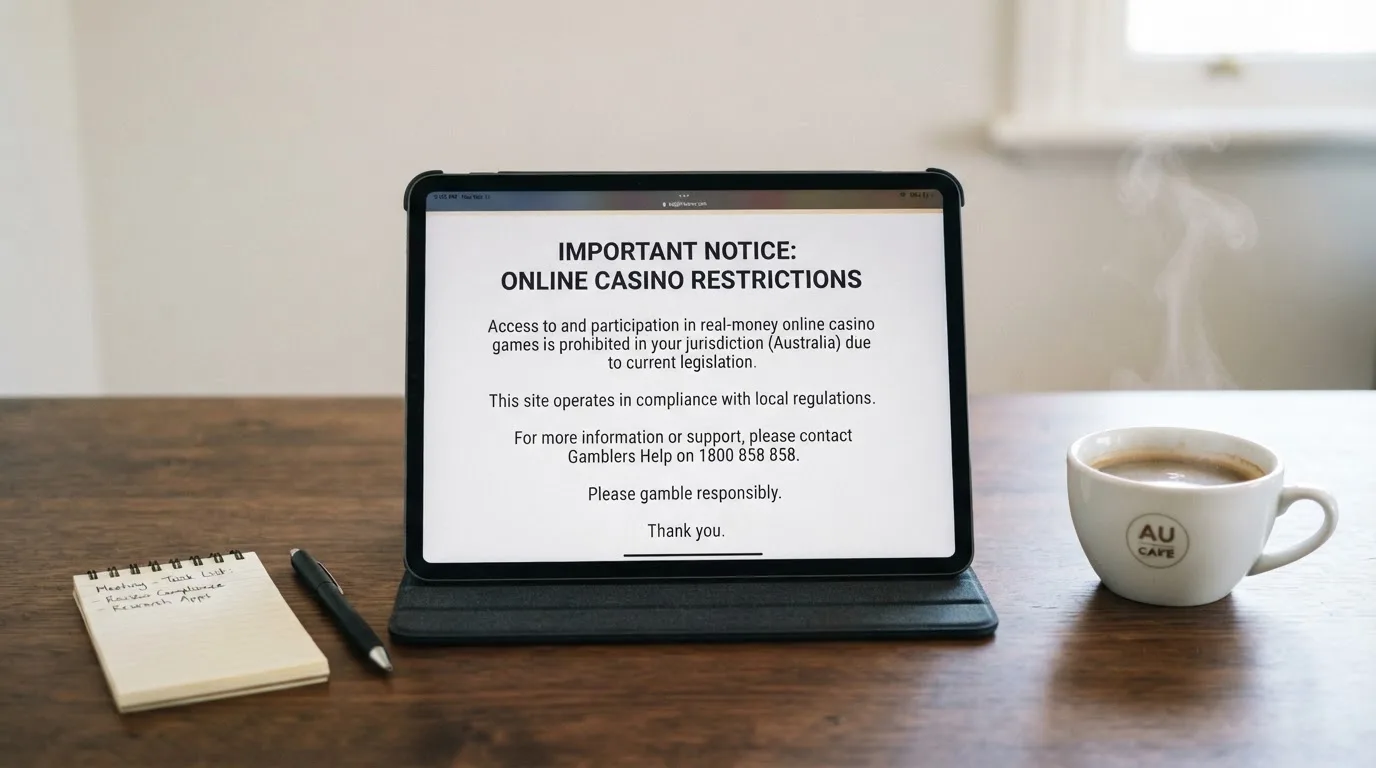
The consequence for a punter who is considering a “no-deposit bonus” offer pitched at Australian search terms is not criminal liability. It is the absence of every protection Australian-licensed wagering has to offer. A dispute over a refused withdrawal goes nowhere. The operator is not licensed by an Australian regulator, and the regulator therefore has no power to compel a payout, reverse a voided bonus or investigate a complaint. A blocked balance can sit on a site the ACMA has just directed Australian ISPs to block, with no path to retrieve it. A self-excluded Australian who signs up under a different name is exposed to a marketing cycle no Australian register intercepts.
Losses on that side of the wall are not small. H2 Gambling Capital’s 2025 estimate put the annual amount Australian players send to illegal offshore gambling sites at around A$3.9 billion, with the share of gambling going through legal Australian channels falling from 74 per cent in 2021 to 64 per cent in 2025. The legal channel is shrinking, and the illegal channel is taking up the slack.
Enforcement against the supply side has accelerated rather than eased. The ACMA reported in June 2026 that a cumulative total of 1,751 illegal gambling and affiliate marketing websites had been blocked since the first blocking request in November 2019, and that more than 230 unlicensed gambling services had left the Australian market since enforcement was strengthened in 2017. A single round reported on 26 June 2026 added twelve more sites to the block list — 7Signs, ChromaBet, Donbet, Duospin, Freshbet, Slots Gem, Jacks Club, Lucky Start, Pointsbetz, Spinrise, Vinyl Casino and Wildsino. The blocking cadence is steady rather than occasional, and the operator that targets an Australian punter this year is more likely than not to find its site unreachable by next year.
A statutory refresh sits one step behind. The Interactive Gambling Amendment (Gambling Reform) Bill 2026 passed Parliament on 19 August 2026. Its advertising and inducement measures commence on 1 January 2027, so the law is on the books in 2026 but its bite on inducements — the promotional mechanics an NDB offer relies on — starts with the calendar year. A punter comparing an offer this 2026 is comparing it under the law as it stands, not under the law as it will be.
The arithmetic underneath the enforcement record is its own summary. From the first ACMA blocking request in November 2019 to the June 2026 cumulative total of 1,751 illegal sites, the rate works out at roughly twenty-two illegal gambling and affiliate marketing websites blocked every month, or somewhere between 260 and 270 a year on the ACMA’s own count, averaged across the 79 months between those two dates. The cumulative count has grown every quarter, the rate has not, and the offer pool has grown in step. The 230-plus unlicensed services that have left the Australian market since 2017 are the supply-side counterpart of the same picture: operators decide that the cost of staying — the block, the warning, the bank friction — outweighs the revenue from the Australian channel.
Where to turn instead of an offshore NDB
The Australian help system is built around wagering services, not casino sites, and that distinction matters when an NDB offer is the thing on the table.
BetStop, the National Self-Exclusion Register, has been live since August 2023 and is the only nationally consistent self-exclusion mechanism in the country. It binds every Australian-licensed online and phone wagering service. Registering for a period between three months and a lifetime blocks the operator side from sending marketing, offering credit, and letting the registered person place a bet. It does not, and could not, bind an offshore casino. The site offering a “free” NDB to an Australian customer is not on the register’s hook, and registering with BetStop does not prevent that site from accepting a deposit or running a credit card for a future sign-up.
The National Gambling Helpline, 1800 858 858, is free, operates around the clock and routes callers to the relevant state or territory service. Gambling Help Online, run by a consortium of state-funded organisations, provides web chat and email counselling at no cost. Both services are designed for an Australian caller and work under Australian privacy law. An offshore operator’s own “responsible gaming” page is a marketing artefact by comparison.
Self-help at the bank level is the third layer. Westpac’s gambling block works at the card level and refuses authorisation of any transaction registered under the merchant category code for “Betting/Casino Gambling” on an eligible personal credit or debit card. ANZ’s gambling transaction block, activated through the ANZ app, extends to digital wallets such as Apple Pay linked to an eligible card, not just the physical card itself; ANZ warns that not every gambling transaction will be blocked and some non-gambling transactions may be blocked in error, and removing the block requires a forty-eight-hour waiting period by design. The Commonwealth Bank offers a comparable gambling lock through the CommBank app.
None of these blocks is a complete shield. An offshore site that mis-codes its transactions may still slip past the merchant-level filter. The bank blocks are best understood as one tool inside a broader plan, and the broader plan is the one BetStop and the Helpline sit on.
Crypto, anonymity and the same prohibition
The legal position does not soften because the deposit is in bitcoin. The Interactive Gambling Act targets the offer, not the payment rail, and a no-deposit bitcoin casino offer is the same prohibited offer paid for with a different currency. What the payment rail changes is the consumer experience: who can be traced, who can complain, and which Australian protections the punter can reach.
The 2023 amendment to the Interactive Gambling Act, in force since 11 June 2024, makes it an offence for an Australian-licensed online wagering service to accept payment by credit card or other credit-related products. The rule extends to digital wallets linked to a credit account. Penalties for an Australian-licensed operator that breaches the rule reach A$247,500. The restriction does not, in itself, make an offshore site illegal — the offshore site is already illegal because the offer itself is prohibited — but it makes the licensed side of the Australian market a cash-and-debit-only environment, and it makes the appearance of a “crypto accepted” badge on an Australian-facing offer a signal of which side of the wall the site is on.
Crypto brings one practical difference a punter can act on. A bitcoin transfer settles pseudonymously, and once sent, it is not reversed by a bank. The Australian payments system a punter might use instead is built around reversibility and identification. With Osko, a bank transfer between participating Australian banks arrives in under a minute around the clock, including weekends, whether addressed to a BSB and account number or to a PayID. With PayID, the name of the account holder shows on the payer’s screen before the transfer is sent — and AP+, the operator of PayID and Osko, warns that being asked to transfer money to a PayID on an illegal gambling site almost certainly means a scam site.
PayID is widely available. More than 100 Australian financial institutions offer it, and more than 25 million PayID identifiers had been registered on Australia’s New Payments Platform by April 2025. Australia’s New Payments Platform became accessible to the public on 13 February 2018; its shareholders include the Reserve Bank of Australia and the country’s major banks; participants must keep the platform’s monthly outages to two minutes or less. In September 2021 the ACCC authorised the merger of NPP Australia with BPAY Group and eftpos into a single holding entity, Australian Payments Plus, the company that runs PayID, Osko and BPAY today.
The asymmetry is the point. PayID and Osko make a mistaken transfer less likely by showing the recipient’s name. Crypto makes a mistaken transfer unrecoverable by design. AP+ warns about scam sites; the crypto rail has no equivalent central operator and no equivalent warning. An Australian punter who uses a PayID to fund a wagering account on a licensed Australian bookmaker is using a rail an Australian regulator can oversee. The same punter using bitcoin to fund an offshore casino is not.
BPAY sits on the same side of that line. BPAY is a bill-payment service in Australian online banking, where the payer enters the Biller Code and the Customer Reference Number printed on the bill. It has operated in Australia since 18 November 1997, is available in the online banking of over 140 banks and financial institutions, and is offered by over 95,000 businesses. It is run by Australian Payments Plus, owned equally by ANZ, Commonwealth Bank, National Australia Bank and Westpac via Cardlink Services Limited. None of that infrastructure is reachable by an offshore casino. The Biller Code and CRN a BPAY payer enters are designed for a registered Australian biller, and an offshore casino is not one.
Apple Pay, Google Pay and Samsung Pay collectively accounted for around 45 per cent of all card payments in Australia by number at the end of 2025. Apple Pay itself charges no consumer fee in stores, online or in apps — any surcharge comes from the merchant’s own card-processing fees, not from Apple — and Apple states that transaction limits and PIN requirements are set by the card issuer or merchant, not by Apple. ANZ’s gambling block extends to Apple Pay transactions made through an eligible card, which means the digital-wallet rail is not a way around the block on the ANZ side. The relevant card-side rule, the credit ban on licensed wagering, applies whether the card is physical or digital.
One last rail — the credit card — sits outside the legal wagering channel entirely. American Express was established in 1850 as a freight-forwarding company, launched its first charge card on 1 October 1958, and traditionally issues and processes its cards itself rather than relying on a four-party network. The Reserve Bank of Australia’s July 2025 review of merchant card payment costs proposes removing surcharges on eftpos, Mastercard and Visa transactions; American Express sits explicitly outside the scope of the proposed surcharge ban. None of that matters to a punter on an offshore NDB site, who is using a card to fund an account the Australian-licensed channel cannot accept. The credit ban under the Interactive Gambling Act applies to credit-related products broadly. A credit card on an offshore site is a marker of which side of the wall the offer is on.
AUSTRAC’s threshold-transaction-report rule, which requires reporting of transfers of A$10,000 or more, applies only to physical cash. Ordinary electronic bank transfers, whatever the amount, are not subject to that per-transaction reporting. Crypto sits outside AUSTRAC’s threshold reporting by virtue of being outside the bank-transfer system entirely, not by virtue of any exemption. The reporting asymmetry is real, but it is not a reason to use crypto. It is a reason to know that the regulatory visibility on a bitcoin transfer is lower than on a BPAY payment, and that lower visibility is the operator’s preference, not the punter’s.
The inducement behind an NDB offer
The mechanics of a no-deposit bonus are older than the offshore sites currently pitching them at Australian search terms, and understanding them is the difference between reading the marketing and reading the offer.
A no-deposit bonus, in the form most offshore sites market it, credits the new account with a small amount — typically a handful of free spins on a named pokie, or a token cash credit — that can be played without a deposit being made. The credit is not a gift. It is a position in a turnover structure whose exit conditions are written into the bonus terms. The headline chip count is what the punter reads; the turnover multiple, the eligible game list, the maximum cashout cap and the expiry clock are what the operator writes.
A wagering requirement is the standard lever. A bonus credited as A$10 in cash credit, paired with a 40x wagering requirement, requires the punter to place A$400 of qualifying bets before any withdrawal is permitted. The qualifying bets are typically restricted to a list of eligible games, and the wagering contribution of each game is rarely 100 per cent of stake. Table games often contribute a fraction of what slots do. The turnover that counts toward the requirement is not the same as the money the punter puts through the games.
A maximum cashout cap is the second lever. An NDB offer promising “up to A$500 in winnings” with a max-cashout of A$100 turns a string of small wins into a withdrawal of A$100 and writes the rest off. The cap is per-bonus, not per-day. A punter who hits it has hit the offer’s design envelope.
An expiry clock is the third lever. Free spins expire within a day or two of issue. Bonus cash expires within a week or a month. The shorter the clock, the more the punter races to clear the turnover and the less time there is to read the terms that govern the racing.
Game weighting is the fourth. Free spins on a single named pokie are not free spins on the punter’s choice of pokie. They are free spins on a game the operator has selected, with a payout profile the operator has decided. A bonus credited against a long list of games is often restricted to a handful of titles that contribute to wagering, with the rest of the lobby either excluded or contributing at a reduced percentage.
The point of the structure is the funnel. The bonus is the inducement, and the label is its own giveaway. The wagering requirement, the cashout cap, the expiry and the game weighting are the conditions on which the inducement converts to a withdrawal. The site has priced the offer to keep more of what the punter puts through the games than it returns in cashable winnings. The offer’s expected value to the punter, calculated honestly, is usually a small positive number on the bonus itself and a sharply negative number on the time and bankroll consumed trying to clear it. The site does not need the punter to win. It needs the punter to play, and the structure is built to keep the punter playing.
The marketing word “free” is the cheapest one on the page. The chip count is free. The turnover that earns the right to withdraw it is not. The expiry that closes the window before the punter reads them is not. The cap that writes off most of the winnings is not. None of those costs appears in the headline a search result returns; all of them appear in the terms a “free” bonus is built on.
The “inducement” label in the Interactive Gambling Amendment (Gambling Reform) Bill 2026 is the regulator’s word for what the operator calls a “promotion”. The Bill’s advertising and inducement measures commence on 1 January 2027, and the regime that will govern how Australian-facing marketing reaches Australian search terms is a regime that, in its terms, treats what is currently the marketing copy as the thing to be restricted.
The ACMA’s eleven formal warnings
The Australian Communications and Media Authority’s enforcement record against offshore operators targeting Australians is the cleanest evidence of how the prohibition bites in practice. Eleven brands the ACMA has formally warned over the past four years appear below. Each was warned for offering prohibited interactive gambling services to Australians. None holds an Australian licence.
| Brand | ACMA action and date | Operator named by the ACMA | Subject support |
|---|---|---|---|
| RocketPlay | Formal warning, March 2026 | Pulsup Ltd | Listings report bonus-style marketing reaching Australian search terms. |
| Level Up Casino | Formal warning, May 2022 | Dama N.V. | Westpac’s gambling block page describes the merchant category code this brand’s transactions fall under. |
| Woo Casino | Formal warning, March 2025 | Dama N.V. | — |
| Spirit Casino | Formal warning, May 2025 | Dama N.V. | — |
| National Casino | Formal warning, July 2025 | Consolutetish S.R.L. | The ACMA, AUSTRAC and BetStop registers all reference this brand. |
| Bizzo Casino | Formal warning, July 2025; earlier 2022 | Consolutetish S.R.L.; earlier TechSolutions | Listings report casino-style bonus marketing. |
| Ignition Casino | Formal warning, July 2025 | Bamboo Media | — |
| Instant Casino | Formal warning, February 2025 | EOD Code SRL | PayID and a payment-processor directory both reference this brand. |
| Jackbit | Formal warning, April 2026 | Ryker B.V. | — |
| Casino Intense | Formal warning, April 2025 | Sterplay Holding Ltd | AUSTRAC, BetStop and affiliate listings all reference this brand. |
| Sky Crown | Formal warning, September 2022 | Hollycorn N.V. | — |
The table is descriptive, not comparative. Every brand carries the same Australian-legal reality: the offer is prohibited regardless of the licence the site displays in its footer, and the operator’s home jurisdiction — Curaçao for Dama N.V. and most of the others — does not license the operator to take Australian bets in the first place. The differing column the table shows is what the ACMA itself has done about it.
Three patterns are visible in the table. The first is operator reuse: Dama N.V. has been warned for at least four separate brands (Level Up, Woo, Spirit and the earlier RocketPlay), and Hollycorn N.V. for at least two (Sky Crown and the unnamed Blue Leo). One operator running several front brands is the pattern the ACMA’s enforcement record repeatedly describes. The second is recurrence: Bizzo Casino has been warned twice, in 2022 and 2025, with a different operator named each time, and the brand has continued to offer across both rounds. The third is recency: eight of the eleven warnings fall within the past three years, and the ACMA’s enforcement tempo has not slowed.
RocketPlay — two operators, two warnings
The ACMA’s most recent action against RocketPlay came in March 2026, naming Pulsup Ltd over RocketPlay. An earlier Dama N.V. warning in May 2022 covered RocketPlay alongside five other Dama brands. Listings report bonus-style marketing reaching Australian search terms. Two operators, two warning rounds, the same brand name. A punter reading “free spins” against RocketPlay reads an offer the regulator has formally told two operators to stop.
Level Up Casino — a 2022 warning still on the books
The May 2022 warning to Dama N.V. covered six brands, and Level Up Casino was among them. Westpac’s gambling block page describes the merchant category code that the bank’s filter catches, and Level Up Casino’s transactions fall under it. The warning is more than three years old and the offer is still active. A formal warning does not require the operator to take the offer down; it requires the operator to stop offering prohibited services to Australians. The ACMA’s enforcement against the operator has continued.
Woo Casino — March 2025 warning
A second Dama N.V. brand came under formal warning in March 2025. Woo Casino had not appeared on the 2022 list. The warning follows the same structure: offering prohibited interactive gambling services to Australians. Same operator, different brand name.
Spirit Casino — May 2025 warning
A third Dama N.V. brand, warned in May 2025. The licensing chain behind the offer is the same one the regulator has now warned three times.
National Casino — July 2025 warning
The July 2025 round covered Consolutetish S.R.L. and three of its brands. National Casino was one of them. The ACMA, AUSTRAC and BetStop registers all reference the brand, which is the closest a non-Australian-licensed operator comes to a public record of being on the regulator’s radar. An offshore casino using PayID is reaching directly into Australian consumer infrastructure for a prohibited offer. The ACMA’s warning follows the operator, not the player.
Bizzo Casino — warned twice
Consolutetish S.R.L. was warned in July 2025. TechSolutions Group N.V. and TechSolutions (CY) Group Limited had been warned earlier in 2022, and Bizzo Casino was named in that earlier round. Two operators, two warning rounds, the same brand. Listings report casino-style bonus marketing, and the marketing has continued across both rounds.
Ignition Casino — July 2025 warning
Bamboo Media was named in the July 2025 round over Ignition Casino. Ignition has historically been pitched at poker players in addition to casino players; the warning covers the casino side. Different operator from Dama N.V., same shape of offer, same prohibition.
Instant Casino — February 2025 warning
EOD Code SRL was warned in February 2025. PayID and a payment-processor directory both reference the brand, which means the offer is reaching into the Australian payments rail as well as Australian search terms. Crypto deposits on an offshore site stack two regulatory signals in one offer: the offer itself is prohibited, and the payment method is the one the credit-and-crypto ban keeps out of the licensed Australian channel.
Jackbit — April 2026 warning
Ryker B.V. was warned in April 2026 over Jackbit and CasinOK. Jackbit is the better-known of the two. The warning is recent; the offer is still live. The marketing outpaces the regulator in the short run; the regulator catches up in the long run.
Casino Intense — April 2025 warning
Sterplay Holding Ltd was warned in April 2025. AUSTRAC, BetStop and affiliate listings all reference the brand. The warning follows the operator, not the player, and the operator’s brand is the one that appears in front of an Australian searcher.
Sky Crown — September 2022 warning
Hollycorn N.V. was warned in September 2022 over its Sky Crown and Blue Leo casino services. Blue Leo is not in the eleven-brand list above; the warning covers both names. The brand’s casino offer is prohibited; the warning covers both front brands under the same operator.
What the table does not show
The table shows what the ACMA has acted on, not what an Australian punter may have been offered. New brands appear every quarter. The 26 June 2026 blocking round alone added twelve brand names to the block list, none of which sit in the eleven above. The size of the offer pool the prohibition covers is larger than the formal-warning record, and the warning record is itself the proof of how much supply there is to warn about.
The fundamentals of the picture
NDB casino offers aimed at Australian search terms are not the fringe of a regulated market. They are the visible layer of a market that does not have Australian regulation, structured to convert the marketing copy into turnover, and policed by an Australian regulator that blocks the operator rather than refunding the player.

The cost the punter actually pays is fourfold. The first cost is the offer’s expected value: the small positive number a fair calculation puts on a bonus credit, set against the time and bankroll consumed meeting the turnover. The second cost is the absence of recourse: no Australian complaints body, no regulator to compel a payout, no enforceable consumer protection. The third is the balance risk: a withdrawal request on a site the ACMA has just directed ISPs to block, with the funds stranded behind the block. The fourth is the harm cost: an offshore site not connected to BetStop, not connected to the National Gambling Helpline, and not under any obligation to apply an Australian responsible-gaming standard.
PayID and Osko sit on the licensed side of the Australian payments infrastructure, and a punter who has decided to play uses them against a licensed wagering service, where the prohibition does not apply. BPAY sits on the same side. Credit cards and crypto do not. The presence of a PayID or BPAY rail on a site’s deposit page is the strongest signal of which side of the wall the site is on, and the absence of those rails — together with a credit-card or crypto badge — is the strongest signal of the other side.
The blocking record is its own summary. From the first ACMA blocking request in November 2019 to the June 2026 cumulative total of 1,751 illegal sites, the rate is roughly 22 illegal gambling and affiliate marketing sites blocked every month, or about 265 a year, on the ACMA’s own count. The cumulative count has grown every quarter, the rate has not, and the offer pool has grown in step. The 230-plus unlicensed services that have left the Australian market since 2017 are the supply-side counterpart: operators decide that the cost of staying — the block, the warning, the bank friction — outweighs the revenue from the Australian channel.
Tax is the line outside the cost stack. Recreational gambling winnings are not assessable income in Australia (section 6-5 of the Income Tax Assessment Act 1997) and losses are not deductible, unless the person carries on a business of gambling. That is the model only, and the ATO is the authority on a personal position.
A punter considering an NDB offer pitched at Australian search terms is, in 2026, weighing an inducement against a prohibition that is being enforced, a payment infrastructure that is built to keep credit and crypto out of the licensed channel, and a regulator that publishes its enforcement record publicly. The arithmetic of an NDB offer is built to extract turnover. The arithmetic of an offshore casino is built to keep the operator one step ahead of the ACMA. The arithmetic of an Australian punter’s cost is the one no offer reimburses.
Frequently asked questions
What does “NDB” actually mean when an offshore casino advertises an NDB pokies bonus?
“NDB” stands for no-deposit bonus — a small credit, usually free spins on a named pokie or a token cash amount, that the new account can play without funding it. The credit is not a gift. Wagering requirements, eligible-game lists, max-cashout caps and an expiry clock govern any withdrawal. The offer’s expected value depends on the structure, not the headline chip count.
Is a no-deposit bitcoin casino offer any different from a regular NDB in Australia?
Legally, no. The Interactive Gambling Act targets the offer, not the payment rail. A bitcoin-funded NDB is the same prohibited offer paid for differently. The practical differences sit with the punter: a bitcoin transfer is irreversible once sent, sits outside bank and AUSTRAC reporting rails, and provides no Australian complaints path if a withdrawal is refused.
Why do offshore NDB casino sites keep advertising to Australian search terms if online casino play is banned here?
Because the channel is profitable enough to keep operating through it. The ACMA has blocked 1,751 illegal gambling and affiliate marketing sites since November 2019, yet the offer pool that generates the marketing remains large. Operators set up new brands when existing ones are blocked, and the 2026 reform Bill’s advertising measures, commencing 1 January 2027, are written specifically to address this funnel.
How fast does a PayID or Osko transfer move compared with the crypto rails an NDB crypto casino relies on?
With Osko, a transfer between participating Australian banks arrives in under a minute, twenty-four hours a day. PayID shows the recipient’s account name before the transfer is sent. A bitcoin transfer settles on the network’s block time, which can stretch to minutes or longer, and the recipient address carries no name-on-account check. The Australian rail is faster in the ordinary case and visibly safer.
What should someone check before trusting a site’s claimed NDB casino terms?
The licence is the first check. An Australian punter reading an offer from any operator not licensed by an Australian state or territory regulator is reading an offer the Interactive Gambling Act 2001 prohibits from being supplied to them. The wagering multiple, the max-cashout cap, the eligible-game list and the expiry clock are the second check. The ACMA’s formal-warning register is the third.