
Best Pokies in Sydney: What a Punter Can Actually Play, Where, and What the Marketing Doesn’t Tell You
Anyone typing this search is, in practice, looking for two things at once. They want to know which pubs, clubs and casino floors in and around Sydney actually run electronic gaming machines under a New South Wales or ACT licence, and they want to know what the “pokies” branding on a dozen offshore websites amounts to under Australian law. Those are different questions with different answers. This page answers both, in that order, and is current as of 29 October 2026, with the operator and venue figures checked against the ACMA’s register of formal warnings and Liquor and Gaming NSW’s published machine counts.
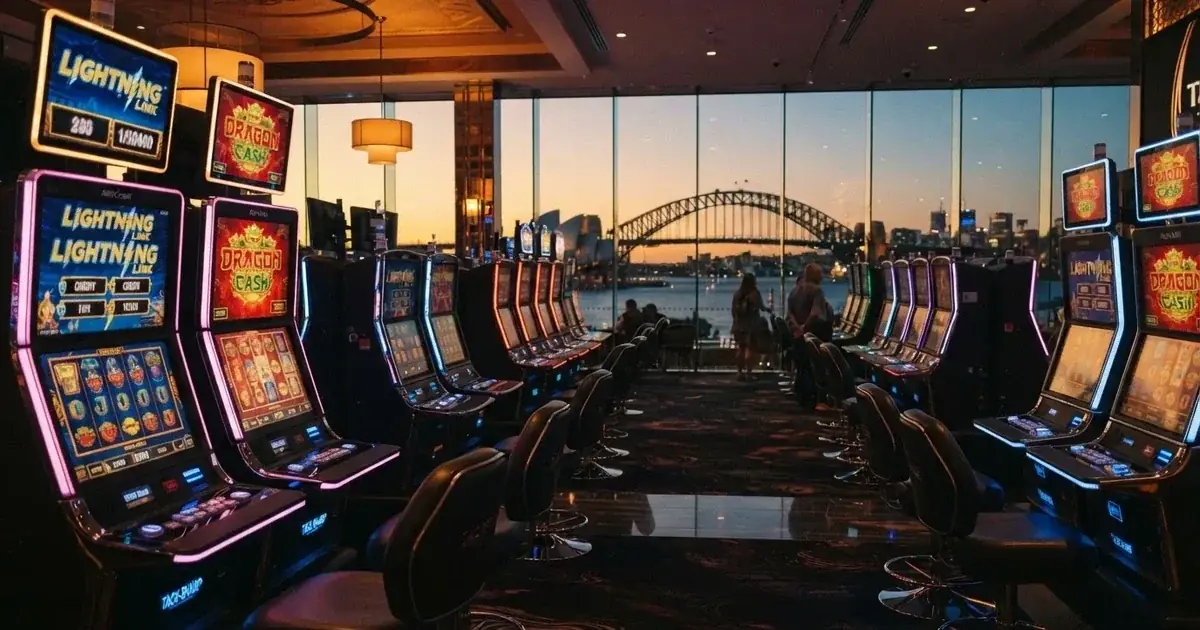
Sydney is a land-based market. There are two licensed casino floors inside the harbour city, and there are tens of thousands of gaming machines in pubs and clubs from the CBD out to Penrith, Liverpool and Campbelltown. Online casino games, including any site that calls its slot library “pokies”, are prohibited under the Interactive Gambling Act 2001 for anyone based in Australia. The first half of this guide explains the licensed floor; the second half tracks the offshore sites the ACMA has told to stop advertising that product to Australians.
Table of Contents
- The Paytables: What “Pokies” Actually Means Inside a Sydney Venue
- How the Shortlist Is Built — And What Separates One Venue From the Next
- The Basics: How Pokies Venues in Sydney Are Actually Run
- The Legal Frame: What the Interactive Gambling Act Actually Prohibits
- Responsible Gaming: The Supports That Bite, and the Ones That Don’t
- Land-Based Venues: Where the Machines Actually Sit
- Payments and Settlement: How Deposits and Withdrawals Work
- The ACMA Blocking Picture: How the Enforcement Numbers Actually Run
- The Brands the ACMA Has Formally Warned — and Why That Matters
- What the ACMA Register Looks Like Across the Set
- What a Sydney Punter Actually Decides
- Frequently Asked Questions
The Paytables: What “Pokies” Actually Means Inside a Sydney Venue
A “pokie” is an Australian poker machine — an electronic gaming machine with a random number generator, a return-to-player percentage set by the venue’s class of licence, and a maximum stake that varies by state. In New South Wales, the maximum bet outside a casino is governed by the Gaming Machines Regulation and is well below what most offshore sites quietly allow. Inside Sydney’s two casinos, the limits, the rules and the games themselves diverge further still. Paytables are not the same across all venues, even when the cabinet looks the same.

The Star Sydney in Pyrmont, overlooking Darling Harbour, is Australia’s second-largest casino after Crown Melbourne. Owned by Star Entertainment Group, the complex runs two gaming floors, with the rest of the building given over to 351 hotel rooms, the 2,000-seat Sydney Lyric theatre and a 3,000-seat Event Centre. Crown Sydney, the 271.3 m, 75-floor tower at Barangaroo — the tallest building in the city — opened in December 2020 with its casino housed between the hotel and the residential floors. Both venues operate under casino-specific licence conditions set by Liquor and Gaming NSW and the NSW Independent Casino Commission, which is the body that found The Star unsuitable to hold its licence in September 2022 over money-laundering failures, fined it A$100 million in October 2022 and placed its operations under a government-appointed special manager through at least September 2025.
The picture changes quickly once a player leaves the harbour. New South Wales had 87,298 gaming machines outside casinos across 2,195 venues in June 2023. They live in pubs, in registered clubs, in RSLs and in a handful of bowling clubs and leagues clubs — and that number is what “best pokies in Sydney” actually refers to for almost every punter who types the phrase. Return-to-player figures in NSW are published in bands by Liquor and Gaming NSW, and they sit below what the same machine class returns in South Australia, where the statutory minimum is 87.5% with a maximum bet of A$5.00 outside Adelaide Casino. Sydney’s casino floors operate to their own return settings, and Crown Sydney’s premium gaming rooms run on a different product mix from the main floor.
The comparison that matters for a player is rarely the headline RTP. It is whether the venue has set its machines into the higher or the lower band of the regulator’s allowed range, whether the venue enforces a session-based cash limit, and whether the venue registers play against BetStop, the National Self-Exclusion Register that has been live since August 2023. Pubs and clubs must connect to BetStop; offshore sites do not.
What the Licensing Tiers Look Like
NSW runs on three tiers. Pubs and clubs hold Class B or Class C entitlements, with different machine caps per venue. Casinos hold a single licence that covers all the machines on the gaming floors and the tables. Liquor and Gaming NSW, the state regulator, sets the technical standards and the harm-minimisation settings — pre-commitment requirements, mandatory shut-up notifications, account-based play in the casino tier — and audits venues against them. The casino tier is also separately overseen by the NSW Independent Casino Commission, which exists because of the conduct failures that brought The Star to its current special-manager arrangement.
A venue’s tier changes the player’s experience in concrete ways. A Crown Sydney high-limit room and a pub in Parramatta are both “pokies venues in Sydney”, but only one of them offers a single machine a stake that the other cannot legally accept. The marketing around “high limit pokies Sydney” describes the casino tier; the marketing around “pokies near me Sydney” usually describes the pub tier. Both are licensed; they are not the same product.
How the Shortlist Is Built — And What Separates One Venue From the Next
A shortlist comparing pokies venues in Sydney is, in practice, doing one of two jobs. Either it ranks a handful of casino floors against each other on the basis of paytable settings, machine-mix and the harm-minimisation regime that venue runs, or it sorts pubs and clubs within a suburb or a radius around a postcode. The first job has only two members in Sydney. The second has thousands, and the criteria that meaningfully separate one from another are not the ones affiliate pages usually run.
The Star Sydney and Crown Sydney are not hard to differentiate. The Star is the older and larger property in Pyrmont, with a long gaming floor and a venue mix that includes everything from low-stakes main-floor play to high-limit rooms, and it is the one whose licence has been under review since 2022. Crown Sydney is the newer, smaller gaming footprint inside a much taller building at Barangaroo, with a hotel and residential mix that affects foot traffic more than the gaming product does. For a player weighing the two, the comparison reduces to machine-mix, the open hours of the premium rooms, and which property’s loyalty programme is more useful for the kind of play they do.
For pub and club venues, the criteria that matter are practical. Does the venue operate at the upper or lower end of the NSW return-to-player band. What are its opening hours — many Sydney pubs and clubs run machines twenty hours a day but stop gaming in the small hours to meet their licence conditions. Does it have a self-exclusion pathway in the venue itself, not just the BetStop register. Does the venue offer a non-smoking gaming room, which the NSW reforms have progressively required for new and refurbished venues. Does the machine mix lean towards the older Aristocrat and IGT cabinets or the more recent Lightning Link-style progressive games. These are the questions a local punter asks; these are the questions a shortlist should answer.
What the shortlist does not usefully rank is “best paying pokies in Sydney” as if it were a single number. Paytables are set within regulator-allowed bands, and most venues sit near the centre of those bands. A venue that advertises itself as “high payout” is usually advertising its floor layout, its machine-to-bar ratio, or its location, not a return-to-player figure materially above its neighbour’s.
The Criteria That Actually Bite
A useful shortlist gives the player the criteria that change outcomes, not the ones that change a marketing page. The ones that bite in NSW are:
- The venue’s BetStop enrolment and its in-venue self-exclusion process.
- The venue’s opening hours, including any mandatory breaks under the venue’s licence.
- The machine-mix and whether the venue runs its cabinets at the higher or lower RTP band the regulator permits.
- The venue’s harm-minimisation settings, including whether it runs mandatory pre-commitment above a threshold.
- For the two casino floors, the operating licence status of the venue itself — particularly relevant at The Star through 2026, where the special-manager arrangement is the live question.
A criterion that does not bite, and which most affiliate pages foreground, is the welcome package. There is no welcome package, because there is no online sign-up. The product being compared is a venue you walk into, not a site you log into.
The Basics: How Pokies Venues in Sydney Are Actually Run
Sydney’s pokies market is run by Liquor and Gaming NSW, with a parallel layer of casino-tier oversight at the NSW Independent Casino Commission. The state sets the technical standards for every machine in a pub or a club, audits venues against those standards, and maintains the register of venues and machine entitlements. Casinos have their own licence regime on top, with separate suitability reviews and financial probity checks for the operator.
The minimum age is 18 across NSW. Venues are required to verify identification before letting a patron play, and the casino tier runs account-based play tied to that identification. Pub and club venues run on less stringent identification rules at entry, but they must connect to BetStop and refuse play to anyone who has registered against the venue’s licence number. The harm-minimisation settings — pre-commitment, mandatory breaks, dynamic warnings — are set by the regulator and audited in venue. The combination is what makes a Sydney pokies venue a different product from an offshore site that has simply named its slot library “pokies”.
The market itself is large by Australian standards. NSW recorded AUD$8.18 billion in annual player losses from poker machines outside casinos in FY22-23, equivalent to AUD$986 per capita — the highest per-capita figure of any Australian state. That number is what makes the regulator’s job what it is, and it is also the figure a player is, in effect, playing into.
What “Pokies” Means Outside Sydney
The phrase means different things in different states. South Australia has 11,672 machines outside Adelaide Casino across 471 venues, with a statutory minimum return of 87.5% and a general maximum bet of A$5.00 outside the casino, while Adelaide Casino itself has no maximum-bet limit. Queensland had 21,122 machines in 351 venues in October 2023. Brisbane’s Treasury Casino closed on 25 August 2024 to make way for The Star Brisbane at the new A$3.6 billion Queen’s Wharf precinct, which opened in stages from 29 August 2024. These are sister markets with the same machine class but different regulator settings, and a Sydney player will see the contrast the first time they cross a border.
The comparison is rarely useful as a recommendation. A Queensland player cannot move a machine; a South Australian player cannot move a regulator. The point of the cross-state comparison is that it shows the same product — a poker machine — running under materially different rules in each jurisdiction, and that what an operator calls “pokies” is the same machine class but a different regulatory product.
The Legal Frame: What the Interactive Gambling Act Actually Prohibits
The Interactive Gambling Act 2001, as strengthened by the Interactive Gambling Amendment Act 2017, makes it an offence for an interactive gambling service to offer online casino games, online pokies or in-play betting to a person in Australia. The prohibition applies to the provider, not the individual player. What is licensable under Australian law is wagering on races and sport placed before the event, lotteries and keno, with most online bookmakers — including Sportsbet, Bet365 and Ladbrokes — licensed by the Northern Territory Racing and Wagering Commission for tax reasons. The commission has no full-time staff and meets once a month in Darwin.
The enforcement body is the ACMA — the Australian Communications and Media Authority. The ACMA investigates, issues formal warnings and can direct Australian internet service providers to block illegal sites. The agency does not require a conviction before blocking, and a single blocking direction from the ACMA removes a site from Australian view across most major ISPs in a matter of days. The blocking regime is the reason “pokies Sydney” online searches turn up a smaller set of working sites than the global affiliate pages suggest.
The individual Australian player is not prosecuted for playing on an offshore site. What the player loses is the consumer protection that comes with an Australian-licensed product. There is no Australian complaints body for an offshore site, no recourse if a withdrawal is refused, no guarantee the site will still be online next week, and no path through BetStop. A blocked site can carry a balance still on the player’s account. H2 Gambling Capital’s 2025 report estimates Australians lose about A$3.9 billion a year to illegal gambling sites, with the share of gambling going through legal channels falling from 74% in 2021 to 64%.
The BetStop and Payment Layer
The National Self-Exclusion Register — BetStop — went live in August 2023 and binds every Australian-licensed online and phone wagering service. A player who registers with BetStop is excluded across the licensed wagering market; they are not, however, excluded from an offshore casino site that does not connect to the register. That is the practical limit of self-exclusion in Australia today.
The payment side of the law changed on 11 June 2024. From that date, credit cards, credit-related products and digital currency are banned as payment for licensed online wagering, with penalties of up to A$247,500 for operators that breach the rule. The legal deposit routes for a licensed Australian wagering service are debit card, bank transfer, PayID/Osko and BPAY. An Australian-facing site that asks for a credit card or a crypto deposit is, by definition, operating outside the licensed wagering regime. Whether it is licensed in another jurisdiction is irrelevant to that breach.
Winnings from gambling are not assessable income for a recreational player under section 6-5 of the ITAA 1997, and losses are not deductible. A player who carries on a business of gambling sits under a different model, and the ATO remains the right body for that conversation.
The Interactive Gambling Amendment (Gambling Reform) Bill 2026 passed Parliament on 19 August 2026. Its advertising and inducement measures commence 1 January 2027 — law with a start date, not yet in force on a page read in 2026.
Responsible Gaming: The Supports That Bite, and the Ones That Don’t
The supports available to a Sydney punter split cleanly into two groups. The first group is connected to the licensed product — BetStop, Gambling Help Online, the venue’s in-house self-exclusion process, and the harm-minimisation settings Liquor and Gaming NSW requires of every pub and club. The second group is connected to offshore sites that advertise a “pokies” library to Australians — and that group is, in practice, disconnected from every Australian support.
The first place a Sydney player with a problem should go is Gambling Help Online, with the National Gambling Helpline on 1800 858 858 — free, 24 hours a day, with web chat available. From there, registration with BetStop closes off the licensed wagering channels. A pub or club venue that has its own self-exclusion process — a paper-based sign-up that bars the player from that specific venue’s gaming floor — adds a second layer. NSW has its own voluntary exclusion arrangements administered by venues and by Liquor and Gaming NSW, and they sit beside BetStop rather than replacing it.
The second group is where the protections stop. An offshore casino site is not connected to BetStop, and it has no Australian complaints pathway. A player who registers with BetStop and then opens an account with an offshore site has registered against the wrong set of operators. The site will, in most cases, still accept their deposits, run their slots and refuse their withdrawals with no recourse other than an overseas dispute-resolution service. The block that the ACMA places on the site can also leave a balance locked, since the site itself remains online in other jurisdictions.
Why the Marketing Makes This Hard
Affiliate marketing for offshore casinos targets Australian search terms — “best pokies Sydney”, “high limit pokies Sydney”, “online pokies Sydney no deposit bonus” — with a confident tone that the law does not support. The phrase “no deposit bonus” is the marketing wrapper around what is, in Australian law, an offer to provide a prohibited interactive gambling service to a person in Australia. The bonus is the lure; the prohibition is the framework; the player’s protection is the empty middle. The reason the ACMA has been able to block 1,751 illegal gambling and affiliate marketing websites since November 2019 is that those sites have been doing exactly this, at scale, for years.
Land-Based Venues: Where the Machines Actually Sit
A “best pokies venue in Sydney” question is, for almost every punter, a question about pubs and clubs. There are 87,298 gaming machines outside casinos across NSW, and they live in registered clubs, in RSLs, in bowling clubs and leagues clubs, and in the larger hotels and pubs. Two thousand one hundred and ninety-five of those venues sit in NSW, and the bulk of them are within an hour’s drive of the Sydney CBD.
The CBD has the densest concentration. The inner west — Newtown, Marrickville, Balmain, Rozelle — runs a deep pub and club tier, much of it in older buildings with long-standing gaming entitlements. Western Sydney — Parramatta, Liverpool, Campbelltown, Penrith — runs the largest single concentration of machines by venue, with the registered clubs in particular operating machine floors that rival a small casino. The Hills District and the Northern Beaches run a thinner machine footprint per venue, with higher per-patron turnover in the venues that do run gaming. The pattern is not uniform; it reflects the local liquor-licensing history and the registered-club structure of each suburb.
The Star Sydney in Pyrmont and Crown Sydney at Barangaroo are the two casino floors. The Star, the older property, has been under a government-appointed special manager — Nicholas Weeks — since the October 2022 fine, with ASIC suing members of its former board on 10 February 2025 over failures to track money-laundering risks. Crown Sydney, the newer tower, opened under different management conditions and has not been the subject of a comparable suitability review. The practical effect on a player is that The Star’s premium gaming rooms and main floor have run under tighter oversight than Crown Sydney’s since 2022, with the special-manager arrangement the visible manifestation of that.
The Practical Limits of a Casino Floor
Sydney’s casino floors run on their own licence conditions, separate from the pub-and-club tier. The technical standards, the return-to-player settings and the machine-mix are set at the licence level, not the venue level, and the casino’s gaming floor is subject to account-based play tied to verified identification. A player who wants to play at the casino tier in Sydney will need to verify their identity on first visit and may need to register for a loyalty card before they can sit at a higher-limit machine. The casino tier is the only tier in Sydney that allows stakes materially above the pub-and-club maximum, and it is the only tier where the player’s session is recorded against their identity at the regulatory level.
The limits a pub or club operates under are different. A registered club’s gaming floor can have hundreds of machines, but each machine is bound by the regulator’s stake cap, and the venue is required to enforce harm-minimisation settings across all of them. A pub’s gaming entitlement is usually smaller — often ten to thirty machines — and runs on a more limited product mix.
Payments and Settlement: How Deposits and Withdrawals Work
The “best paying pokies in Sydney” question is sometimes a question about return-to-player and sometimes a question about cash payout mechanics. The two are different. Pub and club venues in NSW run on ticket-in, ticket-out systems, with the printed ticket redeemable at the venue’s cashier. The cashier pays out cash, and there is no deposit in the online sense — the player pays cash at the venue, plays, and either walks away with what is on the printed ticket or keeps playing. There is no “withdrawal time” because there is no electronic funds transfer.
The casino tier runs differently. Crown Sydney and The Star operate cash-out counters on the gaming floor, and they run account-based play that records the player’s session against their verified identification. Larger winnings at the casino tier can be paid by cheque or by electronic transfer, and the venue’s own settlement times apply. A player can ask at the cashier what the venue’s settlement time is for the size of payout they have, because the answer varies by venue and by amount.
The question of “maximum cash payout pokies Sydney” is a question about ticket redemption at pubs and clubs. Most pub and club venues will pay out ticket balances in cash on the spot up to a cashier limit, and any balance above that limit is paid by cheque or by electronic transfer. The exact ceiling is a venue-level setting, and it is not a number the regulator publishes in a single table — players who play for larger amounts will know the venue’s ceiling from experience or by asking.
The “online pokies Sydney no deposit bonus” angle is, under Australian law, the marketing language for a prohibited service. The bonus is real; the prohibition is real; the two cannot be reconciled. A licensed Australian wagering service does not offer online casino games at all, because it cannot, and the no-deposit-bonus framing is the wrapper around that prohibition on the offshore sites that target Australian search terms.
Settlement Times in Practice
A player asking “how long does a payout take at a Sydney casino” should treat that as a venue question, not a market question. Crown Sydney and The Star set their own settlement windows, and they differ by amount. A small payout is usually settled at the cashier in minutes; a larger payout is settled by cheque or by transfer and takes longer. The casino’s own cashier desk will tell a player the relevant window for the amount they hold. A player who plays at the pub-and-club tier is asking a different question, because the ticket balance is cashed at the venue, and the venue’s cashier ceiling is the only number that matters.
The reason this section runs short is that the market itself runs short. There is no Australian online casino product to compare payout times against, because the product does not exist in Australia. What a player compares is venue to venue, and that comparison has to be done in venue.
The ACMA Blocking Picture: How the Enforcement Numbers Actually Run
The ACMA has asked Australian ISPs to block 1,751 illegal gambling and affiliate marketing websites since the first blocking request in November 2019, with more than 230 unlicensed gambling services having left the Australian market since enforcement was strengthened in 2017. In the round reported on 26 June 2026, the ACMA directed ISPs to block a further twelve: 7Signs, ChromaBet, Donbet, Duospin, Freshbet, Slots Gem, Jacks Club, Lucky Start, Pointsbetz.com, Spinrise, Vinyl Casino and Wildsino. Each blocking direction follows an investigation and a formal warning under the Interactive Gambling Act, and the cumulative effect of the regime is what makes the affiliate pages’ “pokies” library much smaller in practice than the marketing suggests.
The blocking rate — sites blocked per year against the years since the first blocking request — is the arithmetic that shows how the enforcement is scaling. November 2019 to June 2026 is roughly six and a half years. Against 1,751 blocked sites, that is a band of roughly 220 to 270 blocked sites per year, accelerating in the rounds after 2021, when the ACMA began to issue blocking directions more aggressively. The figure is a band rather than a single number because the round-by-round cadence is uneven — the agency issues directions in groups, sometimes months apart, sometimes weeks — and the cumulative total is the only stable measure.
The deeper consequence is the offshore exit rate. More than 230 unlicensed gambling services have left the Australian market since 2017, which is a separate count from the blocking count. A site that “leaves the Australian market” has stopped accepting Australian players and stopped advertising to them; it may still operate in other jurisdictions. A site that is blocked has been made inaccessible to Australian ISPs but is not necessarily offline elsewhere. The two counts measure different things, and the sum of them is what has narrowed the field that an Australian search actually returns.
The picture a player should hold is this: the ACMA’s enforcement regime is the reason the offshore “pokies” market is smaller than its marketing claims, and the regime is scaling. A site that is online in 2026 may be blocked by 2026 next year. The rate at which that happens is the rate at which the marketing proposition for an Australian-facing offshore casino erodes.
Why the Blocking Regime Is the Real Limit
An offshore casino’s offer to an Australian player is, in marketing terms, an offer of a slot library. In regulatory terms, it is an offer of a prohibited service. The ACMA’s blocking regime is what closes the gap between those two framings: a site that advertises to Australians is investigated, formally warned and, in many cases, blocked. The blocking is not a penalty on the player; it is a measure that makes the service inaccessible across Australian ISPs. The site itself usually continues to operate in other jurisdictions — Curaçao in most of the brands below, with the licence register the site displays being just that: a register of one country’s permissions, not Australia’s.
The Brands the ACMA Has Formally Warned — and Why That Matters
Eleven brands appear in the ACMA’s formal-warning register for offering prohibited interactive gambling services to Australians. Each brand is listed below because the ACMA itself named it. The list is not a recommendation, and it is not a ranking. It is the operator-facing record of who has been told to stop.
RocketPlay
The ACMA issued a formal warning to Pulsup Ltd over Rocketplay.com.au in March 2026, with an earlier warning to Dama N.V. in May 2022 covering this brand among six others. Online casino games cannot be licensed anywhere in Australia, and the licence RocketPlay displays in its footer — a Curaçao registration — does not change that. Research carries no third-party listings for the brand beyond the ACMA register itself, which is what makes a player-side check on its payout record difficult from inside Australia. The point of the warning is that the brand has been formally told that offering online casino games to Australians is prohibited, and that the blocking regime is the next step.
For a player weighing whether to open an account, the verdict is that the brand is offering a prohibited product to Australians. The marketing wrapper is irrelevant. The product is the product.
Level Up Casino
The ACMA issued a formal warning to Dama N.V. over Level Up Casino in May 2022, among six brands warned that month. Third-party listings for the brand exist — Wikipedia and Victoria’s regulator carry mentions — but those listings record the brand’s market presence, not a permission to offer the product to Australians. The brand’s licence displayed in its footer is, again, not an Australian licence.
Level Up is one of the better-known Dama brands in the offshore affiliate channel. The ACMA warning is older — 2022 — but it is still the operator-facing record of who has been told to stop. For a player, the brand’s appearance in the register is the part that matters.
Woo Casino
The ACMA issued a further formal warning to Dama N.V. over Woo Casino in March 2025, with an earlier warning in May 2022 to the same operator over other brands. Wikipedia carries a listing for the brand; the ACMA register carries the warning. The product Woo offers to Australians is the same prohibited product its sibling Dama brands offer, and the warning is the operator-facing record that the regulator has told it so.
A player who lands on Woo Casino through an affiliate link is, in regulatory terms, landing on a site the ACMA has named in 2025. The warning’s freshness is itself part of what it says.
Spirit Casino
The ACMA issued a formal warning to Dama N.V. over Spirit Casino in May 2025, the second of the two further warnings Dama received that year. Research carries no third-party listings for Spirit Casino beyond the ACMA register itself, which means a player checking the brand from outside the affiliate channel has very little to look at. The product is the same prohibited product, and the warning is the regulator’s record that Dama has been told.
The freshness of the warning — May 2025 — and the absence of any third-party market record are both consistent with a brand that is more a marketing construct than an operating casino. That is not a finding the regulator has made; it is a reading of what the public record carries.
National Casino
The ACMA issued a formal warning to Consolutetish S.R.L. over National Casino in July 2025. ABC News and the federal infrastructure department carry mentions of the brand in their listings, which is more third-party coverage than most of the brands in this register carry. The coverage does not change the prohibition; it does mean the brand has a longer public paper trail than most of the brands on this list.
For a player, the question is not whether the brand has third-party coverage — it does — but whether that coverage translates into a permission to offer the product to Australians. It does not. The licence in the brand’s footer is not an Australian licence, and the ACMA warning is the record that the regulator has told it so.
Bizzo Casino
The ACMA issued a formal warning to Consolutetish S.R.L. over Bizzo Casino in July 2025, with an earlier formal warning to TechSolutions (CY) Group Limited and TechSolutions Group N.V. in 2022. The brand is on its second formal warning for the same prohibited service to Australians, which is itself a finding about how the brand’s operators have responded to the first. Research carries no third-party listings beyond the ACMA register itself.
A second warning is, in operator terms, what the ACMA does when the brand has not changed its conduct after the first. For a player, the dual warning is the record that the regulator has had to tell the brand twice.
Ignition Casino
The ACMA issued a formal warning to Bamboo Media over Ignition Casino in July 2025. Research carries no third-party listings for the brand, and the brand’s name is shared with a separate US-facing poker product that has no Australian connection. The Australian-facing Ignition Casino is a different product, even where the marketing looks similar, and the ACMA warning is the regulator’s record over the Australian-facing one.
For a player, the brand confusion is itself a finding. An Australian search returning “Ignition Casino” may return either the US-facing product or the Australian-facing one the ACMA has warned, and the player’s job is to know which.
Instant Casino
The ACMA issued a formal warning to EOD Code SRL over Instant Casino in February 2025. Research carries no third-party listings for the brand. The warning is the regulator’s record that the brand was offering a prohibited interactive gambling service to Australians, and the blocking regime is the next step. The brand’s licence displayed in its footer — a Curaçao registration — is not an Australian licence, and the warning is what closes that gap for the regulator’s purposes.
The freshness of the warning — February 2025 — is itself part of the picture. A brand warned a year and a half ago is a brand the regulator has been actively pursuing.
Jackbit
The ACMA issued a formal warning to Ryker B.V. over Jackbit in April 2026, alongside a warning over CasinOK from the same operator. Research carries no third-party listings for either brand. The warning is the regulator’s record of the brand’s most recent offering of a prohibited service to Australians, and the date — April 2026 — is the most recent action in this register.
For a player, the freshness of the warning is the part that matters most. A brand warned three months ago is a brand the regulator has actively pursued this year.
Casino Intense
The ACMA issued a formal warning to Sterplay Holding Ltd over Casino Intense in April 2025. Third-party listings for the brand exist — ABC News, ASGAM and South Australia’s Consumer and Business Services carry mentions — which is more third-party coverage than most of the brands in this register. The coverage does not change the prohibition; it does mean the brand has a longer public paper trail.
A player-side check on Casino Intense from Australia has more sources to consult than most of the brands on this list. The sources do not change the regulator’s position, but they do give a player a fuller picture of who is on the other side of the screen.
Sky Crown
The ACMA issued a formal warning to Hollycorn N.V. over Sky Crown and Blue Leo, as published in the regulator’s September 2022 PDF. Wikipedia carries a listing for the brand. The warning is older than most of the register — 2022 — but it is still the operator-facing record that the regulator has told Hollycorn to stop.
Sky Crown is one of the longer-established Hollycorn brands in the offshore channel, and the brand’s third-party listing is the longer paper trail. For a player, the warning is still the regulator’s position.
What the ACMA Register Looks Like Across the Set
The eleven brands above run across seven different operators. Pulsup Ltd is behind RocketPlay. Dama N.V. is behind Level Up, Woo Casino and Spirit Casino — three brands, three warnings, three dates. Consolutetish S.R.L. is behind National Casino and Bizzo Casino. Bamboo Media is behind Ignition Casino. EOD Code SRL is behind Instant Casino. Ryker B.V. is behind Jackbit. Sterplay Holding Ltd is behind Casino Intense. Hollycorn N.V. is behind Sky Crown.
Licensed Operator Comparison: Formally Warned Brands
| Brand | ACMA action and date | Operator named by the ACMA | Subject support |
|---|---|---|---|
| RocketPlay | Formal warning, March 2026 | Pulsup Ltd | No third-party listings carried |
| Level Up Casino | Formal warning, May 2022 | Dama N.V. | Third-party listings carried (Wikipedia, Victorian regulator) |
| Woo Casino | Formal warning, March 2025 | Dama N.V. | Third-party listings carried (Wikipedia) |
| Spirit Casino | Formal warning, May 2025 | Dama N.V. | No third-party listings carried |
| National Casino | Formal warning, July 2025 | Consolutetish S.R.L. | Third-party listings carried (ABC News, federal infrastructure) |
| Bizzo Casino | Formal warning, July 2025; earlier 2022 | Consolutetish S.R.L. | No third-party listings carried |
| Ignition Casino | Formal warning, July 2025 | Bamboo Media | No third-party listings carried |
| Instant Casino | Formal warning, February 2025 | EOD Code SRL | No third-party listings carried |
| Jackbit | Formal warning, April 2026 | Ryker B.V. | No third-party listings carried |
| Casino Intense | Formal warning, April 2025 | Sterplay Holding Ltd | Third-party listings carried (ABC News, ASGAM, SA Consumer and Business Services) |
| Sky Crown | Formal warning, September 2022 | Hollycorn N.V. | Third-party listings carried (Wikipedia) |
The table does not rank the brands. It maps the ACMA’s formal-warning register against the third-party listings that exist for each brand. The point of the spread is that the ACMA’s enforcement is uneven across operators — Dama N.V. alone carries three of the eleven warnings, with two of them in 2025 — and the third-party paper trail is uneven across brands. RocketPlay has the freshest warning and no third-party listings; Sky Crown has the oldest warning and a Wikipedia entry. The player-side reading of that spread is that a fresh ACMA warning is itself the more useful piece of information than any third-party listing.
The Operator-Level Picture
The seven operators behind these eleven brands have been told, in aggregate, more than a dozen times to stop offering prohibited interactive gambling services to Australians. The repetition is what the ACMA’s blocking rate is the arithmetic of: each formal warning is the record that the regulator has had to act, and each blocking direction that follows is the consequence of the operator not changing its conduct. The 1,751 sites blocked since November 2019 is the cumulative consequence across the broader market. The eleven brands on this list are a slice of that consequence, narrowed to the operators the regulator has named in formal warnings in 2026 and the years just before it.
A player weighing whether to open an account with any of these operators should treat the ACMA register as the authoritative record. The marketing pages for each brand will say something different. The regulator’s register is the one that closes the question.
What a Sydney Punter Actually Decides
A Sydney punter deciding where to play is, in practice, deciding between three things. They are deciding which pub, club or casino venue to walk into — a question the licensing tier, the venue’s opening hours and the venue’s harm-minimisation settings answer. They are deciding whether to take up any of the offshore “pokies” brands the ACMA has named — a question the register above answers, with the verdict that the brands are offering a prohibited service to Australians. And they are deciding how to manage the harm-minimisation tools the regulator makes available — BetStop, Gambling Help Online, the venue’s own self-exclusion — a question the responsible-gaming section above answers.
The first decision is the one a Sydney player can act on today. The second is the one the ACMA’s blocking regime has been narrowing for six and a half years. The third is the one the regulator has built the tools for, and it is the one a player who finds themselves playing more than they meant to should act on first.
The arithmetic of the ACMA’s blocking rate — roughly 220 to 270 sites blocked per year since November 2019, against 1,751 cumulative — is the rate at which the offshore proposition is shrinking. The marketing pages will not say that. The regulator’s register will.
Frequently Asked Questions
Which venues in Sydney are licensed to operate pokies?
Two casino floors operate under NSW casino licences — The Star Sydney in Pyrmont and Crown Sydney at Barangaroo — and 2,195 pubs, clubs, RSLs and registered clubs operate gaming machines across NSW under Liquor and Gaming NSW entitlements. The casino tier runs account-based play with the venue’s licence conditions; the pub-and-club tier runs on individual machine entitlements with a regulator-set maximum stake.
Are pokies in Sydney available around the clock?
Not uniformly. Most pubs and clubs stop gaming in the early hours to meet their licence conditions, with the specific hours set at the venue level rather than the regulator level. The two casino floors run longer hours than the pub-and-club tier, and The Star and Crown Sydney each publish their own gaming-floor hours.
What identification do venues in Sydney require before letting someone play pokies?
Pub and club venues verify age on entry — minimum 18 — and are required to check against BetStop. Casino venues run account-based play tied to verified identification, with photo ID required on first visit and a player card issued for higher-limit play.
Can visitors to Sydney use self-exclusion schemes at local pokies venues?
BetStop, the National Self-Exclusion Register, has been live since August 2023 and binds every Australian-licensed online and phone wagering service. A visitor who has registered with BetStop will be refused play at every connected venue. A visitor from another state can also use the NSW-specific voluntary exclusion arrangements administered by Liquor and Gaming NSW.
How does the payout percentage on Sydney pokies compare with other Australian cities?
NSW sets return-to-player bands through Liquor and Gaming NSW, with the casino tier running on its own licence settings. South Australia sets a statutory minimum of 87.5% and a maximum bet of A$5.00 outside Adelaide Casino, with the casino itself running no maximum-bet cap. The cross-state comparison is most useful as a way to see how the same machine class runs under materially different regulator settings.
Is it legal for an online casino to advertise “pokies” in Sydney the same way a pub or club does?
No. The Interactive Gambling Act 2001 prohibits offering online casino games, online pokies or in-play betting to a person in Australia, and the ACMA enforces the prohibition by issuing formal warnings and directing Australian ISPs to block illegal sites. An offshore casino’s licence displayed in its footer is not an Australian licence, and the marketing is not a permission.