
best new australian online pokies 2026: a reader’s map of what the law actually permits
The cleanest answer to the phrase “best new australian online pokies 2026” is the one most affiliate pages bury: there is no such thing, in the sense a reader from Australia can act on. Online casino games — which is what “online pokies” describes — cannot be offered to anyone physically in Australia under the Interactive Gambling Act 2001, and no state or territory issues a licence for them. What the search returns instead is offshore brands the Australian Communications and Media Authority (ACMA) has spent the last several years naming, warning and, increasingly, blocking at the internet-service-provider level. This piece sets that out plainly, lists the brands the regulator itself has acted against, and explains what an Australian reader is actually allowed to play, where the licensed machines live, and what self-exclusion tools apply.
Data current as of 29 October 2026, cross-referenced against the ACMA’s published formal-warning register and the operator listings it cites.
Table of Contents
- The Interactive Gambling Act 2001, and what it actually prohibits
- What the ACMA has actually done: a rate of blocking that adds up
- Why the law is shaped the way it is: the land-based context
- Responsible play: what is actually available to an Australian reader
- Money in, money out: the payment rules that do and do not apply
- What the catalogue would look like, and why the catalogue is not the point
- The brands the ACMA has acted against
- What an Australian reader can actually do
- Frequently asked questions
The Interactive Gambling Act 2001, and what it actually prohibits
The Interactive Gambling Act 2001 (the IGA), tightened by the Interactive Gambling Amendment Act 2017, makes it an offence for a provider to offer online casino games — including online pokies — to a person who is in Australia. The offence is on the provider, not the player; an individual punter is not prosecuted for opening an account. What that means in practice is sharper than the framing most marketing sites use: a site accepting an Australian customer is breaking Australian law at the moment of acceptance, and the question for the reader is not whether the site is licensed somewhere but whether that licence has any reach inside Australia. It does not.
The licensable surface in Australia is narrower than the marketing suggests. Pre-event wagering on racing and sport is licensable — the Northern Territory Racing and Wagering Commission regulates 52 of Australia’s online bookmakers, including Sportsbet, Bet365 and Ladbrokes, licensed in the Territory largely for tax reasons. The same regime covers lotteries and keno. Everything else an online casino product page lists — slots, live dealer, jackpots, table games — sits outside the IGA’s permitted categories. A Curaçao-issued licence on the footer of a pokies site does not move the product into the permitted column. It signals that the operator has chosen a regime with no enforcement relationship with Australia.
That gap has a consumer cost. An offshore casino gives no Australian consumer protection: there is no local complaints body, no local regulator to appeal a refused withdrawal to, and no guarantee that a balance held in an offshore account remains reachable if the site is blocked. Blocking is the enforcement tool the ACMA has been using, and an Australian player’s balance sits on the wrong side of it.
What the ACMA has actually done: a rate of blocking that adds up
Since the first blocking request in November 2019, the ACMA has asked Australian internet service providers to block illegal gambling and affiliate marketing websites. By June 2026 the running total stood at 1,751 sites blocked, with more than 230 unlicensed services having left the Australian market since enforcement was strengthened in 2017. The most recent reported round, on 26 June 2026, added twelve: 7Signs, ChromaBet, Donbet, Duospin, Freshbet, Slots Gem, Jacks Club, Lucky Start, Pointsbetz, Spinrise, Vinyl Casino and Wildsino.
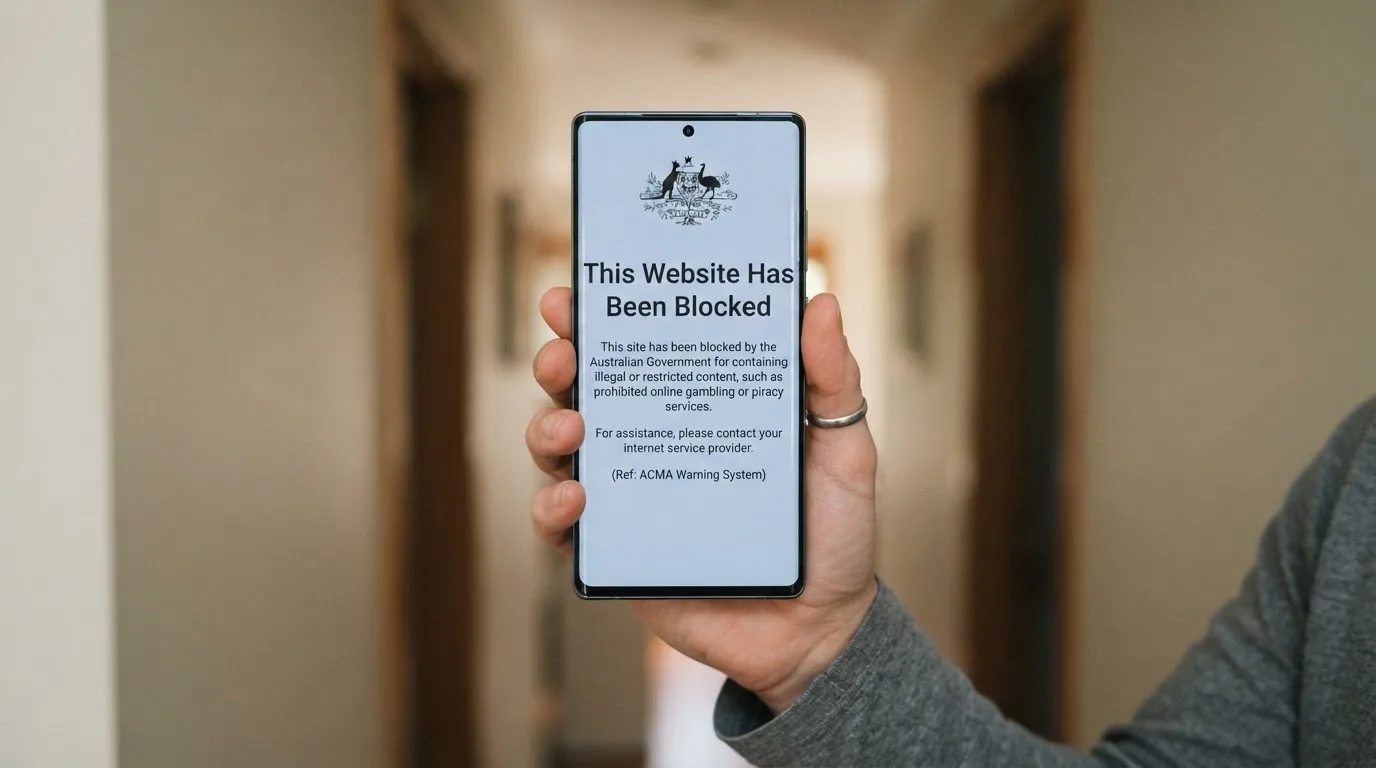
Put as a rate rather than a total, the picture is more useful. Between November 2019 and June 2026 — roughly 79 months — the ACMA moved against 1,751 sites at an average of around 22 blocking actions per month, with the monthly figure climbing as enforcement matured. The earliest rounds were single-figure additions; the 2026 reporting cycle has been running at substantially higher monthly volumes, which makes the simple monthly average a floor rather than a current pace. As a band: between 18 and 28 sites blocked per month across the full period, with the upper end of that band describing the post-2023 cadence more accurately than the lower. The point is not the precise figure — enforcement is lumpy and a single round can move the monthly number by a third — it is that the ACMA’s blocking pipeline has not slowed, and that a site reachable in Australia this month can be unreachable next.
The formal-warning register tells the same story from the operator side, and it is the register most relevant to a reader trying to identify a specific brand. A formal warning is a public step the ACMA takes before a blocking request; a brand that has received one is on a documented path toward being unreachable.
The pattern across the warnings is consistent. Dama N.V. drew the first multi-brand warning in May 2022, covering six brands — Bambet, Dazard, Level Up, Rocketplay, Wild Tornado and Cobra Casinos — and then drew further individual warnings in March 2025 over Woo Casino and in May 2025 over Spirit Casino. Bamboo Media received a July 2025 warning over Ignition Casino. Consolutetish S.R.L. drew a July 2025 warning covering National Casino and Bizzo Casino, the latter of which had already been the subject of a 2022 formal warning to TechSolutions. EOD Code SRL was warned in February 2025 over Instant Casino. Ryker B.V. was warned in April 2026 over Jackbit and CasinOK. Sterplay Holding Ltd was warned in April 2025 over Casino Intense. Hollycorn N.V. was warned over its Sky Crown and Blue Leo services. Pulsup Ltd received a March 2026 warning over Rocketplay.
What the warnings have in common is more important than what separates them: every one of these brands is offering online casino games to people in Australia, which is what the IGA prohibits. The names change, the operators change, the licence jurisdictions cited in the footers change, and the underlying conduct does not.
Why the law is shaped the way it is: the land-based context
The reason online pokies sit outside the IGA’s permitted surface is partly the size of the legal land-based market the law was drafted around. Electronic gaming machines — the land-based pokies — operate in every Australian state and territory, with each jurisdiction separately regulating their design and operation. Registered clubs operated Australia’s first legal poker machines from 1956, in New South Wales. By 2020–21 Australians were betting almost A$150 billion through gaming machines and losing A$12.18 billion on them, on a population base that gives Australia about 3% of the world’s pub and club poker machines with 0.3% of the global population. The density of legal machines is not a small thing: New South Wales alone held 87,298 gaming machines outside casinos across 2,195 venues as of June 2023, with player losses of A$8.18 billion in 2022–23.
Regulation runs state by state, which is why the legal-minimum return-to-player (RTP) — the percentage of money wagered that a machine is required to return over the long run — varies by jurisdiction. The floor is 85% in New South Wales, the Northern Territory, Queensland and (generally) Victoria, climbing to 87% at Crown Melbourne, 87% in the Australian Capital Territory and Tasmania, 87.5% in South Australia, and 90% in Western Australia. Those are the floors; a venue or operator can run above them, but it cannot run below. Two pieces of history explain the spread. Western Australia banned poker machines in pubs and clubs when Crown Perth opened in 1985 — Crown Perth’s own machine count has since grown from about 200 in that year to roughly 2,500, all approved by the state’s Gaming and Wagering Commission. Tasmania ended the Federal Group’s monopoly over poker machines through legislation passed in November 2021, moving oversight to the Tasmanian Liquor and Gaming Commission and planning mandatory pre-commitment cards for the machines, though implementation of that reform was delayed until late 2025.
None of this gives an Australian reader a legal route to “new online pokies.” What it does is draw the boundary the IGA sits inside: a country with one of the densest legal poker-machine footprints in the world has decided the online version of those machines is not part of the licensed product. The ACMA’s enforcement record is the practical expression of that decision.
Responsible play: what is actually available to an Australian reader
The player-protection infrastructure Australia has built is real, and it is built around the licensed surface, not the offshore one.
BetStop, the National Self-Exclusion Register, went live in August 2023. A person who registers with BetStop is excluded from every Australian-licensed online and phone wagering service for a chosen period — from three months up to a permanent exclusion — and the exclusion cannot be lifted early. That reach stops at the Australian-licensed boundary. An offshore casino is not connected to BetStop; an exclusion registered there does not bind a Curaçao-licensed pokies site, nor does a BetStop registration reach one. The cost of using an offshore product, on this dimension, is that the main Australian self-exclusion tool does not cover it.
Help lines sit alongside the register. The National Gambling Helpline on 1800 858 858 is free, runs 24/7, and offers chat at Gambling Help Online. For land-based play, each state and territory runs its own venue-level exclusion arrangements, which are administered by the venues themselves and run on different terms. The licensed pokies a reader can reach in a pub or club are the ones those state-level exclusions can affect.
The 2026 reform package sets a start date for new measures rather than an in-force date. The Interactive Gambling Amendment (Gambling Reform) Bill 2026 passed Parliament on 19 August 2026; its advertising and inducement provisions commence on 1 January 2027. That is law with a calendar start, not a regime that is yet operating, and an Australian reader making a decision this year is deciding under the rules as they currently apply.
A point that earns explicit mention because it is the one a marketing page buries: the licensed protections apply to licensed operators, and an offshore pokies site is, by definition, outside them.
Money in, money out: the payment rules that do and do not apply
The payment rules for Australian-licensed wagering are stricter than the marketing suggests, and the same rules do not bind an offshore site, which is itself information.
Since 11 June 2024, credit cards, credit-related products and digital currency have been banned as payment methods for licensed online wagering in Australia. The penalty for an operator that accepts them runs up to A$247,500. The legal deposit routes that remain are debit card, bank transfer, PayID/Osko and BPAY. An Australian reader at a licensed bookmaker will see those four methods and no others; the absence of credit-card and crypto options is the rule, not an oversight.
The same logic does not apply offshore. A Curaçao-licensed pokies site will, in practice, accept credit cards and a range of crypto and e-wallet options that an Australian-licensed bookmaker cannot. The reader choosing between the two is choosing between a tighter payment surface backed by Australian consumer law and a broader one backed by none. The wider surface is more convenient at the deposit step; the cost shows up when a withdrawal is requested.
PayID and Osko — the instant-payment rails operated under New Payments Platform Australia — are the deposit method an Australian reader will most often see discussed in the licensed context. PayID settles between Australian bank accounts in seconds, which is why it is the rail of choice for licensed Australian wagering deposits: the deposit is essentially immediate, and the receiving account is traceable. An offshore site accepting PayID is unusual; the rail is built for Australian banks, and the offshore operator sits outside that system.
A practical test an Australian reader can apply: if the deposit page offers a credit card or a crypto wallet as the first option, the site is operating outside the Australian rules, which is the same thing as saying it is outside the Australian rules for everything that follows.
What the catalogue would look like, and why the catalogue is not the point
The mechanics of an online pokie are not exotic. A paytable lists what each symbol combination pays; a reel set and a payline structure decide how combinations are evaluated; an RTP and a volatility class describe the long-run return and the spread of outcomes around it. New releases in the licensed Australian market — the land-based market, where “new” actually means something — are tested by state regulators before they appear on club or pub floors, which is what “new” looks like when it is real. A game on a casino floor in NSW or Victoria has been through an approval process; a “new release” on an offshore site has been through whatever the operator’s aggregator has approved, which is a different process with a different standard.
What changes between releases is mostly the theme, the bonus structure and the volatility profile. The house edge sits at the design level, set by the mathematics of the paytable rather than by anything a player does at the machine. The licensed Australian floor places a legal floor on RTP, by jurisdiction: 85% in NSW, the NT, Queensland and (generally) Victoria, 87% in the ACT and Tasmania, 87.5% in South Australia, and 90% in Western Australia. Offshore, the floor is whatever the operator’s licence regime requires, which is often no floor at all. The mathematics of the individual game is the same in either case; what changes is the discipline applied to it.
For an Australian reader, the practical consequence is that “new” is not a meaningful attribute for an offshore pokies title — the word is doing marketing work, not regulatory work. The same title may appear and reappear under different names on different aggregator skins, and the regulator’s name on the footer does not change the underlying mathematics.
The brands the ACMA has acted against
What follows is not a ranking. None of these brands can be recommended to an Australian reader as a place to play: every one of them has been the subject of a formal ACMA warning for offering prohibited online casino services to Australians. They are listed here because they are the brands the regulator itself has named in its published enforcement record, and a reader trying to identify a specific site needs the name, the operator and the date in one place.
| Brand | ACMA action and date | Operator named by the ACMA | Subject support |
|---|---|---|---|
| RocketPlay | Formal warning, March 2026 (Pulsup Ltd); earlier warning May 2022 (Dama N.V.) | Pulsup Ltd (Rocketplay), March 2026; Dama N.V., May 2022 | — |
| Level Up Casino | Formal warning, May 2022 | Dama N.V., May 2022 | Bgaming-listed |
| Woo Casino | Formal warning, March 2025 | Dama N.V., March 2025 | — |
| Spirit Casino | Formal warning, May 2025 | Dama N.V., May 2025 | — |
| National Casino | Formal warning, July 2025 | Consolutetish S.R.L., July 2025 | Wikipedia-listed |
| Bizzo Casino | Formal warning, July 2025; earlier 2022 | Consolutetish S.R.L., July 2025; TechSolutions, 2022 | — |
| Ignition Casino | Formal warning, July 2025 | Bamboo Media, July 2025 | — |
| Instant Casino | Formal warning, February 2025 | EOD Code SRL, February 2025 | — |
| Jackbit | Formal warning, April 2026 | Ryker B.V., April 2026 | — |
| Casino Intense | Formal warning, April 2025 | Sterplay Holding Ltd, April 2025 | ABC, ACMA, Crown Melbourne-listed |
| Sky Crown | Formal warning (Hollycorn N.V., Sky Crown and Blue Leo) | Hollycorn N.V. | — |
Three observations the table is designed to surface. First, the operator named is rarely the brand name on the site’s front page: Dama N.V. operates six of the eleven brands on this list across different periods, Hollycorn N.V. operates Sky Crown, and the brand-to-operator map is the kind of detail an enforcement register carries that an affiliate page does not. Second, several brands have been warned more than once under different operating companies: RocketPlay and Bizzo Casino have both received a 2022 warning and a later one, which means the ACMA’s enforcement did not end the brand’s Australian-facing activity on the first pass. Third, the empty cells in the subject-support column are themselves information: a brand that does not appear in the listings the ACMA cites is one the regulator’s record does not document, and “no-data” is the right cell rather than a gloss.
The marketing language around each of these brands describes them as “new,” “exciting” or “feature-rich,” and every one of those adjectives is doing the work the licence cannot. The cost to the reader is the same on each row: a balance held with any of these brands sits on the wrong side of an Australian consumer-protection regime, and the ACMA’s enforcement record is the published evidence that the conduct is being policed.
What an Australian reader can actually do
The phrase “best new australian online pokies” returns a long list of offshore brands, none of which an Australian reader can lawfully use and several of which have been formally warned. The lawful alternatives sit in three places.
Licensed clubs, pubs and casinos hold the legal pokies surface. New South Wales runs the largest machine footprint, at 87,298 gaming machines outside casinos across 2,195 venues as of June 2023, with player losses of A$8.18 billion in 2022–23. Queensland held 21,122 gaming machines in 351 venues as of October 2023; Victoria ran 26,380 machines outside Crown Casino across 488 venues in 2021–22, under a 30,000-machine statewide cap. Crown Melbourne, regulated by the Victorian Gambling and Casino Control Commission since 1 July 2022, offers three baccarat variants and a deeper table-game floor; Crown Perth holds the Western Australian licence under the state’s Gaming and Wagering Commission.
Pre-event wagering on racing and sport is the licensable online product, covered above. Lotteries and keno make up the rest of the licensed online surface. Everything that calls itself an “online casino” and targets Australian customers is, by the ACMA’s published enforcement record, operating outside that surface.
For a reader who has been using an offshore site, the immediate next step is BetStop: a registration excludes the person from every Australian-licensed online and phone wagering service for the chosen period. It does not reach the offshore site the reader has been using, which is the limitation of an exclusion built for the licensed surface. The National Gambling Helpline on 1800 858 858, free and 24/7, with chat at Gambling Help Online, is the other practical entry point.
For a reader who is deciding what to do next, the arithmetic is simple. The legal route costs nothing in compliance terms: the venues are licensed, the machines have an RTP floor set by a state regulator, the self-exclusion tools apply, and the consumer-protection regime reaches the operator. The offshore route offers a wider payment surface and a larger game library at the cost of every protection Australia has built around gambling, on top of a non-trivial probability that the site itself becomes unreachable while a balance is held on it. The reader’s decision is between those two surfaces, and the ACMA’s blocking pipeline — 1,751 sites since November 2019, with the recent monthly rate running well above the long-run average — is the published evidence that the second surface is being actively narrowed.
Frequently asked questions
How much do Australians actually lose on gaming machines in a typical year?
The most recent full-year figure is for 2020–21, when Australians bet almost A$150 billion through gaming machines and lost A$12.18 billion on them. The number is large enough that it is worth restating in its parts: the bet total is turnover, not loss; the loss figure is what was retained by the machines. The same period gave Australia roughly 3% of the world’s pub and club poker machines on about 0.3% of the global population, which is the density the per-capita loss figure reflects. New South Wales alone recorded A$8.18 billion in player losses in 2022–23, against 87,298 gaming machines outside casinos.
What actually counts as a “new” pokies release?
In the licensed Australian market, “new” is a state-regulated event. A title has to be approved by the relevant state regulator before it can be deployed on a club or pub floor, and the approval process tests the mathematics of the paytable as well as the presentation. That is what “new” means when it is a real term. On an offshore site, the same word is doing marketing work: titles can be re-skinned, re-released under new names, or appear and reappear across different aggregator skins, and there is no Australian regulator checking the design. The two uses of “new” describe different things, and the marketing use carries none of the regulatory meaning.
Is it legal for an online casino to offer pokies to Australians?
No. The Interactive Gambling Act 2001, as strengthened by the Interactive Gambling Amendment Act 2017, prohibits offering online casino games — including online pokies — to anyone in Australia. No Australian state or territory issues a licence for online casino games; what is licensable is pre-event wagering on racing and sport, lotteries and keno. The ACMA enforces the prohibition on the provider side through formal warnings and through blocking requests to Australian internet service providers. The player is not prosecuted, but a balance held with an offshore provider sits outside any Australian consumer-protection regime.
Can a new pokies bonus be claimed through a PayID deposit?
For a licensed Australian wagering service, PayID is one of the permitted deposit methods and the bonus mechanics are governed by the operator’s terms. For an offshore pokies site, PayID is rarely available as a deposit rail at all — the rail is built for Australian banks, and offshore operators sit outside the New Payments Platform. Where an offshore site does offer PayID, it is worth treating as unusual rather than normal. The more common offshore payment surface is credit card and crypto, which are the methods the Australian rules have banned for licensed wagering since 11 June 2024; an offshore site offering them is operating outside the Australian regime for that reason alone.
Are new pokies titles tested before they reach an Australian club or pub floor?
Yes. Each Australian state and territory regulates the design and operation of its gaming machines separately, and a new title cannot appear on a licensed venue floor until the relevant state regulator has approved it. The approval process covers the mathematics of the paytable, including the RTP, and the result is a legal floor on RTP that varies by jurisdiction: 85% in NSW, the NT, Queensland and (generally) Victoria (87% at Crown Melbourne), 87% in the ACT and Tasmania, 87.5% in South Australia, and 90% in Western Australia. An offshore site carries no equivalent discipline on what it lists under “new.”