
Best Pokies in Tasmania in 2026
There are pokies on a licensed floor somewhere within a sensible drive of almost every Tasmanian, and then there is everything that calls itself “pokies” on the other side of an internet connection. The two are not the same product. The first runs under a state licence, pays tax into Hobart, hands a player a plastic card from December 2025 onwards, and is governed by a regulator the punter can actually ring. The second is the reason the ACMA has spent the last decade asking Australian ISPs to block websites, and the reason those blocks now pass 1,750 since the first one in November 2019. A page that asks which pokies are best in Tasmania in 2026 has to start by separating those two worlds, because treating them as one choice is the mistake that costs Australians roughly A$3.9 billion a year.
This page is current as of 29 October 2026 and was checked against the ACMA register of formal warnings and blocking actions, and against the Tasmanian Liquor and Gaming Commission’s published material on the cashless gaming card.
Table of Contents
- What “Best Pokies in Tasmania” Actually Means
- How a Shortlist of Tasmanian Pokies Venues Gets Built
- The Games on Tasmanian Floors
- Twenty-Four-Hour Pokies in Tasmania
- Cashless Pokies in Tasmania
- Where the ACMA Has Acted — The Offshore Side
- What the Blocking Rate Tells You
- What the Law Actually Says About Online Pokies in Australia
- Payout Percentage and the Comparison With Other Australian Cities
- The Cashless Gaming Card and What It Costs a Punter
- Where the Two Tasmanian Casinos Sit
- What “Best Payout” Actually Means in Practice
- Responsible Gambling in Tasmania
- What the Numbers Mean for the Player
- Frequently Asked Questions
What “Best Pokies in Tasmania” Actually Means
The phrase is doing more work than it looks. It can mean a venue with a generous return-to-player setting, a venue close to home, a venue where the machines run at a stake a player is comfortable with, or a venue where the smoking area is bearable. It can also mean, in the looser usage the search engines have absorbed, an offshore website that calls its slots “pokies” because the word sells in Australia. Both readings land on this page. Only the first one survives the law.

On the licensed side, Tasmania has always run a tight ship. The state has two casinos — Wrest Point in Hobart, which opened on 10 February 1973 as Australia’s first legal casino, and the Country Club Casino and Resort in Launceston, opened by Federal Group in 1982 — and a separate network of hotels and clubs that run pokies under their own machine permits. Until August 2017, every pub and club machine outside the two casinos answered to Federal Group, which held the monopoly written into the Gaming Control Act 1993. That monopoly was relinquished that year, and individual venues took over their own machine licensing. The state still only has two casinos, and the venues that hold machine entitlements are still a finite group the Tasmanian Liquor and Gaming Commission knows by name.
Offshore, the picture is the opposite. The Interactive Gambling Act 2001 makes it an offence to provide online casino games or online pokies to a person physically in Australia, and no state or territory issues a licence for them. What the ACMA has been doing since 2017 is treating that prohibition as enforceable: more than 230 unlicensed services have left the Australian market under formal warnings, and 1,751 illegal sites and affiliate pages have been blocked since November 2019. A page that ranks “the best pokies in Tasmania” in 2026 is therefore a page that has to be honest about which of those two industries it is talking about.
How a Shortlist of Tasmanian Pokies Venues Gets Built
A shortlist that means anything starts with the licence, not with the welcome offer. The order the rest of the criteria sit in matters as well, because two venues can have identical licences and opposite strengths. What follows is the order this site uses, and the rationale for each cut.
Licence standing comes first, and it is binary. A venue either holds a Tasmanian machine entitlement issued by the Tasmanian Liquor and Gaming Commission, or it does not. That single check rules out the entire offshore category for the licensed half of the page, and it rules out venues whose state paperwork has lapsed for the other half. Player-protection settings come second: under the cashless gaming card reform, every hotel and club poker machine in Tasmania runs carded play from December 2025, with default loss limits of A$100 a day, A$500 a month and A$5,000 a year. A venue’s job is to make that card work; a venue’s quality on this measure is whether the limit applies cleanly or whether the venue treats the system as a hassle. The third cut is the machine mix. Tasmania’s two casinos run Aristocrat and IGT floors, with a smaller IGT and Konami presence in the pubs and clubs around Hobart and Launceston. A shortlist should say which titles a player can actually find on the floor. The fourth cut is stake range and opening hours, which decides whether the venue fits a specific reader’s week. The fifth cut is the venue’s track record on self-exclusion, complaints and payout disputes, judged against the Tasmanian Liquor and Gaming Commission’s published action log.
The same shape governs a list of offshore sites, but the criteria reverse. The first cut is whether the ACMA has acted against the operator. The second is whether the operator has responded, which means whether the brand is still serving Australian traffic at all. The third is the date the ACMA issued the warning, because that tells a reader whether the action is current or historical. A list that omits the first cut is a list of marketing pages. A list that uses the second cut alone is a list of brands that have already been blocked. Neither is useful, and the order above is what makes the table further down readable.
The Games on Tasmanian Floors
The paytable details a punter cares about live on the cabinet itself, and a shortlist that names a venue without naming what the venue runs is missing the point. Tasmania’s casino floors carry the titles that hold Australian market share, with a handful of regional machines in the pubs and clubs that mirror the casinos’ headline games.
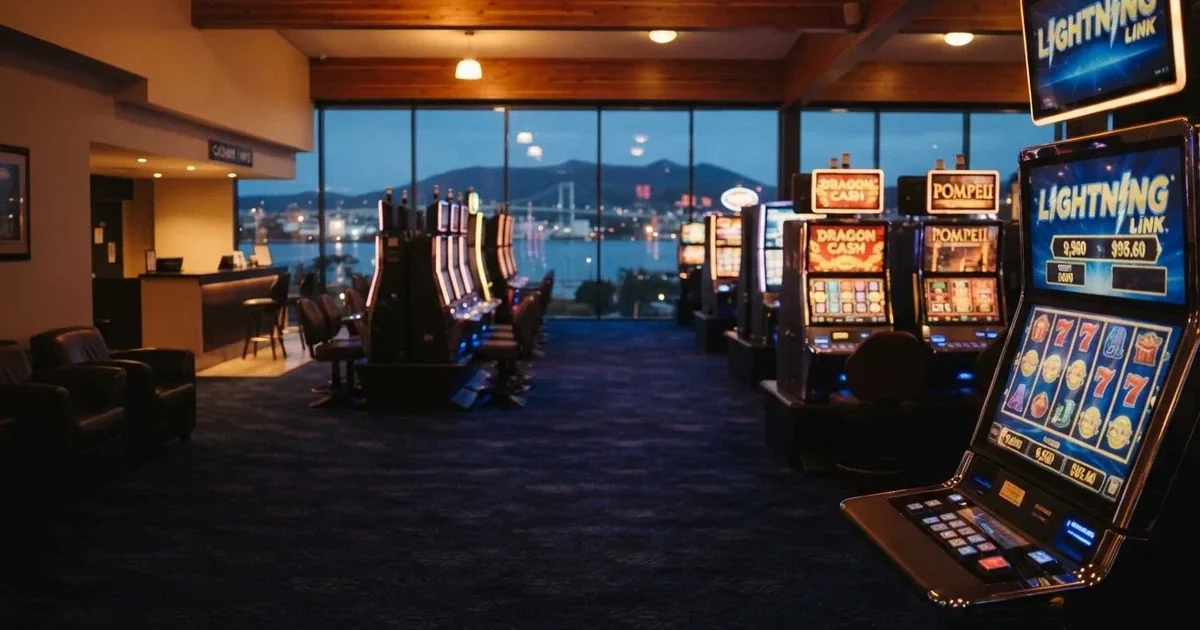
Aristocrat remains the dominant supplier on Tasmanian casino floors. The Lightning Link and Dragon Link families have run on Wrest Point and at the Country Club for years, and a player walking onto either floor will find a row of those cabinets near the main gaming room. The mechanic on those titles is the hold-and-spin bonus, where pearl, coin and similar symbol collections fill out a feature board and award a jackpot tier — Mini, Minor, Major and Grand, with the Grand set as a fixed dollar amount per machine. The return-to-player figures on these cabinets are set by the operator within a regulator-approved range, which means the same title can pay a slightly different rate at Wrest Point than at the Country Club. Punters who care about that detail ask at the player desk.
IGT’s Wonder Wheel titles and the Wheel of Fortune range also run on Tasmanian casino floors, with three-reel and five-reel mechanical-reel machines still in place at Wrest Point’s heritage gaming room. Konami’s Asian-themed cabinets appear on both floors in smaller numbers, and Ainsworth rounds out the lower-stake sections. The pubs and clubs run a tighter machine mix, mostly Aristocrat’s Birds Pay, Eagle Bucks and the Everlast series, with a smaller number of IGT cabinets. The Spirit of Tasmania ferry does not carry its own gaming room, and Tasmanian law treats any pokies offered on the Spirit of Tasmania crossing as a prohibited interactive gambling service the moment a punter can sit down at them; that question has come up enough in the press that the operator has clarified the situation.
The reason paytable numbers vary is the regulatory framework. Tasmania sets a minimum return-to-player for gaming machines, but allows operators to certify machines within a band above that minimum. The exact figures on a given cabinet are printed on the help screen, and a player who wants to compare titles reads them there. A venue that runs older cabinets at the lower end of the band will, over time, return less to players than a venue running newer cabinets at the upper end. That is the only honest comparison available, and a page that lists one figure across an entire venue is doing something else.
Twenty-Four-Hour Pokies in Tasmania
There is no 24-hour pokies venue in Tasmania. The state does not licence any gaming floor to operate around the clock. Wrest Point’s gaming floor runs late, and the Country Club Casino in Launceston runs late, but both close their gaming rooms at a state-mandated hour. The hotels and clubs that hold machine entitlements have their own opening hours, and most close the gaming room between midnight and 2 a.m. on weeknights, with extended hours on Friday and Saturday in the bigger Hobart and Launceston venues. A reader searching for “24-hour pokies Tasmania open now” will not find a venue that matches, and the honest answer is that the search is asking for something the state does not provide.
The reason the question keeps getting asked is partly an artefact of how the search engines serve results. The phrase “24 hour pokies Tasmania open now” returns a list of offshore sites that brand themselves “Tasmania 24-hour pokies” without being licensed in the state. Those sites advertise continuous play because they have no closing hours to honour, and the wording is a sales pitch. None of them is a substitute for a licensed venue. A reader who needs help at 3 a.m. should ring the National Gambling Helpline on 1800 858 858, which is genuinely 24 hours a day, seven days a week.
Cashless Pokies in Tasmania
Tasmania was the second Australian state to mandate a cashless gaming card on hotel and club poker machines, after the system was first introduced in the larger states. The reform began mandatory carded play in December 2025, and the default loss limits under the system are A$100 a day, A$500 a month and A$5,000 a year. A player who wants to lift any of those limits has to wait a minimum of 24 hours after the request, which is the system’s main behavioural brake. The Tasmanian Liquor and Gaming Commission oversees the system, and the rollout to the two casinos had not been scheduled as of the September 2024 update.
The card works like the systems in the larger mainland states. A player tops up at the venue, sets the limits they want to live under, and presents the card at the machine. The machine reads the card, applies the limit, and declines play above it. The card holds a balance, not a credit line, and a player cannot chase losses from a future pay packet. A punter who loses their card reports it at the player desk, and the venue cancels the old card and issues a replacement. The reason the system matters for a page about “best” pokies is that it changes what the venue can offer a player. A venue that runs the card cleanly is a venue that respects the limit; a venue that treats the card as an inconvenience is a venue whose idea of “best” still belongs to the pre-2025 market.
The rollout is not yet finished. The Tasmanian Liquor and Gaming Commission has signalled that the casino floors will move to the same carded system, and the casino rollout date is the kind of detail a reader checking “Tasmania cashless pokies” should expect a venue to answer. A venue that says “we are waiting on the casino rollout” is telling the truth; a venue that says “we are not carded yet” is, in late 2026, telling the reader something is wrong with the paperwork.
Where the ACMA Has Acted — The Offshore Side
The table below is not a ranking. Every brand in it is a brand the ACMA has issued a formal warning to for offering prohibited interactive gambling services to people in Australia. The product the brands advertise is, in every case, illegal to provide to an Australian resident, and the operator carrying the warning may or may not be the operator the player sees on the website. Where research only names the operator behind the brand and not the brand’s support in any third-party listing, that column is left blank rather than guessed at. A reader reading this table is reading it as a record of regulatory action, not as a shortlist of places to play.
| Brand | ACMA action and date | Operator named by the ACMA | Subject support |
|---|---|---|---|
| RocketPlay | Formal warning, March 2026; earlier warning to Dama N.V., May 2022 | Pulsup Ltd; previously Dama N.V. | — |
| Level Up Casino | Formal warning, May 2022 | Dama N.V. | Listed on third-party sites and at the Victorian regulator’s public register |
| Woo Casino | Formal warning, March 2025 | Dama N.V. | Listed on third-party pages |
| Spirit Casino | Formal warning, May 2025 | Dama N.V. | — |
| National Casino | Formal warning, July 2025 | Consolutetish S.R.L. | Listed on third-party pages and at the Commonwealth infrastructure register |
| Bizzo Casino | Formal warning, July 2025; earlier warning, 2022 | Consolutetish S.R.L.; previously TechSolutions (CY) Group Ltd and TechSolutions Group N.V. | — |
| Ignition Casino | Formal warning, July 2025 | Bamboo Media | — |
| Instant Casino | Formal warning, February 2025 | EOD Code SRL | — |
| Jackbit | Formal warning, April 2026 | Ryker B.V. | — |
| Casino Intense | Formal warning, April 2025 | Sterplay Holding Ltd | Listed on third-party pages and at the South Australian Consumer and Business Services register |
| Sky Crown | Formal warning, September 2022 | Hollycorn N.V. | Listed on third-party pages |
The same operator appearing more than once is not an accident. Dama N.V. shows up three times in the table because the ACMA has issued separate warnings for separate brands under the same corporate umbrella — RocketPlay, Woo Casino and Spirit Casino, in addition to the May 2022 warning that covered Level Up Casino and three other Dama N.V. brands. A reader who treats the operator behind the brand as the meaningful unit will see a smaller set of warnings than a reader who treats the brand as the unit. Both readings are useful, which is why the table keeps both.
Two of the eleven entries — Jackbit and CasinOK — were the subject of a single April 2026 formal warning to Ryker B.V. The ACMA grouped them because the same operator runs both, and a reader who plays at one plays in the same enforcement context as a reader who plays at the other. National Casino and Bizzo Casino were also grouped in the July 2025 warning to Consolutetish S.R.L., with Bizzo Casino carrying an earlier 2022 warning that ran through TechSolutions (CY) Group Ltd and TechSolutions Group N.V. None of that history changes the bottom line for a player: every brand in the table is a brand the ACMA has acted against for offering a prohibited service to Australians.
What the Blocking Rate Tells You
The rate at which the ACMA has asked ISPs to block illegal gambling sites shows the scale of the enforcement effort. The first blocking request went out in November 2019. As of June 2026, the cumulative total of blocked sites and affiliate pages stood at 1,751. That works out to roughly 263 blocks a year across the six and a half years since the regime started, or about 22 a month — the kind of number that does not look like enforcement until you remember it is also the number of websites the ACMA has had to add to a list one provider at a time, every time a new offshore operator decides to take Australian traffic.
The figure is a band, not a point. The early years were slower — the 2017 amendment was still bedding in, and the ACMA’s blocking request machinery was new. The middle years saw the rate pick up, with multiple brand families taken down in single rounds. June 2026 alone brought another 12 sites, including 7Signs, ChromaBet, Donbet, Duospin, Freshbet, Slots Gem, Jacks Club, Lucky Start, Pointsbetz, Spinrise, Vinyl Casino and Wildsino. A reader who treats the rate as flat is misreading it; a reader who treats it as exponential is also misreading it. The honest reading is that the ACMA’s blocking rate is steady, that it tends to come in rounds rather than dribbles, and that a brand on the list this month was almost certainly selling to Australians last month.
A reader who wants the full blocking record reads the ACMA’s published register of actions. The headline number — 1,751 since November 2019 — is the one a player needs, because it is the one that explains why the offshore “pokies” option keeps disappearing and reappearing under new brand names. The same operator behind one blocked site will often show up a month later under a different URL, sometimes with a different brand name on the same domain and sometimes with the same brand name on a different domain. The blocking rate is a measure of how fast that cycle moves.
What the Law Actually Says About Online Pokies in Australia
The Interactive Gambling Act 2001, strengthened by the Interactive Gambling Amendment Act 2017, makes it an offence to provide online casino games, online pokies or in-play betting to a person physically in Australia. No state or territory issues a licence for those products. What is licensable is wagering on races and sport placed before the event, lotteries and keno, and most of that is licensed through the Northern Territory Racing and Wagering Commission. The Commission regulates 52 of Australia’s online bookmakers — Sportsbet, Bet365 and Ladbrokes among them — for tax reasons, and it has no full-time staff and meets once a month in Darwin.
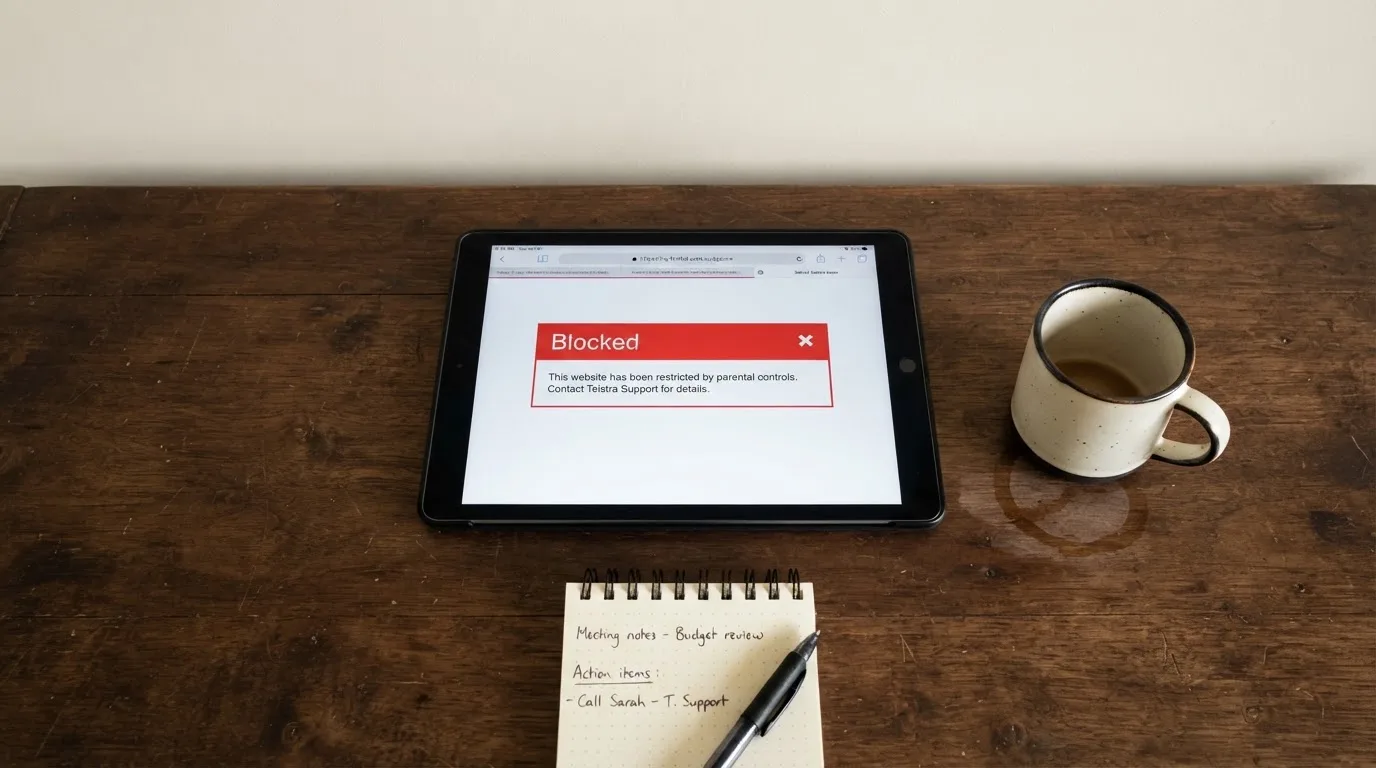
The ACMA’s job is to police the boundary. It investigates complaints, issues formal warnings and directs Australian internet service providers to block illegal sites. The individual player is not prosecuted; the IGA targets the provider. The practical consequence is that an offshore casino gives a player no Australian consumer protection, no complaints body and no recourse if a withdrawal is refused, and it can be blocked with a balance still on it. A player who loses a dispute with an offshore operator has nowhere to escalate except the regulator in whatever jurisdiction the operator claims to be licensed in, and those jurisdictions are not in the habit of refunding Australian balances.
BetStop, the National Self-Exclusion Register, has been live since August 2023 and binds Australian-licensed online and phone wagering services. An offshore casino is not connected to it, which means a Tasmanian who has self-excluded and then opens an offshore account has done the registry nothing — the offshore site has no obligation to honour the exclusion. The National Gambling Helpline on 1800 858 858 is free, 24 hours a day, with chat at Gambling Help Online, and it is the channel that works regardless of where the gambling happened. The minimum age for any gambling product in Australia is 18.
The 2026 reform is worth noting because it changes the rules the ACMA enforces. The Interactive Gambling Amendment (Gambling Reform) Bill 2026 passed Parliament on 19 August 2026. Its advertising and inducement measures commence on 1 January 2027. On a 2026 page, that is law with a start date, not yet in force. A reader who sees an advertising rule cited as live in 2026 has read a page that got its dates wrong.
Payout Percentage and the Comparison With Other Australian Cities
Tasmania does not publish a single state-wide payout percentage for pokies the way some mainland regulators do. The figure lives on each cabinet’s help screen, certified by the operator within a band set by the Tasmanian Liquor and Gaming Commission. A punter who wants the figure asks at the venue or reads the help screen.
The comparisons that do exist are useful in a different way. South Australia sets a minimum return-to-player of 87.5% on gaming machines outside Adelaide Casino, and a general maximum bet of A$5.00 outside the casino. Adelaide Casino itself has no maximum-bet limit, and it is the sole licensed casino in South Australia under the Casino Act 1997. South Australian gaming-machine losses outside Adelaide Casino totalled about A$0.92 billion in 2022-23, equivalent to roughly A$497 per adult. Adelaide Casino’s table-game monopoly in South Australia was extended to 30 June 2035 under a licence formalised on 11 October 2013, which also allows the casino to expand to up to 200 gaming tables and 1,500 gaming machines subject to redevelopment.
Queensland had 21,122 gaming machines operating in 351 venues in October 2023. Brisbane’s Treasury Casino, operated by Star Entertainment Group, closed on 25 August 2024 to make way for the new Star casino at Queen’s Wharf, which began a staged opening on 29 August 2024 at the A$3.6 billion Queen’s Wharf Brisbane precinct. Queen’s Wharf opened amid concerns about the licence position of its lead partner, Star Entertainment Group, after the Queensland Government found Star unsuitable to hold its Queensland casino licences in late 2022 and fined the group $100 million on 9 December 2022. The full context of that finding matters for any reader comparing Tasmanian casino regulation with Queensland: Tasmania’s two casinos run under the Gaming Control Act 1993, and the regulator is the Tasmanian Liquor and Gaming Commission, while Queensland’s casino regulator sits inside a much larger enforcement environment that has been visibly active in the last three years.
The right comparison a Tasmanian punter can make is between venues, not between states. Two licensed venues in the same state, with the same cabinet supplier and the same regulatory band, will sit on different payout settings because each operator certified its own cabinets at the upper or lower end of the band. The help screen on the cabinet is the only honest comparison, and a venue that posts the figure on its own floor signage is a venue that respects the question.
The Cashless Gaming Card and What It Costs a Punter
The cashless gaming card reform is the single biggest change to the Tasmanian pokies market in the last decade. The default loss limits — A$100 a day, A$500 a month and A$5,000 a year — are the same limits other states have run under their own cashless systems, and they are the limits a punter signs up to the moment the card is issued. A player who wants to raise the daily limit above A$100 has to wait at least 24 hours. That wait is the system’s behavioural brake, and it is the part of the reform the regulator is watching most closely.
A venue that runs the card cleanly takes seconds per transaction, applies the limit without complaint and posts the player’s balance on the screen when the card is inserted. A venue that treats the card as a hassle is the venue a punter should treat as a hassle. The reason this matters on a “best pokies” page is that the answer to “best” depends on whether the venue respects the system the regulator mandated, and that is a quality a player can judge at the first transaction.
There is one cost the cashless card imposes that the regulator does not advertise. A punter who used to walk in with a wallet full of notes and leave when the wallet was empty can no longer do that. The card needs to be topped up before play, and the top-up is a deliberate act the punter makes at the venue’s kiosk or desk. For a punter who plays short sessions, that is no change at all. For a punter who played long sessions across multiple visits, the card’s loss limit is the new ceiling, and the ceiling applies even when the punter thinks they are still under it. The system is built around a definition of “in control” that the punter’s own sense of the word may not match.
Where the Two Tasmanian Casinos Sit
Wrest Point sits on a waterfront site in Sandy Bay, Hobart, and opened on 10 February 1973 as Australia’s first legal casino. The gaming room runs late, the floors above it are hotel rooms, and the venue’s heritage position means the regulator has treated Wrest Point as the test case for every change in Tasmanian gaming law since the early 1970s. The Country Club Casino and Resort sits outside Launceston, opened by Federal Group in 1982 and designed in a Georgian style modelled on the stately homes of the American South. Federal Group, which originated as the Federal Coffee Palace Company Limited, founded in Melbourne in June 1885, relinquished its monopoly on electronic gaming machines outside its casinos in August 2017, and the Farrell family, which acquired majority ownership of its holding company by 1989 and privatised the group in 1990, retains Tasmanian family ownership. Mulawa Holdings, part of the Federal Group’s Tasmanian gambling licence structure, reported profit nearly doubling from A$13.9 million to A$24.4 million in the year to 30 June 2018, on revenue of A$543 million, while paying about A$75 million in gaming taxes and licence fees to the Tasmanian government.
Federal Group’s monopoly is the reason Tasmania’s licensed pub and club network looks the way it does. Until 2017, every pub and club machine in the state sat on a machine entitlement Federal Group held and sub-let. When the monopoly was relinquished, individual pubs and clubs took over their own entitlements, and the state moved from one corporate holder to several hundred smaller ones. The change did not add machines — Tasmania’s machine cap is set by the Gaming Control Act — but it changed which venues had a direct say over their own gaming rooms.
What “Best Payout” Actually Means in Practice
A venue’s “payout percentage” is a long-run average, not a guarantee for any single session. A punter who plays 100 spins at a venue that returns 90% will, on average, lose A$10. A punter who plays 1,000 spins at the same venue will, on average, lose A$100. The variance around that average is wider for smaller spin counts, which is why a session’s outcome rarely matches the average. The average is a statement about the venue’s machine settings, not a forecast of the next hour.
The right way to compare venues on payout is to ask which venue runs its machines at the upper end of the regulatory band, and which runs at the lower end. Two venues running the same cabinet model can sit at different points in the band because each certified its own machine. A venue that is willing to say what its setting is — on signage, in a printed player guide or in response to a direct question — is a venue that respects the question. A venue that will not say is a venue whose marketing is doing the talking for it.
The wider comparison with other Australian cities is useful at the regulatory level, not at the machine level. South Australia’s 87.5% minimum is the floor of the band; Tasmania’s minimum sits in the same range. A Tasmanian punter who travels to Adelaide Casino and sees the same cabinet running at a higher return will see the difference on the help screen, and the difference is small in percentage terms but visible over thousands of spins. The reason the difference matters is that it is the difference between a venue that chose the upper end of the band and a venue that did not.
Responsible Gambling in Tasmania
Gambling Helpline Tasmania runs on 1800 858 858, with free 24-hour phone counselling for anyone affected by gambling in Tasmania. The service is run by Anglicare Tasmania’s Gamblers Help Service and can help arrange venue self-exclusion. In-person counsellors are based in Hobart, Launceston, Devonport and Burnie. The National Gambling Helpline on the same number routes to the same service for Tasmanian callers, and Gambling Help Online provides the chat channel. The minimum age is 18, and any licensed venue in Tasmania is required to ask for identification before letting a punter onto the gaming floor.
A punter who wants to self-exclude from every licensed Tasmanian venue can do so through the Tasmanian Liquor and Gaming Commission’s exclusion scheme. The scheme applies to hotels, clubs and the two casinos, and the registration period is set by the punter. An offshore site is not connected to the scheme, which means a self-excluded Tasmanian who opens an offshore account is doing the registry nothing. The Tasmanian scheme also does not extend to venues outside the state, so a self-excluded Tasmanian who crosses to Melbourne can still enter a Victorian venue. The exclusion is venue-bound by design, and a punter who travels needs to extend the registration at the destination’s regulator if they want it to apply there.
The cashless card adds another channel. A punter can set a personal daily limit below the A$100 default, and that limit applies across every venue the punter plays in Tasmania. The punter does not have to tell the venue; the card does the work. A punter who has tried to cut back and failed has a system that will cut back for them, and the system is the same one the regulator designed for the player who could not design it themselves.
What the Numbers Mean for the Player
The ACMA’s blocking record is the part of the offshore market that a Tasmanian punter will meet first. The 1,751 figure across roughly six and a half years is the headline. The 230-plus unlicensed services that have left the Australian market under formal warnings is the figure that explains why an offshore site a punter opened last year may not exist this year. The A$3.9 billion a year Australians are estimated to lose to illegal gambling sites, with the share of gambling going through legal channels falling from 74% in 2021 to 64%, is the figure that explains why the regulator is pushing harder.
The licensed market sits inside a different arithmetic. Wrest Point and the Country Club paid Federal Group’s Tasmanian gambling licence structure about A$75 million in gaming taxes and licence fees in the year to 30 June 2018, which is roughly the scale the state expects. The two casinos’ machine counts are not published in the same way, and Tasmania’s venue-level machine count is not broken out to the same detail as South Australia’s 11,672 machines in 471 venues outside Adelaide Casino in September 2023, or Queensland’s 21,122 machines in 351 venues in October 2023. A Tasmanian who wants the count for the local pub reads the venue’s own signage and the Tasmanian Liquor and Gaming Commission’s published register.
The reason all of this matters on a “best pokies” page is that the question is not really about the machines. The question is about which venue a punter can trust to run the machines the way the regulator says they should, and the trust is built out of licence status, machine certification, cashless card compliance and self-exclusion responsiveness. A venue that scores well on all four is the venue a Tasmanian can return to next week. A venue that scores well on one and poorly on the others is the venue that will be in the regulator’s log sooner or later.
Frequently Asked Questions
Which venues in Tasmania are licensed to operate pokies?
Tasmania has two licensed casinos — Wrest Point in Hobart and the Country Club Casino and Resort in Launceston — and a separate network of hotels and clubs that hold their own machine entitlements under the Tasmanian Liquor and Gaming Commission. The full list of licensed venues sits on the Commission’s public register, and a venue not on that list is not licensed to run pokies in the state.
Are pokies in Tasmania available around the clock?
No. Tasmania does not licence any 24-hour pokies venue. The casino gaming rooms and licensed hotel and club gaming rooms close at state-mandated hours, with most pub and club gaming rooms closing between midnight and 2 a.m. on weeknights and extended hours on Friday and Saturday at the bigger Hobart and Launceston venues. A reader searching for “24-hour pokies Tasmania open now” is asking for a product the state does not provide, and the search returns offshore sites that brand themselves accordingly without being licensed here.
What identification do venues in Tasmania require before letting someone play pokies?
A licensed Tasmanian venue asks for identification before letting a punter onto the gaming floor. The minimum age is 18, and the venue is required to verify age before entry. Under the cashless gaming card system that began mandatory carded play in December 2025, the card itself becomes the identification at the machine, and the venue’s job is to issue the card against the ID. A venue that lets a punter onto the floor without checking ID is a venue acting outside its licence conditions.
Can visitors to Tasmania use self-exclusion schemes at local pokies venues?
A visitor can register a self-exclusion through the Tasmanian Liquor and Gaming Commission, and the registration applies to the venue the visitor names. A visitor who has already self-excluded in another state needs to extend the registration to Tasmania for it to apply here, because the Tasmanian scheme is venue-bound by design and does not automatically extend to venues outside the punter’s home state. An offshore casino is not connected to any Australian self-exclusion scheme, and a self-excluded visitor who opens an offshore account has done the registry nothing.
How does the payout percentage on Tasmania pokies compare with other Australian cities?
The comparison a Tasmanian punter can make honestly is between venues, not between states, because Tasmania does not publish a single state-wide payout figure the way some mainland regulators do. The figure lives on each cabinet’s help screen, certified by the operator within a band set by the Tasmanian Liquor and Gaming Commission. South Australia sets a minimum return-to-player of 87.5% on gaming machines outside Adelaide Casino, and Tasmania’s minimum sits in the same range. A punter who wants to compare venues reads the help screen on the cabinet, which is the only honest comparison available.
Is it legal for an online casino to advertise “pokies” in Tasmania the same way a pub or club does?
No. The Interactive Gambling Act 2001 makes it an offence to provide online casino games or online pokies to a person physically in Australia, and no state or territory issues a licence for them. An offshore casino that markets itself with “Tasmania pokies” or “Tasmania 24-hour pokies” is offering a prohibited interactive gambling service, and the ACMA has issued formal warnings to the operators behind many of those brands. The Interactive Gambling Amendment (Gambling Reform) Bill 2026 passed Parliament on 19 August 2026 and tightens the advertising rules from 1 January 2027, but on a 2026 page the existing prohibition is the rule that applies.