
Best progressive jackpot slots 2026: what the rising prize pool really costs an Australian player
A progressive jackpot slot is a slot machine whose top prize is not fixed at the factory — it climbs with every losing spin until somebody wins it, then resets and starts climbing again. The appeal is obvious: a single spin can pay a sum that dwarfs anything a non-progressive slot offers, and that is why offshore casino sites plaster the figure across their homepages. What those sites tend not to advertise is the other side of the same coin — a lower base return-to-player than a fixed-jackpot game, a pool that grows because every other player is paying into it, and, for an Australian reader, the fact that no online casino game, progressive jackpot or otherwise, can be licensed onshore. The offshore site offering the jackpot is operating outside Australian law, and the Australian Communications and Media Authority (ACMA) has spent the last several years issuing formal warnings to the operators behind those very brands.
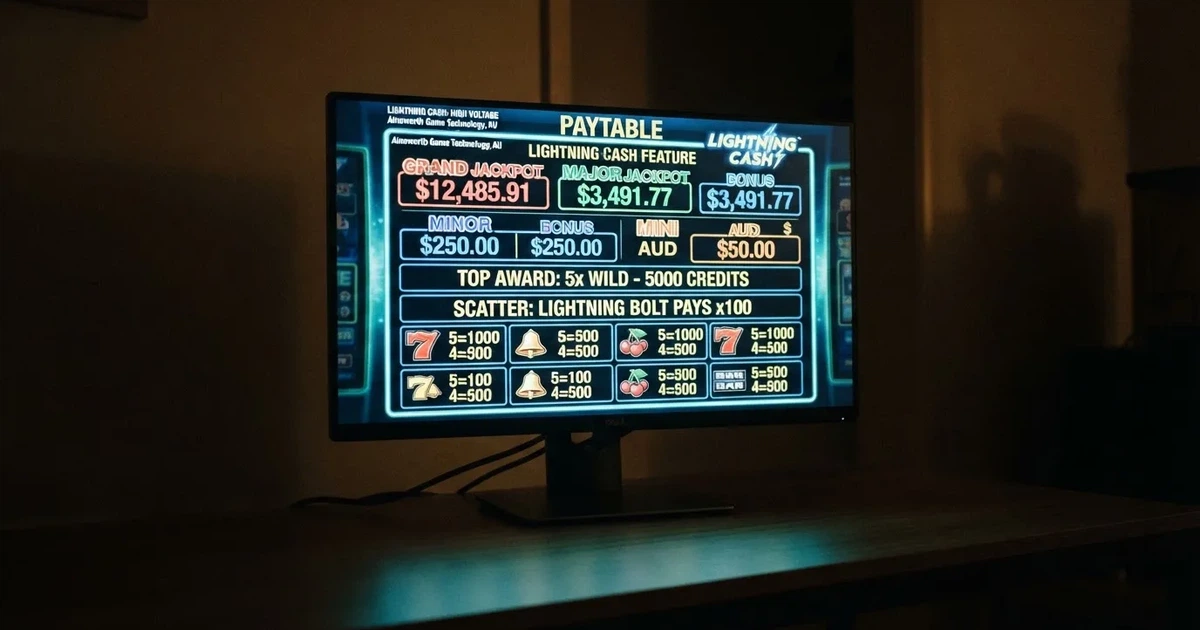
This page goes through what a progressive jackpot actually is, why Australian players cannot legally access one through a licensed Australian venue online, what the offshore alternative looks like in 2026, and what the ACMA’s enforcement record says about the operators behind the brands advertising these jackpots. The aim is to give a reader enough to compare the marketing to the mechanism — and to understand what the regulator has already concluded about the sites that take the deposits.
Data current as of 29 October 2026, checked against the ACMA’s register of formal warnings and blocking actions.
Table of Contents
- How progressive jackpots work, and why the headline figure is misleading
- What an Australian player can and cannot access
- The ACMA’s enforcement record, and what it implies for “best” lists
- Cost to the player: what the offshore site actually charges
- How to read a “best” shortlist without being sold to
- The math behind the headline: how fast the ACMA has been blocking
- Responsible gambling around progressive jackpots
- What an Australian player is actually choosing between
- Frequently asked questions
How progressive jackpots work, and why the headline figure is misleading
A progressive jackpot slot works like any other slot machine on the base game, with one structural difference: a defined slice of every losing wager is siphoned off into a separate prize pool. The pool rises spin by spin, sometimes for weeks or months at a time, until somebody hits the qualifying combination or triggers the jackpot round. At that point the pool pays out, the machine resets to a predetermined minimum seed value, and the climbing begins again.

The headline figure a player sees on the homepage is therefore not what the average spin returns. It is the ceiling — the sum one player will eventually collect after thousands of other players have fed the meter. Casinos fund the growth out of a portion of their profit margin, and that portion comes out of the player’s wager. The trade-off is mechanical: a slot that returns 88% on the base game but routes 4% of every spin into a growing pool is paying out 92% in total, with most of that 92% concentrated in a single event the player may never see.
Three structural types matter to a player comparing offers.
- Standalone progressive. The pool belongs to one machine in one venue (or, online, to one virtual machine on one site). It climbs slowly, pays out small relative to network games, and is the easiest to understand mechanically.
- Linked or in-house progressive. Several machines on one site or venue share a pool. Climbs faster, pays out more often, still bounded to one operator.
- Wide-area network progressive. Machines across many operators — sometimes across many countries — feed a single pool. This is the category that produces the eight-figure payouts. Microgaming’s Mega Moolah, now distributed by Games Global, sits in this group, and the record online slot jackpot of €19,430,723.60 was won on 27 April 2021 by a Belgian player at Napoleon Sports & Casino on Absolootly Mad: Mega Moolah. Later Mega Moolah wins of £11.5 million and 13.5 million have been announced by Games Global.
The wider the network, the faster the meter climbs, and the smaller the share of every wager that stays in the player’s pocket. That is the deal the headline figure is offering.
The “must-hit-by” variant
Some progressive jackpots use a mystery-jackpot structure called a must-hit-by. Instead of waiting for a symbol combination, a random number generator picks the payout amount within a preset range (for example $1,000–$3,000) immediately after the previous jackpot is won. The meter then ticks upward toward a ceiling, and the prize must be awarded before that ceiling is reached. The attraction for the player is that the trigger is not a specific reel outcome — every spin is, in principle, eligible. The cost is that the preset range is the actual ceiling, and the meter is calibrated so the average payout falls inside it.
Why the base RTP sits below a fixed-jackpot slot
A fixed-jackpot slot pays its top prize at a stated frequency on a stated paytable, and the game’s overall return-to-player is the average of all those outcomes. A progressive slot pays its top prize far less often — sometimes not for months — and a defined slice of every wager is reserved for that one eventual payout. The base game’s RTP therefore sits below a comparable fixed-jackpot game, and the progressive component makes up the difference. The total RTP is competitive; the distribution of it is heavily skewed toward a single event.
In some progressive games the prize pool can climb high enough to push the theoretical return above 100%, turning the bet into a positive-expectation proposition. That break-even point is reachable in certain video poker and Caribbean Stud variants, but is hard to calculate for slot machines because the reel layouts are not published — a player cannot compute the precise threshold without information the operator holds.
What an Australian player can and cannot access
The legal picture in Australia is straightforward, and it shapes what the rest of this page can honestly say about any “best progressive jackpot slots 2026” shortlist.
Online casino games are prohibited under the IGA
The Interactive Gambling Act 2001 (IGA), strengthened by the Interactive Gambling Amendment Act 2017, makes it an offence to provide online casino games, online pokies or in-play betting to a person physically in Australia. No state or territory licenses them. What is licensable is wagering on races and sport placed before the event, lotteries and keno — in practice licensed by the Northern Territory through the Northern Territory Racing and Wagering Commission (NTRWC), which oversees 52 of Australia’s online bookmakers including Sportsbet, Bet365 and Ladbrokes. The NTRWC has no full-time staff and meets once a month in Darwin, which is itself a telling feature of how lightly regulated the licensable slice of the market is.
The minimum age is 18. The IGA targets the provider, not the individual player — placing a bet with an offshore site is not itself a criminal offence. What the IGA does mean is that any offshore casino site offering progressive jackpot slots to an Australian player is offering a prohibited service, and the operator behind it is exposed to ACMA enforcement.
What is licensed onshore, and what that means for progressives
The Australian venues that operate slot machines under state and territory licences — clubs, hotels and the two casino floors (Crown Melbourne and The Star Sydney) — run fixed-jackpot machines. A small number of linked progressives exist within the licensing footprint of a single venue or a single state, but the eight-figure wide-area networks that produce the Mega Moolah-scale payouts are online-only products run by offshore operators. A licensed Australian venue does not host a wide-area progressive slot of that scale.
In other words: a reader searching for “progressive jackpot slots” in 2026 and expecting to find a licensed Australian option is searching for a product that, in the wide-area sense, does not exist onshore.
The offshore alternative, and the protections it does not carry
An Australian who opens an account with an offshore casino site is playing on an unregulated product, even if the site displays a Curaçao or other overseas licence. The licence the site advertises is not an Australian one; the operator is not bound by the IGA, by BetStop, by the Australian consumer protection regime, or by the Australian Payments rule that banned credit cards and crypto as deposit methods for licensed wagering from 11 June 2024 (penalties up to $247,500 for licensed operators who breach it). If a withdrawal stalls, the player’s recourse is whatever dispute mechanism the operator’s home regulator provides — and ACMA enforcement has, over the last several years, repeatedly found that the operators behind the most heavily advertised offshore brands are willing to keep offering prohibited services after being told to stop.
The ACMA’s enforcement record, and what it implies for “best” lists
A “best progressive jackpot slots 2026” shortlist is, in practice, a list of games hosted by offshore casino sites — sites that are themselves the subject of ACMA formal warnings or blocking actions. The reader is owed that context before any game title or payout figure is discussed.
Blocking actions and the running total
By June 2026 the ACMA had asked Australian internet service providers to block a running total of 1,751 illegal gambling and affiliate marketing websites since the first blocking request in November 2019. More than 230 unlicensed gambling services had left the Australian market since enforcement was strengthened in 2017. In a single round reported on 26 June 2026 the ACMA asked ISPs to block 12 more sites: 7Signs, ChromaBet, Donbet, Duospin, Freshbet, Slots Gem, Jacks Club, Lucky Start, Pointsbetz.com, Spinrise, Vinyl Casino and Wildsino.
The arithmetic the ACMA’s record puts on the table is the central calculation for a reader. Taking the first blocking request as November 2019 and the reported running total as 1,751 blocked sites by June 2026 — roughly 79 months of operation — the average blocking rate sits in a band of roughly 22 blocked sites per month over the life of the regime, with the actual month-to-month figure swinging sharply between quiet months and rounds of a dozen or more. The figure is best read as an order of magnitude rather than a precise monthly rate: enforcement has not produced a steady stream, and any month where the ACMA publishes a new blocking round pushes the trailing average up while quiet months leave it unchanged.
Formal warnings to operators behind the brands
Alongside blocking actions, the ACMA issues formal warnings to the operators behind offshore brands. The warnings are public, named and dated. The set of operators the ACMA has warned in recent years overlaps heavily with the brands that dominate “best progressive jackpot slots” affiliate marketing.
| Brand | ACMA action and date | Operator named by the ACMA | Subject support |
|---|---|---|---|
| RocketPlay | Formal warning, March 2026 | Pulsup Ltd (Rocketplay.com.au); earlier Dama N.V. warning, May 2022 | — |
| Level Up Casino | Formal warning, May 2022 | Dama N.V. | listings-only |
| Woo Casino | Formal warning, March 2025 | Dama N.V. | — |
| Spirit Casino | Formal warning, May 2025 | Dama N.V. | — |
| National Casino | Formal warning, July 2025 | Consolutetish S.R.L. | listings-only |
| Bizzo Casino | Formal warning, July 2025; earlier 2022 warning to TechSolutions | Consolutetish S.R.L. | — |
| Ignition Casino | Formal warning, July 2025 | Bamboo Media | — |
| Instant Casino | Formal warning, February 2025 | EOD Code SRL | — |
| Jackbit | Formal warning, April 2026 | Ryker B.V. | — |
| Casino Intense | Formal warning, April 2025 | Sterplay Holding Ltd | listings-only |
| Sky Crown | Formal warning, September 2022 | Hollycorn N.V. | — |
The “Subject support” column reflects what third-party listings say about progressive-jackpot content on these brands — for Level Up Casino, National Casino and Casino Intense, listings report progressive-jackpot content; for the others, nothing in the consulted set establishes the subject one way or the other. Either way, the ACMA action is the relevant column for an Australian reader: the operator behind the brand has been formally warned for offering prohibited services to people in Australia.
The pattern is the point. Dama N.V. has been warned repeatedly — Level Up Casino and other Dama brands in May 2022, then Woo Casino in March 2025 and Spirit Casino in May 2025. TechSolutions was warned over Bizzo Casino in 2022; Consolutetish S.R.L. was warned over the same brand in July 2025. Operators change names; the brands reappear under new parent companies. From a reader’s perspective the brand on the homepage is a thin wrapper around the same proposition the ACMA has already assessed.
What the warnings imply
A formal warning is not a blocking action — the ACMA uses both tools, and the difference matters. A blocking action asks ISPs to make the site unreachable from an Australian IP. A formal warning puts the operator on notice that the service is prohibited; a continuing breach can move the ACMA toward civil penalties or a blocking action. Several of the brands above were warned once and then warned again under a new operator — Woo Casino and Spirit Casino under Dama N.V., Rocketplay under Pulsup Ltd after the 2022 Dama N.V. warning, Bizzo Casino under Consolutetish S.R.L. after the 2022 TechSolutions warning. The pattern is one of rebranding rather than withdrawal.
Cost to the player: what the offshore site actually charges
The marketing on these sites plays up the prize pool and plays down what feeds it. Three cost lines matter to an Australian reader who ends up on one of these sites regardless.
The base RTP is lower than a fixed-jackpot game
A wide-area progressive slot pays back a smaller share of every wager through the base game than a comparable fixed-jackpot slot of the same theme and volatility. The slice that goes into the pool is the slice the base game is not paying out. The total return is competitive; the distribution is heavily skewed. A player who plans to play 200 spins on a session is, in expectation, paying for the chance at an event that almost certainly will not arrive in those 200 spins.
Payment rules the Australian regime does not apply offshore
For licensed Australian wagering, credit cards, credit-related products and digital currency have been banned as deposit methods since 11 June 2024. Legal deposit routes for licensed wagering are debit card, bank transfer, PayID/Osko and BPAY. Offshore sites are not bound by this rule. The same site that has been formally warned by the ACMA for offering prohibited services will frequently accept a credit card deposit or a crypto transfer without flinching — the rule applies only to operators licensed in Australia, and an offshore operator is not one. A deposit that would be unlawful for a licensed Australian bookmaker is, on an offshore casino site, simply a deposit.
No Australian consumer protection
BetStop, the National Self-Exclusion Register, has been live since August 2023 and binds Australian-licensed online and phone wagering services. An offshore casino site is not connected to it — a player who has self-excluded through BetStop and then opens an account with an offshore operator has, in practice, self-excluded only from the licensed side of the market. There is no Australian complaints body, no Australian regulator to appeal to if a withdrawal stalls, and no guarantee the balance is recoverable if the site is blocked. The ACMA has blocked 1,751 sites since November 2019; a balance sitting on a site that gets blocked in the next round is a balance the player may not see again.
Help is still available
Player protection does not depend on which site someone is using. The National Gambling Helpline (1800 858 858) is free and operates 24/7, with chat support through Gambling Help Online. These services are Australian, confidential and available regardless of where the play is happening.
How to read a “best” shortlist without being sold to
A shortlist of progressive jackpot slots is, mechanically, a list of games hosted by offshore casino sites. The sites themselves are operating outside Australian law, and the ACMA has formal-warned the operators behind most of them. A reader looking at such a list is owed a framework for sorting the marketing from the mechanism.
What the list can honestly tell a reader
- Which sites the ACMA has acted against, and when. That is the relevant column for an Australian reader.
- Which network the jackpot sits on — standalone, in-house linked, or wide-area. The wider the network, the smaller the share of every wager that stays in the player’s pocket.
- Whether the site accepts payment methods the Australian regime has banned for licensed operators. That is a signal, not a proof.
What the list cannot honestly tell a reader
- That any one site is a safer place to play than another. They are all offshore; the protections an Australian licence confers do not apply.
- That a specific progressive payout is likely on any given session. The base RTP is lower than a comparable fixed-jackpot game; the pool climbs because other players are paying into it.
- That the operator behind the brand will be reachable for a complaint if something goes wrong.
What to do with the bonus terms
Affiliate marketing for these sites usually attaches a deposit bonus, free spins or a “voucher code” to the brand. The page does not carry those terms, and the reader should treat any such offer with the same scepticism they would treat any marketing claim that the prize pool alone does not support. The offer exists to move the deposit; the math on the wagering requirement, the maximum cashout and the eligible games is where the cost is actually set out, and it is set out in terms pages the player reads after signing up, not on the homepage.
The math behind the headline: how fast the ACMA has been blocking
The ACMA’s enforcement record gives a reader a concrete answer to a question the marketing never asks: how sustainable is the offshore site offering this jackpot from Australia? The arithmetic is on the record.
Inputs
- Running total of blocked sites reported in June 2026: 1,751.
- Date of the first blocking request: November 2019.
Result
Over the approximately 79 months from November 2019 to June 2026, the average rate of blocked sites is roughly 22 per month. The figure is a trailing average over the whole period; the actual month-to-month rate swings sharply between quiet months and rounds like the 12-site round reported on 26 June 2026. Stated as a band: somewhere between a handful per month in quiet periods and a dozen or more in active rounds, against a long-run average in the low twenties.
Key assumption
The 1,751 figure is the cumulative count the ACMA reports, not a monthly flow. A reader who interprets it as “22 new blocks every month” is over-reading — most months see fewer, some months see more. The right reading is “this regime has been running long enough, and hard enough, that 1,751 sites have been blocked since it began; the cadence has been irregular but persistent.”
What the rate implies for an offshore site
A site offering progressive jackpot slots to Australian players is offering a prohibited service. The probability that a particular site will be the subject of a future ACMA action is not zero, and a site that has already been formally warned — as every brand in the table above has — has a regulator-attested record of having offered the prohibited service. The trailing blocking rate does not single out any one site, but it does describe the regime the operator is sitting inside.
Responsible gambling around progressive jackpots
The mechanics of a progressive jackpot slot make it a product that benefits disproportionately from extended play. The base RTP is lower, the prize is concentrated in a single event, and the longer the session, the more the player has paid into the pool. That is the structural shape of the product, and it is why responsible-gaming safeguards matter more here than on a fixed-jackpot game of comparable theme.
Player-controlled safeguards
- Deposit limits, time-out reminders and self-exclusion are universal on licensed Australian wagering sites, and BetStop binds them across the licensed Australian market. None of these tools apply to an offshore casino site.
- The National Gambling Helpline (1800 858 858) is free, 24/7, and the chat service at Gambling Help Online is staffed by Australian counsellors. These services are available regardless of where the play is happening.
- A player who has signed up to BetStop and is also playing offshore is, in practice, only self-excluded from the licensed side. Closing the offshore account is a separate step and a necessary one if the intent is to stop.
What to watch for in the marketing
A progressive jackpot slot is sold on the size of the pool. The size of the pool is paid for by every player who does not win it. The base game’s RTP is the more honest number, and it is the one the marketing tends to leave out.
What an Australian player is actually choosing between
Stripped of the marketing, the choice an Australian reader is making is between:
- A licensed Australian venue — clubs, hotels, Crown Melbourne or The Star Sydney — offering fixed-jackpot machines under state or territory regulation, with Australian consumer protection, BetStop coverage and payment rules that prohibit credit cards and crypto. Progressive jackpot machines exist within this footprint but are bounded to the venue or the state, and the wide-area networks that produce the eight-figure payouts are not available through this route.
- An offshore casino site offering the wide-area progressive jackpots, operating outside the IGA, with the ACMA’s enforcement record as context. The brand is one the ACMA has acted against in most cases; the payment routes include credit cards and crypto; the consumer protection regime is whatever the operator’s home regulator provides, which is not Australian.
The reader is not choosing between two products of comparable standing. They are choosing between a licensed product with limited progressive availability and an unlicensed product that exists because the licensed product is prohibited from offering the wider networks. The headline figure the unlicensed product advertises is paid for by a base RTP the marketing tends not to mention, and the operator behind it has, in most cases, already been formally warned by the regulator for offering the service in the first place.
Frequently asked questions
How does a progressive jackpot slot’s prize pool actually grow between wins?
A defined slice of every losing wager is siphoned into a separate pool. The pool rises spin by spin until the jackpot triggers, then pays out, resets to a predetermined minimum seed and starts climbing again. The slice comes out of the player’s wager and out of the base game’s return-to-player, which is why progressive games typically sit below comparable fixed-jackpot slots on the base RTP.
What’s the difference between a standalone jackpot and a network-wide progressive jackpot?
A standalone jackpot belongs to one machine (or, online, to one virtual machine on one site) and climbs slowly. A network-wide progressive links machines across many operators — sometimes across many countries — into a single pool, which is the category that produces the eight-figure payouts. Microgaming’s Mega Moolah, now distributed by Games Global, sits in the network-wide group; the record online slot jackpot of €19,430,723.60 was won on Absolootly Mad: Mega Moolah at Napoleon Sports & Casino in Belgium on 27 April 2021.
Do licensed Australian pokies venues offer progressive jackpot machines?
Licensed Australian venues — clubs, hotels and the casino floors at Crown Melbourne and The Star Sydney — operate fixed-jackpot machines and a small number of in-house linked progressives bounded to the venue or the state. The wide-area network progressives that produce eight-figure payouts are online-only products run by offshore operators, and no state or territory licenses online casino games or online pokies.
Why do progressive jackpot slots typically have a lower base return-to-player than fixed-jackpot games?
Because a slice of every wager is reserved for the jackpot pool rather than paid out through the base paytable. The total RTP can be competitive, but the distribution is heavily skewed toward a single event, and the base game’s share is correspondingly smaller.
How is a record progressive jackpot payout verified?
Major wins on the wide-area networks are reported by the operator hosting the game and the platform distributing it, and the figures are carried by trade outlets such as gamingintelligence.com and europeangaming.eu. Games Global, which now distributes Mega Moolah, has announced later wins of £11.5 million and 13.5 million. Verification in the regulatory sense — independent audit of the triggering event — sits with the operator’s home regulator, which for these products is not an Australian one.
What triggers the jackpot round on a typical progressive jackpot slot?
Most progressive jackpots are triggered by landing a specific combination of symbols on a qualifying spin. Some games use a “must-hit-by” structure where the trigger is not a symbol combination but a random number generator: the payout amount is picked from a preset range (for example $1,000–$3,000) immediately after the previous jackpot is won, and the prize must be awarded before a published ceiling. Every spin is in principle eligible; the meter is calibrated so the average payout falls inside the range.