
Casino sites that accept Trustly in Australia: what the listings miss
The right answer to this search is uncomfortable and it does not fit the listings. No online casino operating offshore is allowed to take a real-money bet from a person physically in Australia, regardless of which deposit method the cashier advertises, and the Australian Communications and Media Authority has spent several years quietly turning that prohibition into blocked domains, formal warnings, and operator exits. Trustly is a perfectly real payment rail with a perfectly real European footprint, but its presence in a casino’s banking page tells a reader in Australia nothing about legality, recourse, or whether the site will still be reachable by the time they want to withdraw.

Data current as of 29 October 2026. Operator and licence claims checked against the ACMA’s published register of formal warnings and blocking requests.
Table of Contents
- Settlements and shortcuts: how offshore Trustly casinos actually present themselves
- The legal frame: why the ACMA list is the list
- Player protection: where BetStop ends and offshore begins
- Payments: what Trustly at an offshore cashier actually does
- A landscape that is not a ranking: brands the ACMA has warned
- The cost of the chase: a closing arithmetic on what an offshore cashier actually delivers
- What an Australian reader can actually use
- Frequently asked questions
Settlements and shortcuts: how offshore Trustly casinos actually present themselves
Walk into any affiliate-driven “top Trustly casino” listicle and the picture looks orderly. Eleven offshore brands, an EU licence badge apiece, a deposit column showing Trustly alongside Visa and a handful of crypto coins, a withdrawal time framed in hours rather than days. The framing depends on a sleight of hand that this page is written to undo: it treats payment-method availability as the answer, when the actual answer is who is allowed to serve whom.
Trustly’s own footprint is global. The company holds authorisation from Sweden’s Financial Supervisory Authority for the EU and EEA, and a separate licence from the UK Financial Conduct Authority. Its network reaches 12,000 banks and roughly 650 million consumers across more than 20 European countries — the UK, Norway, Spain, Austria, Finland, the Netherlands, Ireland, Croatia, Germany and Malta among them — and the firm processed about $58 billion of transaction volume on roughly $265 million of 2023 revenue. Pay N Play, the gambling-specific product launched in 2016, was supported by more than 200 gaming brands within six years, and ownership history (Nordic Capital took 70% in 2018, the planned 2021 Nasdaq Stockholm listing valued Trustly near $11 billion) explains why gaming is so visibly a priority product. None of those numbers, however, is in the Australian banking rails.
The reason is straightforward and not a quirk of Trustly’s compliance team. Trustly’s Australian-facing product page addresses the US market. In Australia, the equivalent of what Trustly does in Europe — instant bank-to-bank settlement under the account holder’s verified name — is delivered by PayID and Osko, on top of the New Payments Platform that went public on 13 February 2018 and is now run by a single consolidated entity, Australian Payments Plus. Over 100 Australian institutions participate in PayID, more than 25 million PayID identifiers had been registered by April 2025, and an Osko transfer between participating banks arrives in under a minute around the clock. None of that infrastructure talks to a Curaçao- or Costa Rica-licensed casino cashier. The cashier pages of the brands reviewed here either list Trustly by reflex, because it is the default European instant-bank option, or they list it because the affiliate the page is sourced from was paid per click. Either way the listing is real; what it leaves out is the part that matters.
That part starts with the Interactive Gambling Act 2001 and runs through every other section of this page.
The legal frame: why the ACMA list is the list
| Measure | Statistic | Context |
|---|---|---|
| Illegal sites blocked | 1,751 | Since Nov 2019 |
| Unlicensed services exited | >230 | Since 2017 enforcement |
| Illegal gambling losses | A$3.9 billion | 2025 estimate |
Australian-licensed operators may take bets only on races, sport (pre-event), lotteries and keno. Online casino games and online pokies cannot be licensed in any state or territory. The Interactive Gambling Act 2001, strengthened by the 2017 amendments, makes the supply of those games to a person in Australia an offence. It targets the provider, not the punter, but the practical effect for anyone trying to use one of these brands is the same: no Australian regulator behind the cashier, no Australian complaints body on the other end of a refused withdrawal, no Australian court to complain to if a balance is held. The site is reachable until it is not.
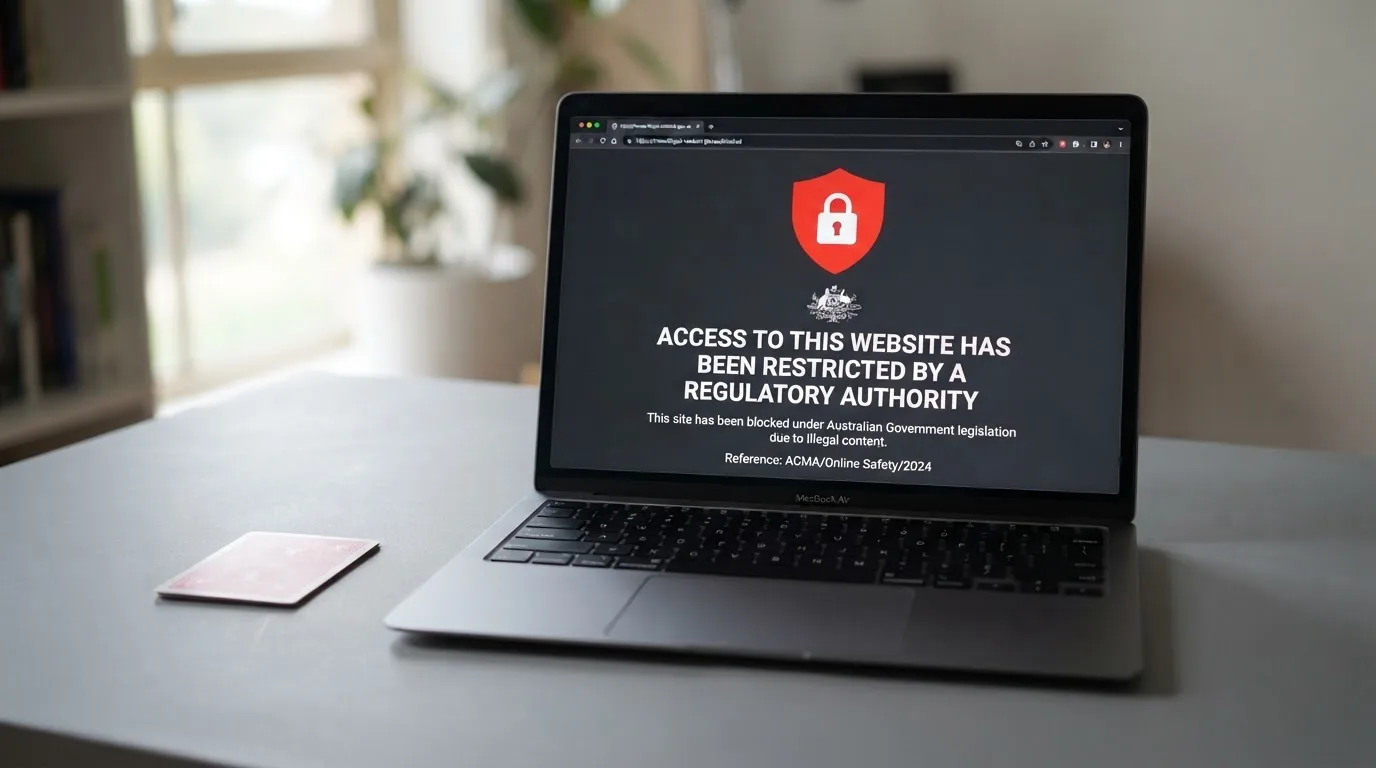
Enforcement has been methodical and is well documented. The ACMA had asked Australian internet service providers to block 1,751 illegal gambling and affiliate sites by June 2026, the first such request having gone out in November 2019, and more than 230 unlicensed services had left the Australian market since enforcement was strengthened in 2017. A blocking round alone, reported on 26 June 2026, added another twelve domains — 7Signs, ChromaBet, Donbet, Duospin, Freshbet, Slots Gem, Jacks Club, Lucky Start, Pointsbetz, Spinrise, Vinyl Casino and Wildsino — to the cumulative count. H2 Gambling Capital’s 2025 estimate puts Australian losses to illegal gambling at roughly A$3.9 billion a year, with the share of gambling going through legal channels falling from 74% in 2021 to 64%.
Beneath the blocking totals sits a quieter stream of formal warnings, one per operator, dated and named. In May 2022 the ACMA warned Dama N.V. over six brands: Bambet, Dazard, Level Up, Rocketplay, Wild Tornado and Cobra Casinos. The same operator was warned again in March 2025 over Woo Casino, then in May 2025 over Spirit Casino. July 2025 brought two more: Bamboo Media over Ignition Casino and Consolutetish S.R.L. over National Casino and Bizzo Casino, with Bizzo already the subject of an earlier warning in 2022 to TechSolutions (CY) Group Limited and TechSolutions Group N.V. February 2025 added EOD Code SRL over Instant Casino; April 2025 added Sterplay Holding Ltd over Casino Intense; September 2022 added Hollycorn N.V. over Sky Crown and Blue Leo; April 2026 added Ryker B.V. over Jackbit and CasinOK. Most recently, in March 2026, the ACMA warned Pulsup Ltd over Rocketplay.
The point of the warning list is not that every operator on it is gone — most still load in Australia at the time of writing — but that the ACMA, by name, has told each one to stop offering prohibited services to Australians. Anyone who has put a real balance into one of these brands after the named date is, by the regulator’s own record, on a site that has been put on notice.
What the offshore “licence” actually means
Every brand on the page below carries an EU or Caribbean licence badge. They are real licences, granted by real authorities — typically Curaçao, sometimes Anjouan, occasionally Malta — and the brands operate to those jurisdictions’ rules. What the badge does not cover is service to an Australian resident. A Curaçao sub-licence does not authorise an operator to take Australian traffic; it authorises an operator to take traffic from jurisdictions whose own law permits that traffic to be taken. Australia is not one of those jurisdictions. Treating the licence badge as a green light for an Australian player reads the licence for the jurisdiction it was issued in, not the one the player is sitting in.
The Northern Territory Racing and Wagering Commission (NTRWC) is the closest thing Australia has to a federal online-gambling regulator, and even that role is narrow. It licenses 52 of Australia’s online bookmakers — including Sportsbet, Bet365 and Ladbrokes — for tax reasons, not because sports betting is the regulator’s policy choice. The commission has no full-time staff and meets once a month in Darwin. Its remit covers wagering only. Casino games are outside it, in every state and territory.
Player protection: where BetStop ends and offshore begins
The Australian consumer protection stack is real and well built, and it stops precisely at the border of an offshore casino. BetStop, the National Self-Exclusion Register, went live in August 2023 and binds every Australian-licensed online and phone wagering service. Exclusion periods start at three months and run permanently. A punter who has self-excluded through BetStop cannot reach a Sportsbet account or a Ladbrokes account from a re-verified Australian identity.
The same punter, on the same day, can open an account at any of the eleven brands covered below, deposit with whatever payment method the cashier offers, and lose money with no recourse to an Australian body. Offshore casinos are not connected to BetStop. They are not required to honour an Australian self-exclusion. The exclusion lives where it was registered, and only there. Anyone who has gone through the trouble of registering a BetStop exclusion should understand that the protection does not travel.
For anyone who has not, the National Gambling Helpline on 1800 858 858 is free, runs 24/7, and offers a chat channel through Gambling Help Online. Both are Australian services for Australian residents. Neither has a relationship with an offshore casino, and neither can recover a balance from one.
Payment-side blocks the player can use
The banks have built parallel protection, and it works at the merchant-category level rather than the site level. Westpac’s gambling block refuses authorisation of any transaction registered under the merchant category code for betting and casino gambling on eligible personal credit and debit cards. ANZ’s gambling block, set up in the ANZ app, blocks gambling transactions made through a digital wallet such as Apple Pay on an eligible card — not only on the physical card. Removing the ANZ block requires a 48-hour cooling-off period, a deliberate friction the bank built in.
The blocks are imperfect. ANZ warns that not all gambling transactions will be blocked and that some non-gambling transactions might be blocked in error. The merchant category code the blocks look for is set by the merchant’s acquiring bank, and offshore sites that route their acquiring through intermediaries are harder to catch. What the blocks reliably do is stop a chunk of attempts to deposit, which is enough to be worth turning on for anyone who wants friction before they reach for the cashier.
For the licensed side of the Australian market, payment is governed by the 2023 amendments to the IGA and the rules that took effect on 11 June 2024. Australian-licensed online wagering services cannot accept credit cards, credit-related products or digital currency; the penalty for an operator that does is up to $247,500. The legal deposit rails at a licensed bookmaker are debit card, bank transfer, PayID and Osko, and BPAY. A site asking an Australian for a credit card or for a crypto deposit is, by definition, not running under Australian rules.
Payments: what Trustly at an offshore cashier actually does
For an Australian resident, depositing at an offshore Trustly-accepting casino means one of three things, in order of how often they happen. The first is that the cashier lists Trustly, the player does not have a European bank account, and the deposit simply does not go through. Trustly’s network is European banks; an Australian bank account is not on it. The second is that the player has a European bank account in a participating institution, the deposit clears through Trustly’s EU authorisation, and the wagering then happens under the Interactive Gambling Act 2001 from the player’s Australian end of the connection. The third is that the site lists Trustly because the affiliate template demanded it, and the cashier actually offers POLi, MiFinity, a handful of crypto coins, and a Visa deposit routed through a high-fee processing chain.
The first and the third are common; the second is the only case in which “Trustly at an offshore casino” is, strictly, what it claims to be. None of the three cases changes the legal exposure of the player, which is identical in each. The card and the wallet transactions are caught by the bank-side gambling blocks more often than the bank-transfer path is, and that is the only behavioural difference the payment rail itself introduces.
Withdrawals follow the same shape, with one extra delay. A Trustly withdrawal request at an offshore casino still has to clear the casino’s own internal review, which is the rate-limiting step on every payout regardless of payment method. The site’s terms typically set the first withdrawal at a longer review window than subsequent ones, and the first withdrawal is also where most KYC escalations happen. The 24/7 instant-bank premise that sells the European product — a Pay N Play brand like a European punter would recognise — applies only on the operator side that has nothing to verify, which is not the situation of an Australian punter funding from an account that is not in the EU authorisation perimeter.
PayID’s equivalent warning, written into the PayID operator’s own consumer materials, makes the legal picture precise. The page for paying to a PayID shows the name of the account holder before the transfer is sent, and AP+ warns that being asked to transfer money to a PayID on an illegal gambling site almost certainly means a scam site. The mechanism it warns about — the funds-request scam built on instant settlement and a verified name — does not require a Trustly integration to operate. It operates wherever instant bank-to-bank settlement meets an unlicensed counterparty, which is the entire offshore Trustly market for an Australian resident.
The blocking-rate picture in one line
The arithmetic that this page offers as its one new piece of information is simple and the inputs are public. The ACMA’s first blocking request went out in November 2019. By June 2026 the cumulative count of blocked illegal gambling and affiliate sites was 1,751. That works out to roughly 26 to 27 sites blocked per month across the seven years of the regime, with the rate climbing as the rounds have got larger and the operator pool has narrowed. The rate is a statement about the regulator’s output, not about a player’s deposit; what it tells a reader is that the median life of a domain on the ACMA’s working list is short, and that an offshore casino reachable today is not a guarantee of one reachable next year.
A landscape that is not a ranking: brands the ACMA has warned
What follows is not a ranking. None of the brands below may lawfully serve an Australian resident, every one of them has been the subject of a formal ACMA warning under the Interactive Gambling Act 2001, and the only honest reason to list them at all is so a reader who is already on the cashier page of one of them has a chance to read the regulator’s own record before depositing. The order follows the chronology of the ACMA’s actions, not the marketing reach of any one brand.
| Brand | ACMA action and date | Operator named by the ACMA | Trustly support |
|---|---|---|---|
| Sky Crown | Formal warning, September 2022 | Hollycorn N.V. | — |
| Level Up Casino | Formal warning, May 2022 | Dama N.V. | Westpac listings note the operator |
| Casino Intense | Formal warning, April 2025 | Sterplay Holding Ltd | AUSTRAC, NAB and iTnews listings refer to the operator |
| Woo Casino | Formal warning, March 2025 | Dama N.V. | — |
| Spirit Casino | Formal warning, May 2025 | Dama N.V. | — |
| Instant Casino | Formal warning, February 2025 | EOD Code SRL | ecoPayz and PayID listings name the operator |
| National Casino | Formal warning, July 2025 | Consolutetish S.R.L. | AUSTRAC and Wikipedia listings refer to the operator |
| Bizzo Casino | Formal warning, July 2025 (earlier 2022 to TechSolutions) | Consolutetish S.R.L. | — |
| Ignition Casino | Formal warning, July 2025 | Bamboo Media | — |
| Jackbit | Formal warning, April 2026 | Ryker B.V. | — |
| RocketPlay | Formal warning, March 2026 (earlier May 2022 to Dama N.V.) | Pulsup Ltd | — |
The right column deliberately runs to dashes for most rows. Where the only available sources on a brand’s payment rails are affiliate listings, this page records them as listings rather than as confirmed support; where research carries no source at all, the brand is not attached to a payment method on this page at all. A reader who lands on this table from a search for “Trustly” will see Trustly in the header and an honest gap underneath. That gap is the point.
Sky Crown
The earliest warning on the list belongs to Hollycorn N.V. The ACMA issued a formal warning in September 2022 covering Sky Crown and Blue Leo. No Australian-facing cashier page should be on this brand’s site in the first place; the operator has been on notice under the IGA for several years and remains so. Any reader who arrived here from a “top Trustly casino” listicle should treat the EU licence badge as the licence the operator holds, not as authorisation to take Australian traffic.
Level Up Casino
Dama N.V. picked up a single warning in May 2022 that named Level Up alongside five other brands. The warning pre-dates the 2023 IGA amendments and the 11 June 2024 credit-card ban, and it is one of the older entries on the ACMA’s register. Westpac’s consumer-facing pages refer to Level Up Casino in the context of its own gambling block, which is the operative use of the name for an Australian reader: a merchant code the bank’s block catches.
Casino Intense
Sterplay Holding Ltd received a formal warning in April 2025. The brand appears in AUSTRAC’s published material, on iTnews, and in NAB’s own pages, which is the kind of cross-reference that shows up on a regulator’s working list rather than a marketing one. A reader weighing whether to deposit at a brand named by three different Australian sources is, in effect, deciding whether to deposit at a brand that three different Australian sources have already had cause to name.
Woo Casino
A second Dama N.V. entry, this one from March 2025. The earlier Dama warning in 2022 covered six brands; this one is brand-specific. The pattern matters more than any single warning: an operator warned once and warned again, on a different brand, is an operator that has continued offering prohibited services to Australians after the first notice. The cashier page is unchanged; the regulator’s file is not.
Spirit Casino
A third Dama N.V. entry, dated May 2025. By the time of the third warning the pattern is no longer plausible as an accident. Three warnings across roughly three years on three separate brands from one operator tells a reader that the IGA exposure is built into the operating model, not a one-off miscommunication.
Instant Casino
EOD Code SRL received a formal warning in February 2025. ecoPayz and PayID’s consumer-facing pages name Instant Casino, which puts the brand in the same category as Casino Intense: named by Australian payment-rail operators rather than only by affiliate marketing. The PayID-side warning about scam sites that route through instant-bank settlement applies here with the same force it applies anywhere on the list.
National Casino
Consolutetish S.R.L. was warned in July 2025 over both National Casino and Bizzo Casino. AUSTRAC and Wikipedia entries refer to the operator. Two brands from one corporate vehicle on the same warning is the same shape as the Dama pattern, in a different operator’s hands.
Bizzo Casino
The same July 2025 warning to Consolutetish S.R.L., with the additional history that Bizzo was already the subject of a 2022 formal warning to TechSolutions (CY) Group Limited and TechSolutions Group N.V. A brand that has been warned twice, by two different corporate vehicles, on roughly the same prohibited conduct is a brand the ACMA has tracked for several years.
Ignition Casino
Bamboo Media was warned in July 2025 over Ignition Casino. The brand has been a fixture of offshore-poker affiliate marketing for years; the warning makes the operator-side picture explicit.
Jackbit
Ryker B.V. was warned in April 2026 over Jackbit and CasinOK. CasinOK was warned on the same notice, which the table does not capture but the underlying record does. A single operator, two brands, one notice.
RocketPlay
The most recent entry. In March 2026 the ACMA warned Pulsup Ltd over Rocketplay. The brand had already been named in the May 2022 Dama N.V. warning under the original Rocketplay name, which means RocketPlay has now been on the ACMA’s record twice, under two different corporate operators, across roughly four years. The same brand, two different warnings, two different parent companies.
The cost of the chase: a closing arithmetic on what an offshore cashier actually delivers
Imagine a punter in Australia who has decided to deposit at one of the brands above regardless of the legal frame. The arithmetic is independent of the legal frame, and it tells the same story every time.
Pick the most generous version of the offer as it appears on the affiliate page. Say the headline is a matched deposit worth A$1,000 with a 40-times wagering requirement on the bonus, a maximum-bet clause while the bonus is active, and a maximum-cashout clause that the affiliate page buries. To clear the bonus in a vacuum the punter has to turn over A$40,000 of bets. At an average slot RTP in the mid-90s, the expected house edge on that turnover is roughly A$2,000. The A$1,000 bonus costs A$2,000 to clear, before the time it takes, the variance that turns a single session into a long way to the cashout clause, and the chance that a withdrawal will trigger the kind of KYC escalation that holds the balance for weeks.
The same offer in a different framing: A$1,000 in, A$3,000 out in expected gross winnings across a cleared bonus, A$2,000 of that returned to the house on the wagering path alone, the remainder split between the punter’s cleared balance and the site’s max-cashout clause. None of this is unique to Trustly. It is the standard offshore-casino bonus shape, and the shape is what the cashier page is selling.
The legal frame sits on top of that arithmetic. If the operator decides, after a withdrawal request, to delay, reduce or refuse the payout, the punter has no Australian regulator to complain to. The Curaçao or Anjouan regulator behind the licence badge handles complaints through a process that runs in months, not weeks, and the operator’s terms typically carve out the conditions under which the operator can keep the balance. The 48-hour cooling-off period ANZ built into its gambling block, the merchant-code block at Westpac, and the merchant-code block at the digital-wallet level at ANZ are the only Australian-side friction in the system. They do not recover a balance after it has been paid in.
The picture that the affiliate page does not draw is therefore a three-line one. The payment method is real. The licence is real. The exposure for an Australian resident is the same across every brand on the list, and the exposure is the only fact on the page that does not depend on a marketing template.
Tax and the recreational punter
For completeness: gambling winnings of a recreational Australian player are not assessable income under section 6-5 of the ITAA 1997, and losses are not deductible. A punter who is carrying on a business of gambling is in a different position, and that position is the model only — anyone in it should check with the ATO. None of this changes the IGA exposure, and the IGA exposure is the more important of the two to understand before a deposit.
What an Australian reader can actually use
The IGA carve-out that the affiliate page does not name is the licensed bookmaker channel. Sportsbet, Bet365 and Ladbrokes are licensed by the Northern Territory Racing and Wagering Commission. Their cashier pages take debit card, bank transfer, PayID and Osko, and BPAY. They do not take credit cards, credit-related products or crypto. They are connected to BetStop. They are subject to Australian consumer law, the ACMA, and the Australian Financial Complaints Authority on the banking side. They are the entire Australian-licensed online wagering channel that the IGA permits.
If the question is “where can I bet online with my Australian bank account under Australian law”, that is the answer. If the question is “which Trustly-accepting online casino can I play at”, the legal answer is none of them, and the practical answer is the same list as every other month, with a longer set of formal warnings on it than the last time the reader looked.
Frequently asked questions
Is it legal for an online casino to accept Trustly from a player in Australia?
No. The Interactive Gambling Act 2001, as amended in 2017 and 2023, prohibits the supply of online casino games to a person in Australia regardless of payment method. The operator is the party the Act targets, but the player has no Australian regulator behind the cashier and no Australian recourse on a refused withdrawal.
What is the smallest deposit a Trustly casino site usually asks for?
The affiliate template typically frames a minimum at A$10 or the euro equivalent. The figure is the deposit floor at the cashier, not a measure of whether the cashier is allowed to take an Australian player. A minimum that small on a brand the ACMA has named in a formal warning is a low entry point into a high-exposure transaction.
Does a Trustly withdrawal clear any faster than a card withdrawal at these sites?
Not meaningfully. The cashier’s review and the operator’s KYC pass determine the payout time; the rails on either end are usually both instant once the operator releases the funds. What the Trustly path can do at a European-regulated brand is collapse the deposit and identity verification into a single step, but that single-step product is the EU product, not the Australian-facing one.
Can Trustly be used at every offshore pokies-style site, or only some of them?
Only the ones whose cashier is integrated with Trustly, and only from a bank account in a Trustly-participating institution, which is overwhelmingly European. The Australian-resident end of the connection is the same on every brand whether the cashier lists Trustly or not.
Does depositing with Trustly add an extra fee at these casino sites?
Trustly’s deposit fees are typically zero at the merchant end, but the merchant-side processing fee and any currency-conversion spread are baked into the operator’s terms. The fee is rarely the largest cost of the transaction; the wagering requirement on the matched bonus, the max-cashout clause, and the chance of a withdrawal escalation typically cost more.
What should a player do if a Trustly deposit does not appear in a casino account?
Check the bank first for an authorisation, then the casino’s transaction history for a pending or failed entry, then contact the casino’s support with the bank-side reference. If the cashier is unresponsive and the deposit is genuinely unaccounted for, the player has no Australian regulator to escalate to, which is the standing position on every brand on this page.