
Best First Deposit Bonus Casinos in Australia
A first deposit bonus is the offer a casino puts on the table to make a player’s first deposit feel bigger than it is. Match a deposit by some percentage, hand over a stack of free spins, sometimes bolt on both, and the marketing page calls it a welcome. The reader who clicks through hoping for a shortlist of Australian-licensed online casinos will not find one, because no such list exists. The Interactive Gambling Act 2001 prohibits the supply of online casino games and online pokies to anyone in Australia, and no state or territory issues a licence for it. What this page does instead is set the offer next to the law, line up the brands the Australian Communications and Media Authority has acted against, and walk through what money actually does when a player tries to deposit from an Australian bank account.

Current as of 29 October 2026. Operator and enforcement claims verified against ACMA formal warning notices.
Table of Contents
- Best First Deposit Bonus Casino Australia: ACMA Market Check
- How a First Deposit Bonus Actually Works
- What the Interactive Gambling Act 2001 Actually Says
- What Responsible Gambling Looks Like for an Australian Reader
- How Money Actually Moves Between an Australian Bank and a First Deposit Bonus
- The Operators the ACMA Has Acted Against
- Frequently Asked Questions
Best First Deposit Bonus Casino Australia: ACMA Market Check
Eleven brands turn up again and again on Australian-facing affiliate pages promoting a “first deposit bonus” or a “casino welcome package”. None of them is licensed to offer online casino games to Australians. The ACMA has issued a formal warning over each, and the entry below carries the operator name and date as the ACMA published them. Where the regulator acted more than once against the same operator, both rounds are recorded.

The table is organised by the regulator’s action, not by a ranking. The “subject support” column records whether the broader research found listings-only confirmation of these brands’ first deposit bonus mechanics from sources other than the ACMA, or whether it found nothing at all.
| Brand | ACMA action and date | Operator named by the ACMA | Subject support |
|---|---|---|---|
| RocketPlay | Formal warning, March 2026 (Pulsup Ltd); earlier May 2022 (Dama N.V.) | Pulsup Ltd; Dama N.V. | Listings only |
| Level Up Casino | Formal warning, May 2022 | Dama N.V. | Listings only |
| Woo Casino | Formal warning, March 2025 | Dama N.V. | No data |
| Spirit Casino | Formal warning, May 2025 | Dama N.V. | No data |
| National Casino | Formal warning, July 2025 | Consolutetish S.R.L. | Listings only |
| Bizzo Casino | Formal warning, July 2025 (Consolutetish S.R.L.); 2022 (TechSolutions) | Consolutetish S.R.L.; TechSolutions | Listings only |
| Ignition Casino | Formal warning, July 2025 | Bamboo Media | No data |
| Instant Casino | Formal warning, February 2025 | EOD Code SRL | Listings only |
| Jackbit | Formal warning, April 2026 | Ryker B.V. | No data |
| Casino Intense | Formal warning, April 2025 | Sterplay Holding Ltd | Listings only |
| Sky Crown | Formal warning, September 2022 | Hollycorn N.V. | No data |
The names that sit behind those brands recur because most of them are shell companies stacked behind the same few marketing groups. Dama N.V. accounts for three of the eleven. Consolutetish S.R.L. accounts for two. The same handful of Curaçao-registered vehicles cycles through rebrands after each ACMA round, and the brand on the front page is often the only part that changes. A reader comparing these “top casinos” is usually comparing a handful of operators wearing different hats.
What the table deliberately leaves out is any bonus size, wagering multiple or payout time. The only sources for those figures on the ACMA-warned brands are affiliate marketing pages, and affiliate pages are paid by the casino for the click. The arithmetic that follows in this article uses figures from named Australian payment and regulatory sources instead.
How a First Deposit Bonus Actually Works
Strip away the banner image and a first deposit bonus is three numbers: a match percentage, a maximum bonus amount, and a wagering requirement. The match is the easy part. “100% match up to A$500” means a A$500 deposit is doubled into A$1,000 of playable balance. “200% match up to A$300” means the casino triples a A$150 deposit but caps the bonus. The percentage and the cap are independent levers, and a higher percentage with a lower cap can hand over less money than a lower percentage with a higher one.
The wagering requirement is where the offer’s real cost lives. A “35x bonus” wagering requirement means the bonus amount has to be bet thirty-five times through before any of it can be withdrawn. On a A$500 bonus that is A$17,500 in qualifying wagers. On a A$300 bonus it is A$10,500. The bonus itself is rarely paid in cash that can be withdrawn as it lands. The deposit usually can be, but the bonus portion sits in a “bonus balance” until the wagering target is hit, and the casino’s terms typically say what counts toward it — most slots count in full, most table games count at a reduced rate or not at all.
Free spins attached to the offer work the same way. Any winnings from the spins usually land as bonus money subject to the same wagering requirement, and there is almost always a cap on how much of those winnings can be converted into withdrawable cash. A “100 free spins” headline is rarely A$100 of withdrawable value once the small print is read.
Where the Bonus Money Comes From
A first deposit bonus is not a gift. It is a marketing budget the casino expects to recover, plus a margin, from the wagering the player is required to run through. The mathematical engine behind it is the house edge on the games the wagering has to be played on. If a slot returns 96% to the player over the long run, the casino keeps 4% of every dollar run through it. Wager A$17,500 through a 96% slot and the expected loss to the player is A$700 — which is more than the A$500 bonus that started the whole thing.
That is the line the marketing page does not draw. The offer looks like free money; the arithmetic says it is a discount on money the player was going to lose anyway, sometimes by enough that the discount disappears. A reader who understands it is in a position to decide whether the entertainment is worth the price.
What “No Deposit” Means at the Same Casino
A no-deposit bonus is the smaller cousin. It is a handful of free spins or a small cash credit handed over for the act of registering an account, with no deposit required. The wagering requirements are steeper and the caps on withdrawable winnings are tighter, because the casino has not taken any of the player’s money yet. The trade is straightforward: the player gets to test the games at no cost, and the casino gets a chance to convert the player into a depositing one before the player has had time to think.
A first deposit bonus is the conversion offer that follows. It is bigger because the player has now put their own money on the line, and the casino is no longer competing for attention — it is competing for the deposit. The structure of the offer is the lever the casino uses to make the deposit feel bigger than the player planned.
What the Interactive Gambling Act 2001 Actually Says
The Interactive Gambling Act 2001, strengthened by amendments in 2017 and 2023, prohibits the supply of “prohibited interactive gambling services” to customers physically in Australia. A prohibited service is one that offers online casino games — slots, blackjack, roulette and the rest — or online pokies, or in-play betting on a sporting event. The prohibition runs against the provider, not the individual player. Australians who place bets with offshore operators are not prosecuted, but the operators offering the games are.
What is licensed in Australia is wagering on racing and sporting events placed before the event, lotteries, and keno. The licensing work is done state by state, but most online bookmakers operating to Australian customers are licensed in the Northern Territory through the Northern Territory Racing and Wagering Commission, the same body that regulates Sportsbet, Bet365 and Ladbrokes — 52 bookmakers in all. The NTRWC runs without full-time staff and meets once a month in Darwin, a structure the ABC has reported on as a de facto regulator in need of reform.
The point that matters for a reader looking for a first deposit bonus casino is that no jurisdiction in Australia licenses the product. A licence displayed on the bottom of an offshore casino’s homepage — Curaçao, Malta, Anjouan — is not an Australian licence, and the regulator that issued it does not enforce Australian consumer law. If a withdrawal is refused, the dispute path runs through an overseas complaints body the player has no practical access to, and the ACMA’s blocking power does not return any money already deposited.
How the ACMA Enforces It
The ACMA has three tools. It investigates complaints and can issue formal warnings, which are public and which the regulator publishes by operator name. It can direct Australian internet service providers to block illegal sites at the network level. It can refer matters for civil penalty proceedings, with fines reaching into the hundreds of thousands of dollars.
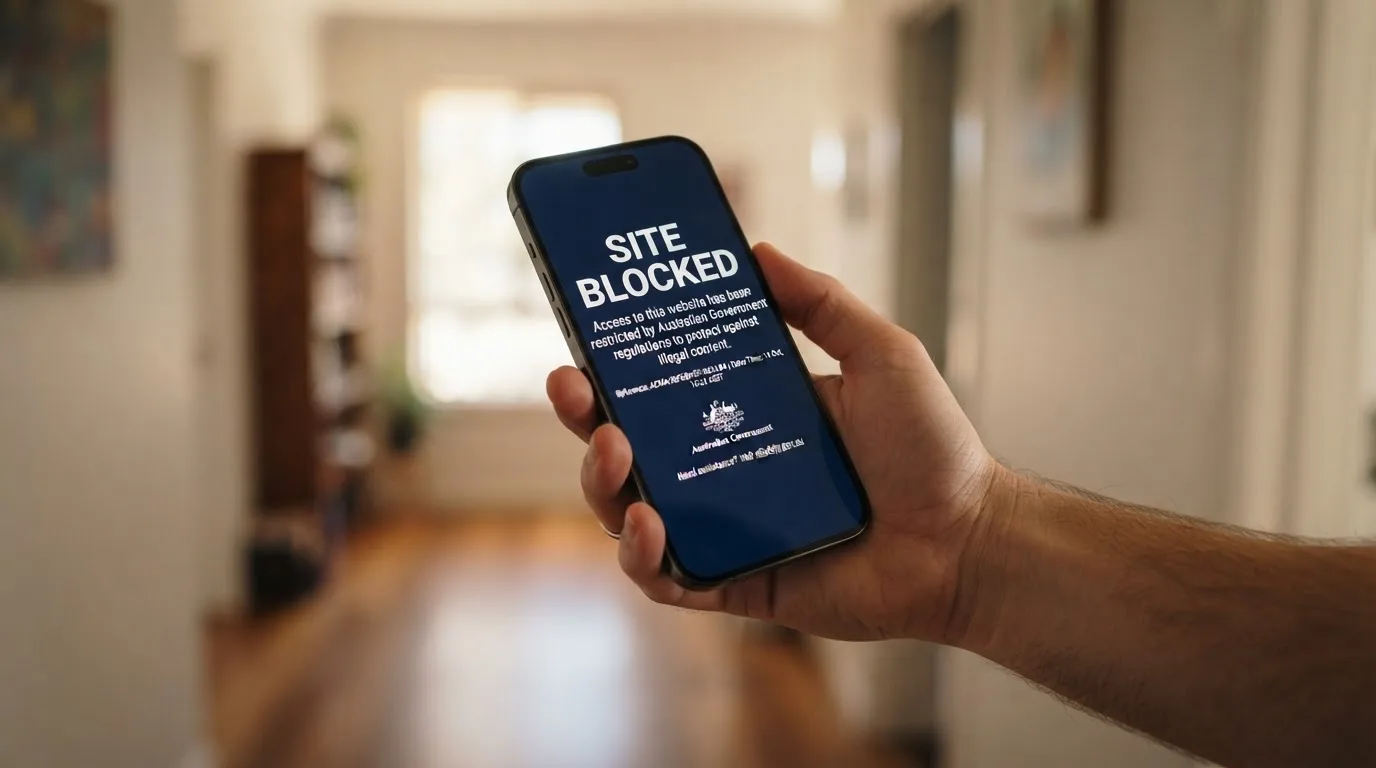
The blocking record is the most measurable. As of the June 2026 round, the ACMA had asked Australian ISPs to block 1,751 illegal gambling and affiliate marketing websites since the first blocking request in November 2019 — a running total that has grown almost every quarter since enforcement was strengthened in 2017. The June 2026 round alone added twelve more domains to the list: 7Signs, ChromaBet, Donbet, Duospin, Freshbet, Slots Gem, Jacks Club, Lucky Start, Pointsbetz, Spinrise, Vinyl Casino and Wildsino. More than 230 unlicensed services have left the Australian market since 2017, either because the ACMA made the proposition too hot or because the operator moved on.
The blocking rate over the life of the regime is the arithmetic that gives the regulator’s work its shape. Spread the 1,751 blocked sites across the roughly 79 months between the first blocking request in November 2019 and June 2026, and the ACMA has been blocking illegal sites at an average rate of roughly 22 sites per month — a number that swings quarter to quarter, with quieter months and rounds like the June 2026 one adding twelve in a single batch. The band is wide: some months the ACMA’s blocking list barely moves, and other months it climbs by dozens at once, but the long-run pace is what tells the reader how active enforcement is, not any single round.
What the Market Loss Figure Means
H2 Gambling Capital’s 2025 estimate puts the money Australians lose to illegal gambling sites at about A$3.9 billion a year. The same report records the share of gambling going through legal channels falling from 74% in 2021 to 64% — a ten-point drop in four years. A A$3.9 billion figure is large enough to be meaningful and small enough to be plausible against a market where losses to licensed wagering run into the tens of billions. It is also a third-party projection, not a regulator’s audit, and the reader should treat it as an estimate rather than a count.
The other way to read it is that every dollar spent on an offshore first deposit bonus is a dollar that did not go through an Australian-licensed channel. The licensed channel collects Australian taxes, returns a share to the racing and sporting codes it funds, and runs under Australian consumer law. The offshore channel returns nothing to the Australian economy, offers no local dispute path, and operates outside the consumer protections the player assumes exist.
What Is Coming in 2027
The Interactive Gambling Amendment (Gambling Reform) Bill 2026 passed Parliament on 19 August 2026. Its advertising and inducement measures commence on 1 January 2027. The reform does not change the underlying prohibition on supply — that has been law since 2001 — but it gives the ACMA a sharper set of tools against the marketing that surrounds illegal supply. On a 2026 page it is law with a start date, not yet in force.
What Responsible Gambling Looks Like for an Australian Reader
The first line is that the responsible-gambling infrastructure that exists in Australia was built for the products Australia licenses. BetStop — the National Self-Exclusion Register, live since August 2023 — binds Australian-licensed online and phone wagering services. An offshore casino is not connected to it. A player who registers with BetStop has excluded themselves from every licensed Australian wagering service, and the registered bookmakers must close the account and refuse to accept further bets, but no offshore casino is on the other end of that arrangement.
The same is true of the deposit limits, time-out tools and activity statements that Australian-licensed bookmakers are required to offer. They are conditions of an Australian licence, and an offshore operator holds no Australian licence. Some offshore operators offer their own self-exclusion tools, and some honour them; the player has no way to verify either before depositing. The protection that the reader assumes is there is, in fact, conditional on the operator choosing to provide it.
The National Gambling Helpline is 1800 858 858, free, available 24/7, with online chat at Gambling Help Online. The helpline is for anyone affected by their own or someone else’s gambling, and it is the right first call whether the gambling takes place through a licensed Australian bookmaker or an offshore casino. Counselling, financial advice and referral to face-to-face services are all available through the same number.
The Australian banks have also built tools that operate one layer down from the regulator. Westpac’s gambling block works at the card level and refuses authorisation of any transaction registered under the merchant category code “Betting/Casino Gambling” on an eligible personal credit or debit card. ANZ offers a gambling transaction block in the ANZ app that blocks gambling transactions made through a digital wallet such as Apple Pay on an eligible card, not just the physical card, and removing the block once it is on requires a 48-hour waiting period. Commonwealth Bank lets customers apply a gambling lock to eligible cards via the CommBank app. None of these tools can promise to block every gambling transaction — the banks say so themselves — and some non-gambling transactions can be blocked in error. Used together with the bank’s own transaction notifications they give a layer of friction that the offshore casino’s marketing pages will not.
What the 2024 Credit Card Ban Does and Does Not Cover
Since 11 June 2024, Australian-licensed online wagering services have not been allowed to accept payment by credit card or other credit-related products, with penalties for operators reaching A$247,500. The ban constrains gambling through linked digital wallets too, because a wallet funded by a credit card falls inside the prohibition. What it does not do is reach an offshore casino that the Australian banks do not see as a licensed wagering service. The merchant category code block is the more reliable filter at the bank level, because it operates on the merchant classification the casino carries, not on the Australian licence the casino does not have.
A reader who has turned on a bank’s gambling block and registered with BetStop has done most of what the Australian system can do for them. The remaining gap is the one the law cannot close: an offshore casino that does not recognise the registration, the block or the helpline, and that operates outside every Australian consumer protection that assumes the player is in a licensed channel.
How Money Actually Moves Between an Australian Bank and a First Deposit Bonus
A first deposit bonus is only as useful as the deposit that triggers it, and the deposit is only as useful as the path the money takes on the way in and on the way out. Two layers of plumbing are in play. The first is the Australian retail payments system, which decides how fast the deposit lands at the offshore casino and how fast any winnings can come back. The second is the offshore casino’s own wallet and pending-withdrawal process, which decides how long the money sits in limbo once the player has asked for it.
The Deposit Side
Australian-licensed wagering services take debit card, bank transfer, PayID/Osko and BPAY, and not credit card or credit-related products. That menu is set by the 2024 credit-card ban and by what the licensed operators have agreed to offer. An offshore casino accepts a wider menu — Visa, Mastercard, sometimes American Express, e-wallets, and increasingly cryptocurrencies — because none of those restrictions bind it.
Where the bank and the casino collide is at the merchant category code level. A Westpac, ANZ or Commonwealth Bank card with a gambling block turned on will refuse authorisation of any transaction tagged “Betting/Casino Gambling”, regardless of which wallet or card-network token is in front of it. Apple Pay does not change this, because Apple does not charge fees to consumers for using Apple Pay in stores, online or in apps — the surcharge, where one exists, comes from the merchant’s own card-processing fees — and the transaction limits and PIN requirements for Apple Pay are set by the card issuer, not by Apple. By the end of 2025, Apple Pay, Google Pay and Samsung Pay transactions collectively accounted for around 45% of all card payments in Australia by number, so a meaningful share of retail payments now travels through wallets the bank has to recognise at the merchant level.
The Australian Payments Plumbing on the Way Out
The money that comes back to an Australian player follows the same plumbing in reverse, with its own timing. Osko, run by Australian Payments Plus, sends a bank transfer between participating Australian banks in under a minute, 24/7 including weekends, addressed either to a BSB and account number or to a PayID. More than 25 million PayIDs were registered on the New Payments Platform as of April 2025, and PayID-based instant transfers are available at over 100 Australian financial institutions. The platform went live to the public on 13 February 2018 and is owned by New Payments Platform Australia Ltd, whose 13 shareholders include the Reserve Bank of Australia and the major banks. Participants have to keep monthly platform outages to no more than two minutes, and in 2021 the ACCC authorised merging NPP Australia with BPAY and eftpos into a single company, Australian Payments Plus.
PayID has one safety feature the reader should know about. Paying to a PayID shows the name of the account holder before the transfer is sent. AP+ warns that being asked to transfer money to a PayID on an illegal gambling site almost certainly means a scam site — the offshore casino’s bank account is unlikely to be in the casino’s brand name. That mismatch between the brand on the homepage and the name on the PayID is itself a signal the reader can act on.
BPAY sits beside PayID as a bill-payment channel that has been in Australian online banking since 1997, available in over 140 banks and financial institutions and offered by over 95,000 businesses. It is run by Australian Payments Plus, the same operator as PayID and Osko, and is jointly owned via Cardlink Services Limited by ANZ, Commonwealth Bank, National Australia Bank and Westpac. For paying a bill it is the right tool; for paying an offshore casino it is not a channel that exists in any practical sense, and the reader can rule it out.
What the Offshore Casino Adds on Top
Once the money has cleared the Australian side, the offshore casino takes over. Pending periods of 24 to 72 hours are standard before a withdrawal is even processed. KYC checks — passport, proof of address, sometimes source-of-funds documentation — can be re-triggered at any time, and an offshore casino has every incentive to use them as a friction layer rather than a verification layer. The bonus balance is rarely withdrawable directly; the wagering requirement has to be cleared first, with whatever game-weighting rules the terms apply.
The transaction-report rule that AUSTRAC applies to transfers of A$10,000 or more applies only to physical cash. Ordinary electronic bank transfers are not subject to that per-transaction reporting requirement, regardless of the amount. A reader worried about AUSTRAC seeing a single transfer to an offshore casino is worried about the wrong thing; the reporting threshold is not the lever in play.
Where the Speed and Cost Settle
The honest answer on speed is that the Australian side moves money almost instantly and the offshore side does not. A PayID to Osko deposit can land at the casino’s bank in under a minute; the offshore casino then takes its own time to credit it to the player’s account, often with a same-day ceiling on the first deposit. A PayID or Osko withdrawal back to an Australian account can arrive in under a minute once the casino releases it — but “once the casino releases it” is the operative phrase, and that step is where the offshore terms page does its work.
The honest answer on cost is that an Australian-licensed wagering service has no surcharging on eftpos, and the Reserve Bank’s July 2025 review proposes removing surcharges on Mastercard and Visa as well, leaving American Express explicitly outside the scope of the proposed ban. An offshore casino operating under no Australian rules can apply whatever processing margin its processor charges, which can be 1% to 3% on a card deposit and disappear into a “processing fee” the player sees only on the statement. The bank-side gambling block does not charge a fee for declining the transaction; it simply refuses to send it.
The Operators the ACMA Has Acted Against
What follows is each of the eleven brands in the table, with the operator name and date the ACMA published, and a verdict that names the specific gap between the brand’s offer and the Australian reader’s position. Nothing here is a recommendation to play; the ACMA’s formal warnings describe a market the regulator has found unlawful, and a reader comparing these names needs them lined up next to that fact.
RocketPlay
RocketPlay carries two ACMA actions: a March 2026 formal warning to Pulsup Ltd over Rocketplay, and an earlier May 2022 formal warning to Dama N.V. — the same Dama N.V. behind four other entries below. The brand has cycled through operator vehicles without changing what it offers Australian readers. Subject support listings exist for the brand’s first-deposit mechanics on Gambling Insider, but those are marketing material, not a substitute for the licence the brand does not hold. Verdict: a brand whose Australian-facing offer is the same product the regulator has warned on twice, under two different corporate names, in four years.
Level Up Casino
Level Up Casino was the subject of the May 2022 Dama N.V. warning, the earliest of the cluster that runs through to the March 2025 Woo Casino warning. Westpac’s gambling-block guidance lists Level Up Casino among the merchant names that the card-level block is built to refuse. The mechanics the brand advertises — first deposit match, free spins, the standard wagering structure — are what the rest of the Dama group runs on. Verdict: a brand whose name has been on the ACMA’s list long enough that the bank’s own block targets it.
Woo Casino
Woo Casino received a Dama N.V. warning in March 2025, the second of the two 2025 Dama rounds that also covered Spirit Casino. No broader subject support turned up for the brand beyond the warning itself. Verdict: a fresh formal warning with the marketing pages that drove it still online, which is the most direct evidence of the gap between the regulator’s action and the offshore operator’s response.
Spirit Casino
Spirit Casino carries the May 2025 Dama N.V. warning — the same operator, the same regulator, a different brand name. No subject support beyond the ACMA record. Verdict: an effective rebrand of the same Dama N.V. operation, with the same Australian-facing offer, two months after Woo Casino was warned.
National Casino
National Casino was named in the July 2025 ACMA warning to Consolutetish S.R.L., alongside Bizzo Casino. ACMA, AUSTRAC and BetStop listings turn up for the brand, which gives the regulator’s view of where the brand sits in the Australian framework. Verdict: a Consolutetish S.R.L. brand operating on the same terms as the next entry, with the regulator’s name on the warning and the consumer-protection register recognising it.
Bizzo Casino
Bizzo Casino was named in the July 2025 warning to Consolutetish S.R.L., and was already on the ACMA’s list from a 2022 formal warning to TechSolutions (CY) Group Limited and TechSolutions Group N.V. Two operator vehicles, two warnings, the same brand. Gambling Insider listings confirm the brand’s first-deposit mechanics in marketing form. Verdict: the brand with the longest ACMA history in the Consolutetish cluster, having been warned twice across two different corporate owners.
Ignition Casino
Ignition Casino carries the July 2025 Bamboo Media warning. No subject support listings turned up beyond the warning. Verdict: a single formal warning on a relatively new operator entry into the Australian-facing market, with the same shape of offer and the same absence of an Australian licence as the rest of the cluster.
Instant Casino
Instant Casino was named in the February 2025 EOD Code SRL warning — the earliest of the 2025 rounds. EcoPayz and PayID listings turn up in the subject support, which says something about the payment rails the brand runs on rather than about the brand’s standing. Verdict: a brand whose first 2025 formal warning ran through a now-familiar operator vehicle and whose payment-side footprint is the most visible part of its Australian presence.
Jackbit
Jackbit carries the April 2026 Ryker B.V. warning, one of the more recent entries in the cluster. No subject support beyond the ACMA record. Verdict: a fresh ACMA action on a brand whose Australian-facing offer has been on the market long enough to attract a warning and short enough that no other regulatory footprint has built up around it.
Casino Intense
Casino Intense was named in the April 2025 Sterplay Holding Ltd warning. AUSTRAC, BetStop and Gambling Insider listings show up in subject support, giving Casino Intense a regulator-side footprint that the brand alone does not generate. Verdict: a brand that sits in the regulator’s other registers alongside its ACMA record, which is the most complete picture of the gap between the offer and the consumer protection around it.
Sky Crown
Sky Crown carries the September 2022 Hollycorn N.V. warning, alongside Blue Leo. The warning is one of the older entries in the cluster, predating the 2024 credit card ban and the 2026 reform bill. No subject support beyond the ACMA record. Verdict: a brand whose ACMA action predates most of the recent enforcement rounds, with the same absence of an Australian licence that the rest of the cluster carries.
Frequently Asked Questions
What is a first deposit bonus, as distinct from a no-deposit bonus?
A first deposit bonus is matched to the player’s first deposit — usually as a percentage match up to a cap, sometimes with free spins attached — and is paid in bonus money that has to be wagered through before it can be withdrawn. A no-deposit bonus is a small credit or batch of free spins given on registration, with no deposit required, but with steeper wagering requirements and tighter conversion caps because the casino has not taken any of the player’s money yet.
Do first deposit bonuses usually carry wagering requirements?
Almost always. The wagering requirement is the multiplier — written as “35x bonus” or “40x deposit plus bonus” — that determines how much has to be bet through before any of the bonus balance converts to withdrawable cash. Game weighting rules usually mean slots count in full and table games count at a reduced rate or not at all, so the wagering target can be much harder to clear in practice than the headline multiple suggests.
Is it legal for an online casino to offer Australians a first deposit bonus?
No, not for online casino games or online pokies. The Interactive Gambling Act 2001 prohibits the supply of those services to anyone in Australia, and no Australian jurisdiction issues a licence for them. The licensed Australian online wagering market covers racing and sport (pre-event), lotteries and keno. Offshore operators that market first deposit bonuses to Australian readers are operating outside the Australian regulatory framework and are subject to ACMA enforcement.
Can a first deposit bonus be withdrawn immediately after it is credited?
Rarely. The bonus portion is paid into a separate bonus balance that the wagering requirement has to clear before it can be converted to withdrawable cash, and most operators also require the deposit itself to be wagered through at least once as an anti-money-laundering step. Free-spin winnings typically land as bonus money with the same rules and a separate cap on how much can be converted. The deposit is more accessible than the bonus, but reading the small print is the only way to know what conditions actually apply.
What should someone read before accepting a first deposit bonus offer?
The wagering requirement and which games count toward it; the maximum conversion cap on bonus winnings; the expiry window for both the bonus and any free-spin winnings; the maximum bet size allowed while a bonus is active; the list of excluded payment methods (some operators exclude deposits made through e-wallets or certain cards); and the verification documents the operator will ask for at withdrawal. The marketing page is the last place to find any of this — the terms and conditions page is the first.
Does a bigger first deposit bonus automatically mean better value?
No. A A$1,000 bonus with a 50x wagering requirement costs more in expected play-through than a A$200 bonus with a 20x requirement, even though the headline number is five times larger. The relevant comparison is the wagering requirement on the bonus times the house edge on the games that count toward it, not the dollar amount on the banner. A reader who works that comparison before depositing is the reader who is harder to disappoint.