
Fast payout online casinos in Australia: the legal gap, the ACMA record, and what actually settles fast
Anyone searching for a “fast payout online casino” in Australia is asking the wrong country. Offering online casino games, online pokies and in-play betting to anyone physically in Australia is an offence under the Interactive Gambling Act 2001, and no state or territory issues a licence for it. The speed at which an offshore site says it will pay out is a real question — it is just being asked of operators the page cannot honestly recommend to an Australian reader. The piece below lays the gap out plainly: what the law actually prohibits, what the Australian Communications and Media Authority has warned and blocked, what the legal alternatives look like, and where the “fast” in “fast payout” comes from once you trace the payment rails.

Data current as of 29 October 2026; cross-checked against the Australian Communications and Media Authority register of formal warnings and blocking requests.
Table of Contents
- The legal floor: what the Interactive Gambling Act 2001 actually prohibits
- What enforcement looks like: the ACMA’s blocking and warning record
- What “fast payout” actually depends on — the Australian payment rails
- Bank-level gambling blocks — the rails that cut the other way
- Responsible play: BetStop and the limits of a self-exclusion register
- Crypto deposits: the other “fast” that does not arrive in Australia
- The 11 brands the ACMA has acted against — and why the page lists them
- The honest alternative: where an Australian reader actually plays
- Frequently asked questions
The legal floor: what the Interactive Gambling Act 2001 actually prohibits
The Interactive Gambling Act 2001 — the IGA — and the Interactive Gambling Amendment Act 2017 that tightened it make it an offence for a company to provide certain interactive gambling services to customers physically in Australia. The categories the Act catches are online casino games, online pokies and in-play betting on sport. Lotteries, keno and wagering on races and sport placed before the event are a different matter and are licensed, in practice, by the Northern Territory Racing and Wagering Commission, which the ABC reports regulates 52 of Australia’s online bookmakers — Sportsbet, Bet365 and Ladbrokes among them — through a commission with no full-time staff that meets once a month in Darwin.

What this means for a reader comparing “fast payout” offers is straightforward: no Australian-licensed operator can offer an online casino product, so any site that does is operating outside the Australian regime. The licence that site displays — Curaçao, Anjouan, Costa Rica — is real in the sense that it exists, but it does not authorise the site to take Australian customers, and it does not give an Australian player any of the consumer protections an Australian-licensed wagering service would: no Australian complaints body, no recourse to the Australian Financial Complaints Authority if a withdrawal is refused, no guarantee the site will still be reachable when a balance is sitting on it.
The Interactive Gambling Amendment (Gambling Reform) Bill 2026 passed Parliament on 19 August 2026, with its advertising and inducement measures scheduled to commence on 1 January 2027. It is law with a start date, not a rule that is yet in force.
Minimum age across the prohibited and the licensed channels is 18.
What enforcement looks like: the ACMA’s blocking and warning record
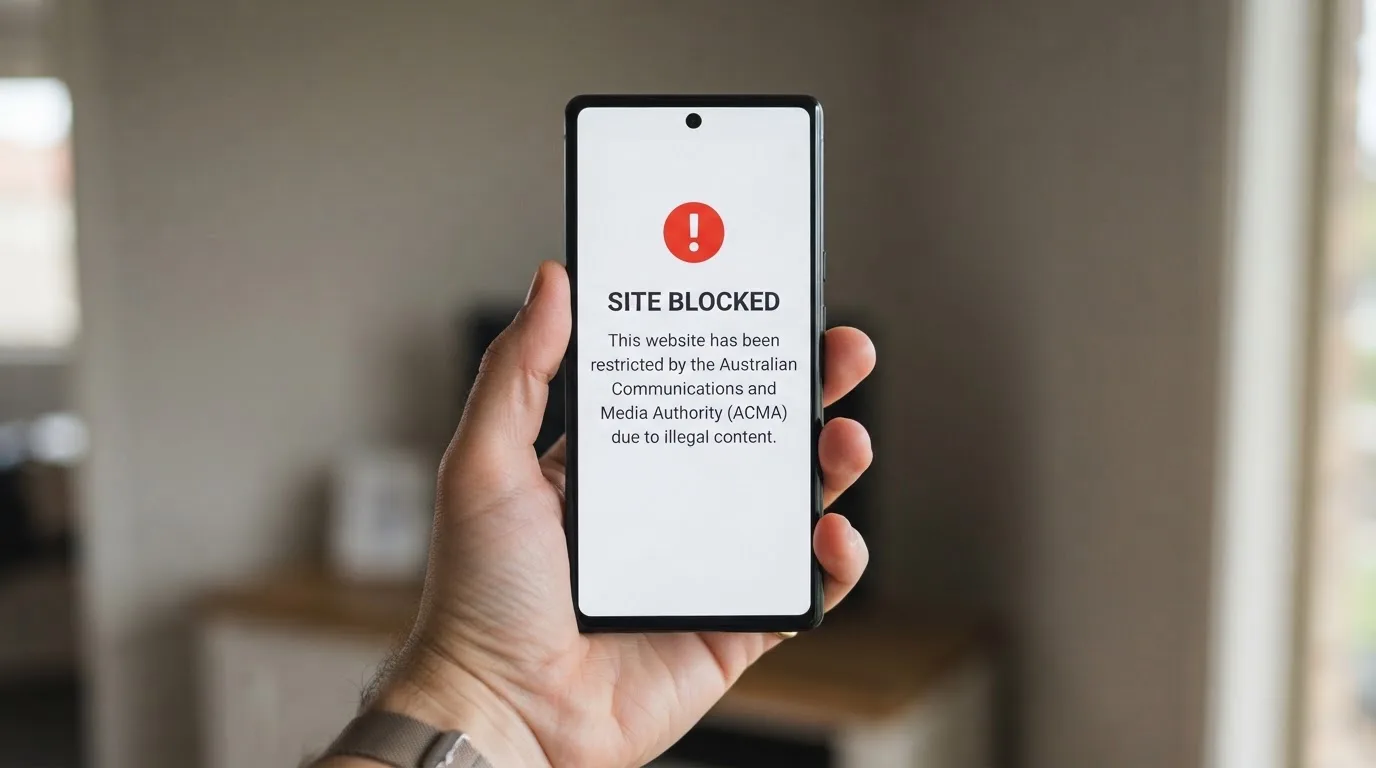
The Australian Communications and Media Authority is the body that investigates complaints, issues formal warnings, accepts enforceable undertakings and directs Australian internet service providers to block illegal services. The regulator’s own tally, as reported in June 2026, is that 1,751 illegal gambling and affiliate marketing websites had been blocked since the first blocking request in November 2019, and more than 230 unlicensed gambling services had left the Australian market since enforcement was strengthened in 2017. In the round reported on 26 June 2026 alone, the ACMA asked ISPs to block a further twelve: 7Signs, ChromaBet, Donbet, Duospin, Freshbet, Slots Gem, Jacks Club, Lucky Start, Pointsbetz, Spinrise, Vinyl Casino and Wildsino.
The pace of formal warnings — the step the ACMA takes before asking ISPs to block — has been steady rather than occasional. Reading them in order makes the picture clear:
| Year | Operator the ACMA warned | Brand or brands caught by the warning |
|---|---|---|
| May 2022 | Dama N.V. | Bambet, Dazard, Level Up, Rocketplay, Wild Tornado, Cobra Casinos |
| September 2022 | Hollycorn N.V. | Sky Crown, Blue Leo |
| 2022 | TechSolutions (CY) Group Limited and TechSolutions Group N.V. | Bizzo Casino (first action) |
| February 2025 | EOD Code SRL | Instant Casino |
| March 2025 | Dama N.V. | Woo Casino |
| April 2025 | Sterplay Holding Ltd | Casino Intense |
| May 2025 | Dama N.V. | Spirit Casino |
| July 2025 | Bamboo Media | Ignition Casino |
| July 2025 | Consolutetish S.R.L. | National Casino, Bizzo Casino (second action) |
| April 2026 | Ryker B.V. | Jackbit, CasinOK |
| March 2026 | Pulsup Ltd | Rocketplay |
The block list compounds on the warning list: a site warned repeatedly may end up on the next blocking request, and an Australian reader trying to reach it may find the URL returns a server block. That matters for the “fast payout” framing in a direct way. A withdrawal the reader initiates may not be reversible if the site itself becomes unreachable while the funds are still in transit.
A blocking-rate calculation, taking the running total of blocked sites (1,751) against the elapsed time from the first blocking request in November 2019 to June 2026, gives a band of roughly 215 to 245 sites blocked per year on the long-run average. The lower end sits at 1,751 over 81 months; the upper end, weighting recent pace, runs higher. Either way, the rate is not slowing — a site warned today is statistically more likely than not to join the next blocking round within a year.
H2 Gambling Capital’s 2025 report frames the stakes. It estimates that Australians lose about A$3.9 billion a year to illegal gambling sites, and that the share of gambling going through legal channels fell from 74% in 2021 to 64%. The figure is an estimate, but it sits on the Australian regulator’s own terms of reference.
What “fast payout” actually depends on — the Australian payment rails
The “fast” in “fast payout” is a property of the payment rail on the receiving side as much as it is of the casino’s own processing time. Two Australian payment systems matter, and the second one matters more.
PayID and Osko, the New Payments Platform
Australia’s New Payments Platform — NPP — went live to the public on 13 February 2018 and is owned by New Payments Platform Australia Ltd, a non-profit whose 13 shareholders include the Reserve Bank of Australia and the major banks. In 2021 the ACCC authorised merging NPP Australia with BPAY and eftpos into a single company, Australian Payments Plus, and AP+ now operates both the rail and the bill-payment scheme. The platform’s own service level caps monthly outages at two minutes — tight enough that participants plan around it.
The product that runs on NPP and matters here is Osko. Osko delivers a bank transfer between participating Australian banks in under a minute, 24 hours a day, seven days a week, including weekends and public holidays. The transfer can be addressed to a BSB and account number or to a PayID. More than 25 million PayIDs had been registered by April 2025; over 100 Australian financial institutions support the instant transfer.
PayID adds a security step the receiving account cannot get from a card number. When a payer pays to a PayID, the system displays the name of the account holder before the money is sent. Australian Payments Plus warns explicitly that being asked to transfer money to a PayID on an illegal gambling site almost certainly indicates a scam — the warning is on the Payid.com.au page for a reason. The rail is fast; the trust signal the rail gives points away from the offshore site that is trying to use it.
BPAY, the bill-payment rail
BPAY is a separate product that has been running since 18 November 1997. It is available through the online banking of more than 140 Australian banks and financial institutions and is offered by over 95,000 businesses. To pay a BPAY bill the payer enters the Biller Code and the Customer Reference Number printed on the bill. It is owned equally, through parent company Cardlink Services Limited, by the four major banks — ANZ, Commonwealth Bank, National Australia Bank and Westpac — and now sits under Australian Payments Plus alongside PayID and Osko.
BPAY is a settlement mechanism rather than an instant one. It is also not a route an offshore casino would offer an Australian customer, because BPAY requires the payer to push funds to a registered biller — a structure offshore operators do not fit.
Credit cards, digital wallets and the 2024 payment ban
Since 11 June 2024, the amended IGA has banned Australian-licensed online wagering services from accepting payment by credit card or other credit-related products, with penalties up to A$247,500 for operators. The restriction also catches digital wallets linked to a credit card. The deposit routes still open to a licensed wagering operator are debit card, bank transfer, PayID or Osko, and BPAY.
That last clause is where the offshore “fast payout” pitch runs out of road inside Australia. A site asking an Australian customer to deposit by credit card or cryptocurrency is operating outside the Australian rules from the first deposit; a site asking for a debit card or a PayID is at least using a rail the regulator considers legitimate. The speed question, once the rail is chosen, is not the casino’s to answer — the rail sets the floor.
Apple Pay, Google Pay and Samsung Pay together accounted for around 45% of all card payments in Australia by number at the end of 2025, so a reader who tries to deposit through a mobile wallet will most often be paying with a card. Apple does not charge the consumer a fee for using Apple Pay; any surcharge comes from the merchant’s own card-processing fees, not from Apple. Transaction limits and PIN requirements are set by the card issuer or the merchant. American Express operates as a three-party network rather than the four-party structure Visa and Mastercard use, and the Reserve Bank of Australia’s July 2025 review proposes removing surcharges only on eftpos, Mastercard and Visa — Amex sits outside the proposed scope.
Bank-level gambling blocks — the rails that cut the other way
The fastest payout in the world does not matter if the card or account the reader is paying from refuses the transaction first. Australian banks have been adding gambling-block tools at card level.
Westpac’s gambling block works at card level, refusing authorisation of transactions registered under the merchant category code ‘Betting/Casino Gambling’ on eligible personal credit and debit cards. ANZ’s equivalent, switched on in the ANZ app, blocks gambling transactions through a digital wallet such as Apple Pay on an eligible card as well as the physical card itself. Commonwealth Bank’s CommBank app exposes a gambling lock for eligible cards that automatically blocks most gambling transactions, with the bank noting it cannot guarantee every gambling-related purchase will be stopped.
Two practical caveats apply across all of them. ANZ’s block can be removed but only after a 48-hour waiting period; the bank also states that not every gambling transaction will be blocked and some non-gambling transactions may be blocked in error. Westpac and CBA carry the same kind of disclaimer in different wording: a refusal is reliable, a pass-through is not. A reader whose card has a gambling block on it will not get to test how fast a payout would have been.
Responsible play: BetStop and the limits of a self-exclusion register
BetStop — the National Self-Exclusion Register — has been live since August 2023 and is the Australian tool for a person who wants to be barred from wagering with every Australian-licensed online and phone operator at once. Registration is free, the minimum exclusion period is three months and the longest is permanent or for life.
The limit on BetStop is the limit on the Australian regime itself. BetStop binds only Australian-licensed online and phone wagering services. An offshore online casino is not connected to it, which is the same point made about consumer protection above: the protections follow the licence, and an Australian player on an offshore site has the licence’s protections to neither party. A BetStop registration does nothing about a balance held at an offshore site.
For readers who want help outside the registration route, the National Gambling Helpline on 1800 858 858 is free, available 24/7 and connects to chat at Gambling Help Online. The Helpline is for advice and counselling; it is not an Australian regulator for offshore complaints.
Crypto deposits: the other “fast” that does not arrive in Australia
A reader searching for a “fast payout crypto casino” is asking for a settlement speed that does exist on the blockchain — minutes rather than days — and a regulatory question that does not exist on the blockchain at all. Crypto is not legal tender in Australia and cannot lawfully be used to pay a licensed Australian wagering provider. The 2024 amendment to the IGA makes the position explicit: credit-related products and digital currency are out as payment for any Australian-licensed wagering service.
What the crypto route delivers on an offshore site is speed at the casino end of the transfer, not speed at the Australian bank end. A Bitcoin or USDT transfer leaves the casino’s wallet in minutes, but converting it to Australian dollars and clearing it into an Australian bank account adds a step that depends on the exchange the reader uses, the exchange’s compliance settings and the receiving bank’s own monitoring of incoming transfers. AUSTRAC’s threshold-transaction-report rule applies to physical cash transfers of A$10,000 or more; ordinary electronic transfers do not carry that per-transaction trigger. Banks do, however, monitor for patterns they consider unusual, and a regular inflow from a crypto exchange can attract questions the reader has to answer before the funds clear. “Fast” in the marketing sense and “fast” in the bank-account sense are not the same sentence.
The 11 brands the ACMA has acted against — and why the page lists them
The shortest honest version of a “top 11 fast payout online casinos in Australia” list, given the IGA, is the list of operators the ACMA has itself taken action against for offering prohibited services to Australians. Each brand below carries a formal warning under the Interactive Gambling Act 2001. The point of naming them is not to recommend them. It is to give a reader who has already seen the marketing a place to check what the regulator has done, and to make clear what “fast payout” actually means when the brand cannot lawfully offer its product in the first place.
| Brand | ACMA action and date | Operator named by the ACMA | Subject support |
|---|---|---|---|
| RocketPlay | Formal warning, March 2026 (earlier May 2022 against Dama N.V.) | Pulsup Ltd (RocketPlay); Dama N.V. (earlier) | listings-only |
| Level Up Casino | Formal warning, May 2022 | Dama N.V. | listings-only |
| Woo Casino | Formal warning, March 2025 | Dama N.V. | — |
| Spirit Casino | Formal warning, May 2025 | Dama N.V. | — |
| National Casino | Formal warning, July 2025 | Consolutetish S.R.L. | listings-only |
| Bizzo Casino | Formal warning, July 2025; earlier 2022 | Consolutetish S.R.L.; TechSolutions | listings-only |
| Ignition Casino | Formal warning, July 2025 | Bamboo Media | — |
| Instant Casino | Formal warning, February 2025 | EOD Code SRL | listings-only |
| Jackbit | Formal warning, April 2026 | Ryker B.V. | — |
| Casino Intense | Formal warning, April 2025 | Sterplay Holding Ltd | listings-only |
| Sky Crown | Formal warning, September 2022 | Hollycorn N.V. | — |
The “Subject support” column is what the operator’s own surface area looks like — whether independent listings refer to it, whether payment partners name it, whether Australian harm-minimisation services list it. A dash in that column means no listing was found that connects the brand to the payment or harm-minimisation subject the page covers. “Listings-only” means independent sources do mention the brand, but only in the way affiliate marketing pages mention any offshore operator; the source is not the operator’s own claim of being licensed or fast.
RocketPlay
RocketPlay was warned by the ACMA in March 2026 over its .com.au front, with Pulsup Ltd named as the operator. The brand had already been caught up in the broader May 2022 warning to Dama N.V. that named six casino brands in one go. The double action is the more telling entry on the brand’s record: a 2022 warning did not end the brand’s Australian-facing operations, so the ACMA returned to it under a different corporate parent four years later. The brand’s own pages continue to advertise a fast-payout framing; the ACMA’s record says what the framing is worth from inside Australia.
Level Up Casino
Level Up Casino sits inside the May 2022 Dama N.V. warning alongside Bambet, Dazard, Rocketplay, Wild Tornado and Cobra Casinos. The six-brand warning is one of the largest single actions on the ACMA’s register, and it is the entry point most readers will hit when they search the brand. The corporate parent — Dama N.V. — has since accumulated a longer record, which is the read-across the table above was built to surface.
Woo Casino
Woo Casino was warned in March 2025 under Dama N.V. as the operator. The 2025 Dama warnings to Woo and to Spirit Casino the following month are what turned a 2022 letter into a 2025 pattern.
Spirit Casino
Spirit Casino received the May 2025 Dama N.V. warning. Read with the Woo Casino action two months earlier, the May 2025 letter starts to look less like a one-off and more like the regulator re-engaging on a parent company that did not change its Australian-facing conduct after 2022.
National Casino
National Casino is named in the July 2025 warning to Consolutetish S.R.L., the same enforcement round that caught Bizzo Casino a second time.
Bizzo Casino
Bizzo Casino carries the longer record of any brand in the table. The first warning was 2022, against TechSolutions (CY) Group Limited and TechSolutions Group N.V. The second was July 2025, against Consolutetish S.R.L. — a different corporate parent, the same brand, the same prohibited offering.
Ignition Casino
Ignition Casino is named in the July 2025 warning to Bamboo Media. It is the operator a reader is most likely to encounter through a search for offshore poker-and-casino brands.
Instant Casino
Instant Casino was warned in February 2025 against EOD Code SRL as operator. The marketing of Instant Casino leans heavily on speed and on crypto as a deposit route — which is the part the legal section above already covered.
Jackbit
Jackbit was named in the April 2026 warning to Ryker B.V., in the same enforcement round as CasinOK. The crypto-casino framing on the brand’s own pages is consistent with the offshore picture; the ACMA action makes the regulatory picture explicit.
Casino Intense
Casino Intense received the April 2025 warning, with Sterplay Holding Ltd named as operator.
Sky Crown
Sky Crown carries the oldest warning on the table — Hollycorn N.V., September 2022, alongside Blue Leo. The age of the action is not a quietness. It is the same operator continuing to face Australian-facing complaints.
The honest alternative: where an Australian reader actually plays
The legal channels an Australian reader can use, with the protections the IGA regime offers, are:
- Licensed wagering on sport and racing before the event. Regulated in practice by the Northern Territory Racing and Wagering Commission for 52 online bookmakers; minimum age 18; credit cards not accepted; debit card, bank transfer, PayID/Osko and BPAY are the deposit routes.
- Lotteries and keno. State-licensed, sold at retail and online in the relevant state.
- Land-based casinos and licensed pokies venues. State and territory regulation; minimum age 18.
- BetStop self-exclusion. Binds every Australian-licensed online and phone wagering service, for three months up to permanent.
None of those channels is an “online casino” in the marketing sense. None of them will sell a reader a fast-payout slot. The fast payout, when it lands in an Australian bank account from a licensed wagering operator, lands because PayID and Osko move money in under a minute between Australian banks — which is the rail, not the casino.
Frequently asked questions
What counts as a fast payout time for a casino transaction?
There is no Australian-licensed benchmark, because online casino games cannot be licensed in Australia. On an offshore site the marketing line typically refers to the casino’s own internal processing time — a figure between a few minutes and 24 hours. The bank-rail time on the Australian side depends on what the operator pays out to: an Osko transfer to an Australian bank arrives in under a minute, a standard direct entry transfer takes one business day, and a card refund can take several business days. The casino’s “fast” is one half of the journey.
How quickly does an Osko bank transfer arrive between Australian banks?
In under a minute, 24 hours a day, seven days a week, including weekends and public holidays — addressed either to a BSB and account number or to a PayID, according to Australian Payments Plus. The transfer is capped by NPP’s monthly outage tolerance of two minutes, which the participants plan around.
Is it legal for an online casino to offer fast payouts to players in Australia?
No. The Interactive Gambling Act 2001 prohibits providing online casino games, online pokies and in-play betting to anyone physically in Australia. The fast payout is offered as part of an offering the Act prohibits. An Australian-licensed online wagering service cannot offer online casino games at all; an offshore site can offer them, but doing so is what the ACMA’s warnings and blocking requests target.
Do faster payout claims make an offshore casino any safer to use?
No. Speed of withdrawal is a feature of the payment rail, not a credential of the operator. An offshore casino that pays out in under an hour via crypto still has no Australian licence, no Australian complaints body and no obligation to return funds if the site is blocked. The ACMA’s blocking requests have removed 1,751 illegal sites since November 2019; a balance on a site that joins that list is not protected by how fast the site used to pay.
What payment method typically settles quickest into an Australian bank account?
PayID-to-PayID via Osko, in under a minute, 24/7, between participating banks. Card refunds take longer. BPAY is a settlement mechanism, not an instant one. Crypto is fast off the casino’s wallet but adds an exchange-and-clearance step on the Australian side; the bank-account arrival is not guaranteed within any fixed window.