
Best instant withdrawal casinos in Australia in 2026: what the offer really costs
The phrase “instant withdrawal casino” promises a shortlist — ten reputable sites, ranked by payout speed, with a clear winner at the top. A reader in Australia searching for such an experience expects a reliable, ordered list. This page delivers a different perspective. No Australian jurisdiction licenses an online casino, so any site claiming to offer “instant withdrawals” to an Australian reader is, by definition, an offshore entity operating in breach of the Interactive Gambling Act 2001. There is no legitimate shortlist. Instead, there is a clear distinction between the promises of offshore marketing and the reality of Australian law.

What follows is a working picture of that gap: how the prohibition is enforced, what the ACMA has actually done, how Australian bank rails and digital wallets respond when a reader tries to move money into or out of one of these sites, what player-protection tools exist for someone in Australia, and which brands the regulator has named in formal warnings. The angle is cost — not the cost in cents, but the cost the reader pays in protections they give up, in recourse they lose, in hours they spend on a withdrawal that the marketing copy says is “instant” and the small print says is not.
Current as of 29 October 2026, checked against the ACMA’s published register of formal warnings and blocking requests.
Table of Contents
- The legal landscape for online casino games in Australia
- Responsible gambling tools that an Australian reader can actually use
- Crypto, anonymity, and the verification question
- How money actually moves: the Australian payments stack
- The ACMA’s record on specific brands
- What the comparison actually finds
- The blocking rate: how quickly the regulator catches up
- Payments the reader can actually use
- Why an “instant” claim needs to be read closely
- The reform on the horizon
- What an Australian reader who wants to gamble online can lawfully do
- What a reader in Australia should take from this page
- Frequently asked questions
The legal landscape for online casino games in Australia
The Interactive Gambling Act 2001 — the IGA — makes it an offence for a person or company to provide an online casino game, an online pokie, or in-play betting to anyone who is physically in Australia. The 2017 amendments hardened the regime: civil penalties, an investigative role for the ACMA, and the power to direct Australian internet service providers to block illegal sites. The Act targets the provider, not the player — Australians have not been prosecuted for playing at offshore sites — but the legal frame is what gives every other fact on this page its weight.

What is licensed is narrower than a casual reader expects. Licensed online wagering in Australia covers betting on racing and sport, with the bet placed before the event — not during play. Lotteries and keno fall under state and territory regulation. Online casino games and online pokies sit outside that licensed perimeter, in every state and every territory. No licence exists for an offshore casino to apply for that would change its status for an Australian reader. The licence the site displays in its footer — Curaçao, Anjouan, Kahnawake, Malta — is a licence to operate from that jurisdiction, not a licence to offer casino games to Australians.
The Northern Territory Racing and Wagering Commission (NTRWC) is the regulator most readers have never heard of. It supervises 52 of Australia’s online bookmakers — Sportsbet, Bet365 and Ladbrokes among them — because the operators chose the Territory as their licensing base for tax reasons. The NTRWC has no full-time staff and meets once a month in Darwin. That single regulator’s reach is what makes licensed wagering in Australia possible, and its limits are the reason offshore casinos do not have a comparable path in.
The role of the ACMA
The ACMA — the Australian Communications and Media Authority — is the body that investigates complaints, issues formal warnings to operators, and asks ISPs to block sites. By mid-2026 the cumulative count had passed 1,750 illegal gambling and affiliate sites blocked since the first blocking request in November 2019, and more than 230 unlicensed services had left the Australian market since enforcement was strengthened in 2017. That is the headline figure for an Australian reader: offshore operators are being found, warned, and cut off, but the count is large because the underlying prohibition has been in force for years and the population of offshore sites keeps replenishing.
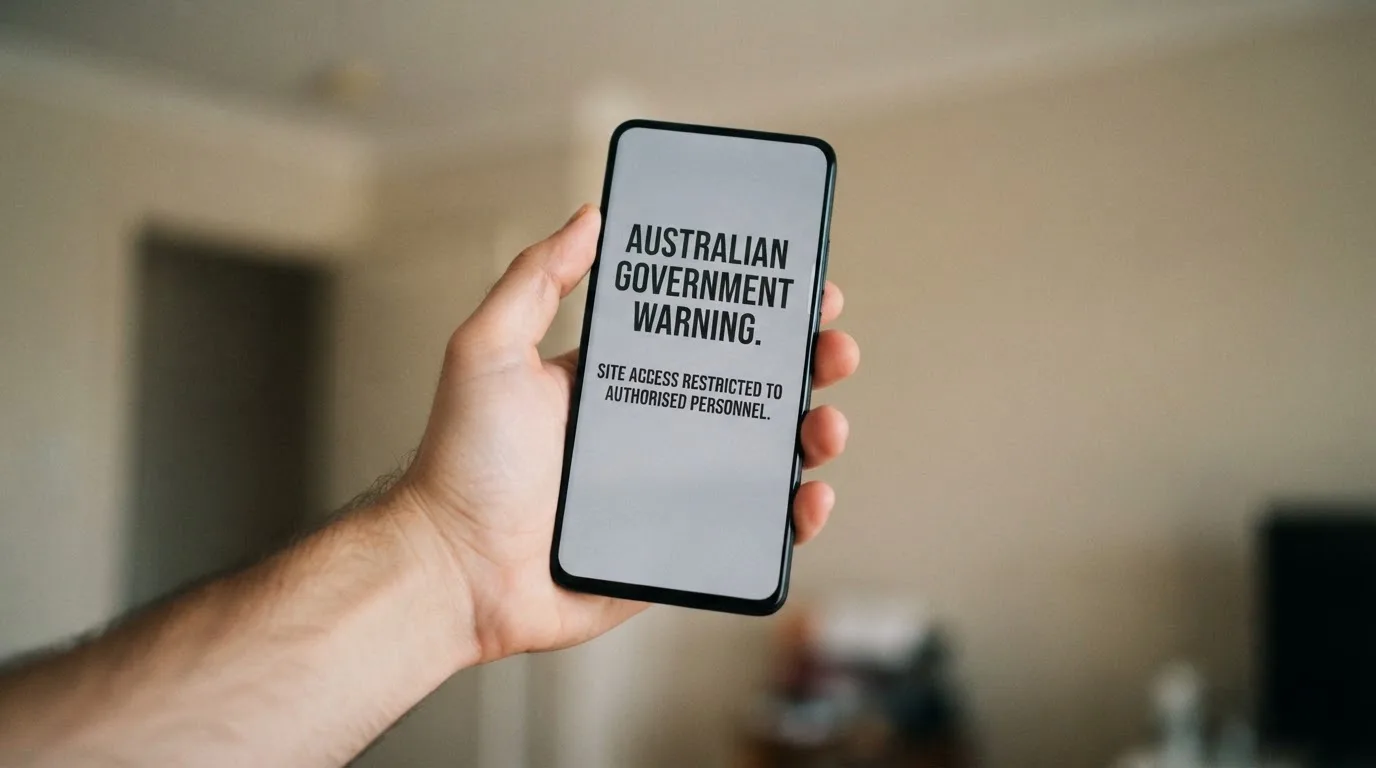
The ACMA’s day-to-day work is visible in two places. First, formal warnings, published on the regulator’s own site and dated. Second, blocking requests, reported to industry outlets when a new batch goes out. The round reported on 26 June 2026 asked ISPs to block 12 more sites — 7Signs, ChromaBet, Donbet, Duospin, Freshbet, Slots Gem, Jacks Club, Lucky Start, Pointsbetz, Spinrise, Vinyl Casino and Wildsino — taking the cumulative total above 1,750. The pattern is not a one-off sweep. It is a rolling enforcement programme that has now run for years.
What a formal warning actually means
A formal warning from the ACMA is a written notice that the regulator has found the named operator offering a prohibited interactive gambling service to Australians, and is putting the operator on notice that further action — civil penalty proceedings, blocking — may follow. It is not a conviction. It does not produce a court order on its own. What it does is document, on the public record, that the regulator has reached a particular conclusion about a particular operator on a particular date. For a reader comparing two offshore sites that both display a Curaçao licence, the ACMA’s warning list is one of the few pieces of independent information available.
The names that appear in ACMA warnings recur. Dama N.V. shows up in multiple warnings — six brands in May 2022 (Bambet, Dazard, Level Up, Rocketplay, Wild Tornado and Cobra Casinos), then Woo Casino in March 2025 and Spirit Casino in May 2025. Consolutetish S.R.L. was warned in July 2025 over National Casino and Bizzo Casino. The pattern is structural: a single corporate group runs several brands, so one warning often lists several sites, and a later warning may catch the same group operating under a new name.
How many Australians use these sites
H2 Gambling Capital’s 2025 report puts Australians’ annual losses to illegal gambling sites at roughly A$3.9 billion. The same report tracks the share of gambling going through legal channels, which fell from 74% in 2021 to 64%. The two figures point the same way: the unlicensed market is large, and it has been growing as a share of the total. The legal perimeter is real, and a meaningful number of Australians step outside it.
Responsible gambling tools that an Australian reader can actually use
A reader in Australia who wants to control their gambling does not need a feature inside the offshore casino’s own software. They need Australian tools, because the offshore site’s self-exclusion button covers nothing an Australian regulator enforces.
BetStop — the National Self-Exclusion Register
BetStop went live in August 2023 and is the only register that carries statutory force. A person who registers with BetStop is excluded from every Australian-licensed online and phone wagering service simultaneously — the operator’s own systems are required to honour the registration. The minimum exclusion period is three months; the maximum is permanent. What BetStop does not cover is any offshore site. An Australian who registers with BetStop and then opens an account at an offshore casino has not excluded themselves from that casino at all.
Bank-level gambling blocks
The major Australian banks now offer card-level gambling blocks, and they are stronger than they sound. Westpac’s gambling block works at card level: it refuses authorisation of transactions registered under the merchant category code “Betting/Casino Gambling” on eligible personal credit and debit cards. ANZ’s block, activated in the ANZ app, blocks gambling transactions made through a digital wallet such as Apple Pay on an eligible card, not just the physical card — the wallet side matters because card tokens carry the merchant category through to the issuer. Commonwealth Bank’s gambling lock, applied through the CommBank app, automatically blocks most gambling transactions, though the bank states it cannot guarantee every gambling-related purchase will be stopped.
A practical point: turning the ANZ block off requires a 48-hour waiting period, by design. The friction is the feature. Each of these banks publishes its own terms, and each warns that some non-gambling transactions may be caught by mistake — the merchant category is set by the merchant, not by the bank, and the bank is matching against categories, not against named operators. The tools are blunt instruments with real coverage.
The National Gambling Helpline
The National Gambling Helpline is 1800 858 858 — free, 24/7, with chat at Gambling Help Online. It is run by state and territory counselling services under a national framework. For a reader who has been playing at offshore sites and wants to step back, it is the first call. BetStop is the register; the helpline is the human support. Both are Australian, both are statutorily grounded, and both reach the reader in a way an offshore casino’s responsible-gaming page does not.
Crypto, anonymity, and the verification question
A specific cluster of search phrases around this topic — “instant withdrawal no verification casino”, “instant withdrawal crypto casino”, “instant withdrawal bitcoin casino” — points at the same underlying pitch: an account that lets you deposit and withdraw without sending ID. In an Australian context, the pitch collapses on contact with three separate rules.
The 2024 credit-ban
Under amendments to the Interactive Gambling Act that took effect on 11 June 2024, Australian-licensed online wagering services cannot accept payment by credit card or by other credit-related products. Digital currency is treated in the same prohibition. A licensed Australian wagering operator that accepts a credit-card deposit or a crypto deposit is breaking its licence conditions, with penalties of up to A$247,500 per offence. For the offshore casino this prohibition does not bind — the IGA targets the operator offering the service, and an offshore operator is not an Australian licensee — but the credit-ban tells the reader what the policy position is. Australia has decided that credit-funded gambling carries risks the law will not underwrite.
Why verification exists
A reader who sees “no verification” advertised should ask what the word covers, because the offshore site’s interest in their identity is the only friction between them and their own money. Identity verification at withdrawal is not a marketing choice. It is a sanctions, anti-money-laundering and problem-gambling requirement at the licensing jurisdiction the site actually answers to — Curaçao, Anjouan, Kahnawake, Malta — and a chargeback defence at the card network. A site that skips verification at the deposit but insists on it at the moment the player asks for their money back is not lying in its marketing. It is running the standard offshore script: accept the deposit without paperwork, demand the paperwork at payout, and use the paperwork gap as the reason the withdrawal stalls.
What a crypto withdrawal actually does
The pitch is that crypto lets the player bypass the verification step. What crypto does, in practice, is move the friction: the on-chain transaction can land in minutes, the conversion into Australian dollars happens off-chain at an exchange the player chooses, and the exchange is where KYC lives. The “instant” part is the part that is genuinely fast. The “no verification” part usually reappears on the way out, at a different gate.
Australian-licensed wagering cannot accept a crypto deposit at all. The credit-and-crypto prohibition is a hard rule for licensed operators. For an offshore operator, crypto is a payment method they accept because it lets the deposit clear without going through an Australian bank, and it lets the operator advertise the withdrawal as “instant” because the on-chain settlement is genuinely fast. The reader who takes the pitch at face value gets the speed and loses the recourse. Australian Payments Plus, the operator of PayID and Osko, warns specifically that being asked to transfer money to a PayID on an illegal gambling site almost certainly means a scam site — the warning applies to crypto-adjacent flows as well, because the same operator structure sits behind them.
How money actually moves: the Australian payments stack
The reader who tries to move money into or out of an offshore casino runs into the Australian payments system, and that system has a specific shape.
Osko and PayID
Osko is the instant-transfer layer on Australia’s New Payments Platform. A bank transfer between participating Australian banks arrives in under a minute, 24/7, whether it is addressed to a BSB and account number or to a PayID. PayID-based instant transfers are available at over 100 Australian financial institutions. By April 2025, more than 25 million PayID identifiers had been registered on the platform. Paying to a PayID shows the name of the account holder before the transfer is sent, which is why AP+ warns about its use on illegal sites — the name on the PayID is the name on the account receiving the money, and an Australian name attached to an offshore casino is, in practice, a money-mule signal.
The New Payments Platform became accessible to the public on 13 February 2018 and is owned by New Payments Platform Australia Ltd, a non-profit whose 13 shareholders include the Reserve Bank of Australia and the major banks. Participants must keep the platform’s monthly outages to no more than two minutes — a tight service-level obligation for retail payments infrastructure. In 2021 the ACCC authorised the merger of NPP Australia with BPAY and eftpos into a single company, Australian Payments Plus. The plumbing underneath the reader’s “instant” deposit is Australian, regulated, and fast — and it is the same plumbing an Australian bank block turns off.
BPAY
BPAY is the bill-payment service inside Australian online banking: the payer enters the Biller Code and the Customer Reference Number printed on the bill. It has operated in Australia since 1997, is available in the online banking of over 140 banks and financial institutions, and is offered by over 95,000 businesses. BPAY is owned, via parent company Cardlink Services Limited, equally by the four major banks — ANZ, Commonwealth Bank, National Australia Bank and Westpac — and is run by Australian Payments Plus. A reader at an Australian bank will see BPAY as a payment option for utility bills, council rates and insurance premiums. It is not a payment method an offshore casino can offer, because the operator is not on the BPAY biller list. The reader who sees BPAY offered on an offshore cashier page is looking at a screen designed to look Australian while routing the payment elsewhere.
Apple Pay, Google Pay, Samsung Pay
By the end of 2025, Apple Pay, Google Pay and Samsung Pay transactions collectively accounted for around 45% of all card payments in Australia by number. The wallet sits between the merchant and the card, and the merchant category code of the underlying transaction travels with it. That is why ANZ’s gambling block stops Apple Pay gambling transactions on an eligible card, not just card-present transactions at the terminal. Apple does not charge fees to consumers for using Apple Pay — any surcharge is the merchant’s own card-processing fee, not Apple’s — and Apple states that transaction limits and PIN requirements are set by the card issuer or the merchant, not by Apple itself. For the reader, what matters is the merchant category behind the wallet transaction: a gambling-blocked card stays blocked when it is tapped through Apple Pay.
AUSTRAC and the A$10,000 threshold
AUSTRAC’s threshold-transaction-report rule, which requires reporting of transfers of A$10,000 or more, applies only to physical cash. Ordinary electronic bank transfers are not subject to that per-transaction reporting requirement, regardless of the amount sent. The rule is sometimes cited as a reason to avoid large bank transfers at offshore sites. The rule does not work that way: it is a cash rule, not an electronic-transfer rule, and the reporting the reader might trigger is the bank’s own AML/CTF reporting, not the AUSTRAC threshold report.
The ACMA’s record on specific brands
The ACMA’s published formal warnings are the only independent, regulator-stamped information about each brand. The brands named below all appear on that record. None of them is licensed to offer online casino games to Australians.
RocketPlay
The ACMA issued a formal warning over Rocketplay to Pulsup Ltd in March 2026. Previously, in May 2022, the ACMA warned Dama N.V. over six brands, including Rocketplay; the brand has since changed hands, and Pulsup Ltd has been warned under its own name. Australians playing here lack any local regulatory protection or complaint recourse.
Level Up Casino
Dama N.V. was warned by the ACMA in May 2022, with Level Up Casino among the six brands named. As an offshore casino operated by Dama N.V., it lacks any standing under Australian gambling regulations.
Woo Casino
The ACMA issued a formal warning over Woo Casino to Dama N.V. in March 2025. While the site displays an offshore licence, it holds no legal authorisation to offer games in Australia.
Spirit Casino
The ACMA warned Dama N.V. over Spirit Casino in May 2025. As part of the Dama N.V. portfolio, this brand falls outside the scope of Australian legal oversight.
National Casino
The ACMA issued a formal warning to Consolutetish S.R.L. over National Casino in July 2025. Australian regulators provide no coverage for the services offered by this operator.
Bizzo Casino
Consolutetish S.R.L. was warned by the ACMA over Bizzo Casino in July 2025. This brand also received a formal warning in 2022 under previous operators, TechSolutions, and offers no path for legal recourse in Australia.
Ignition Casino
The ACMA issued a formal warning to Bamboo Media over Ignition Casino in July 2025. Australian law does not permit this operator to offer its services to residents of the country.
Instant Casino
The ACMA issued a formal warning to EOD Code SRL over Instant Casino in February 2025. The brand name aims to attract search traffic, but it remains unlicensed in Australia.
Jackbit
The ACMA warned Ryker B.V. over Jackbit and CasinOK in April 2026. This operator holds no authorisation from any Australian regulator.
Casino Intense
The ACMA warned Sterplay Holding Ltd over Casino Intense in April 2025. Residents of Australia have no path for legal recourse should they choose to play here.
Sky Crown
The ACMA issued a formal warning to Hollycorn N.V. over its Sky Crown and Blue Leo casino services. As an offshore site, it remains outside the scope of Australian legal protections.
Side-by-side: the ACMA warning record
| Brand | ACMA action and date | Operator named by the ACMA | Subject support |
|---|---|---|---|
| RocketPlay | March 2026 (Pulsup Ltd); May 2022 (Dama N.V.) | Pulsup Ltd; Dama N.V. | Gambling Insider |
| Level Up Casino | May 2022 | Dama N.V. | Westpac |
| Woo Casino | March 2025 | Dama N.V. | — |
| Spirit Casino | May 2025 | Dama N.V. | — |
| National Casino | July 2025 | Consolutetish S.R.L. | acma.gov.au; austrac.gov.au; betstop.gov.au |
| Bizzo Casino | July 2025 (Consolutetish S.R.L.); 2022 (TechSolutions) | Consolutetish S.R.L.; TechSolutions | Gamblinginsider.com |
| Ignition Casino | July 2025 | Bamboo Media | — |
| Instant Casino | February 2025 | EOD Code SRL | EcoPayz; PayID |
| Jackbit | April 2026 | Ryker B.V. | — |
| Casino Intense | April 2025 | Sterplay Holding Ltd | Austrac.gov.au; Betstop.gov.au; Gambling Insider |
| Sky Crown | September 2022 | Hollycorn N.V. | — |
The “subject support” column is what independent listings say about each brand’s fit with the search terms — payment methods the brand’s page lists, responsible-gambling features the brand’s page advertises. It is not an endorsement and not an Australian licence.
What the comparison actually finds
The reader who came to this page for an ordered shortlist has now read eleven names that all sit on the ACMA’s warning list, with a single operator — Dama N.V. — appearing four times across the list. That is the comparison’s finding. Eleven offshore casinos, no Australian licence, and one operator name that recurs because the offshore market is concentrated, not because one operator runs the lot.
What the comparison also finds, on the way through, is that the legal frame is the same for every brand. None of them can offer online casino games to an Australian reader without breaching the Interactive Gambling Act. None of them is connected to BetStop. None of them gives the reader an Australian complaint path. The differences between brands are about game selection, payment methods and bonus size — differences the offshore market is structured to advertise — and they are not differences that bear on the question of whether an Australian reader should be playing there at all.
The reader who came for the shortlist is owed that finding, plainly stated: there is no Australian-licensed online casino to recommend, the offshore list is a list of sites the regulator has named, and the differences between the names on the list do not change what the reader gives up by using any one of them.
The blocking rate: how quickly the regulator catches up
The cumulative count of blocked sites is 1,751 as of mid-2026, and the first blocking request went out in November 2019.
| Metric | Details |
|---|---|
| Total blocked sites | 1,751 |
| First blocking request | Nov 2019 |
| Est. Annual Rate | ~270 sites/year |
That is a little over six and a half years of rolling enforcement, with the count growing in published batches. The arithmetic the page carries forward from those two figures is the rolling rate at which the ACMA has been adding sites to the block list: roughly between 250 and 280 sites per year across the period, with the actual rate varying by year and the round reported on 26 June 2026 alone taking 12 sites off the open web in one batch. The rate is not a forecast. It is a description of the pace at which the regulator has been catching up with the offshore market, and it matters to the reader because each block cuts the site off from Australian players with whatever balance the player has not yet withdrawn.
A site that is blocked mid-session cannot pay out to a player in Australia through any Australian-licensed rails. The player’s remaining balance is, in practical terms, stuck with the offshore operator — a counterparty the player cannot compel to pay from a jurisdiction the Australian courts do not reach. The blocking rate, on the page, sits beside the brand list for that reason. The brand the reader opened an account with last month is a brand the ACMA may have named this month, and the ACMA’s pace of naming is the pace at which the reader’s exit window narrows.
Payments the reader can actually use
The reader who decides to play at an offshore casino anyway needs to know which Australian-rails payment methods will work, which will not, and which will trigger a bank-level gambling block on the way through.
Card payments
Visa and Mastercard debit cards remain the most common deposit route at offshore casinos. They will work as long as the card has not been locked by ANZ, Westpac or Commonwealth Bank’s gambling block. A successful deposit does not guarantee a successful withdrawal: the operator’s payment processor may decline a reverse direction, and the player’s bank may apply additional checks on incoming foreign-currency transfers. The credit-card prohibition does not bind an offshore operator, but the player’s bank may decline a credit-funding transaction on its own initiative.
American Express is a different network. American Express was established in 1850 as a freight-forwarding company and became a card issuer later, launching its first charge card on 1 October 1958. Unlike Visa or Mastercard’s four-party network, Amex traditionally issues cards and processes transactions itself as a three-party scheme. The Reserve Bank of Australia’s July 2025 review proposes removing surcharges only on eftpos, Mastercard and Visa card transactions, explicitly leaving American Express outside the scope of the proposed surcharge ban. Amex is the network the Surcharge Reform left alone, and the network an offshore casino may accept because of its higher interchange, not because it suits the Australian reader.
Bank transfer and PayID
Bank transfer to a PayID shows the recipient’s name before the transfer is sent. A reader who tries to send money to a PayID on an illegal gambling site is showing the operator their own name, and AP+ warns specifically that this is almost certainly a scam site. The reader who sends anyway has given the operator the name on their bank account, and the operator now has the data they need to verify or, depending on the operator’s policy, to refuse to verify at withdrawal.
Apple Pay and Google Pay
By the end of 2025, mobile-wallet payments accounted for around 45% of card payments in Australia by number. Apple Pay does not charge consumers a fee; any surcharge is the merchant’s own card-processing cost. Apple Pay inherits the merchant category code of the underlying transaction, so a card that has been blocked for gambling will still be blocked through the wallet. ANZ’s gambling block applies to Apple Pay transactions on an eligible card. Google Pay and Samsung Pay work the same way, technically: the wallet is a card token, the merchant category travels with it.
Crypto
Crypto is a deposit route at most offshore casinos. It is not a deposit route at any Australian-licensed wagering service, by force of the Interactive Gambling Act amendments that took effect on 11 June 2024. A reader who deposits in Bitcoin at an offshore casino is moving value through an exchange they chose, into a wallet the casino controls, and any on-chain speed at withdrawal runs into the same exchange-side KYC on the way out.
Why an “instant” claim needs to be read closely
The word “instant” sits on the marketing page and on the withdrawal screen and, often, not in the same place. There are three distinct latencies the reader pays for, and they stack.
Payout approval
The casino’s own approval is the first delay, and the easiest to advertise. “Instant withdrawal” at most offshore casinos means the casino’s payments team will, on receipt of a withdrawal request, mark the request approved within a stated window — minutes for the marketed sites, hours for the slower ones. The window is real, but it is also the window during which the casino runs its own checks, and one of those checks is identity verification. A site that approved withdrawals in two minutes yesterday may take three days today, if today’s withdrawal is the first one over a threshold or the first one to a new bank account.
Network settlement
The second latency is the network. Osko settles an Australian-domestic transfer in under a minute, 24/7, including weekends. A transfer to an offshore operator’s payment processor is not an Osko transfer. It is an international bank transfer, and an international bank transfer from Australia typically takes one to three business days to clear into a foreign account, with correspondent-bank fees deducted on the way through. The “instant” in the marketing refers to the first latency, not the second.
Card-network refund
A withdrawal back to a Visa or Mastercard debit card is processed by the card network as a credit to the card, and the credit typically posts to the card account within one to five business days, depending on the card issuer. Faster methods exist — some operators push the credit through the Original Credit Transaction rails for same-day posting — but they are not universal, and the reader’s bank has the final word on when the money is available to spend.
The reader who reads “instant withdrawal” as “the money is in my account in sixty seconds” is reading the first latency. The reader who reads it as “the money is in my account today” is reading the second and third. The difference is whether they checked the operator’s small print, or the card issuer’s posting times, or the correspondent-bank fees that sometimes appear as an unexplained deduction.
The reform on the horizon
The Interactive Gambling Amendment (Gambling Reform) Bill 2026 passed Parliament on 19 August 2026. Its advertising and inducement measures commence on 1 January 2027. The Bill is law with a start date, not yet in force on a page read in 2026, and the page does not claim that it is. The reform targets the way licensed wagering services advertise to Australians — inducements, sign-up offers, the marketing layer above the product — and it does not open an onshore path to online casino games. The legal frame stays the same: no Australian-licensed online casino, and an offshore casino still operating outside the perimeter the reader sits inside.
What the reform does change, once it commences, is the marketing environment around licensed wagering. For the reader of this page, the practical effect in 2026 is the one the Act has had since 2017: no Australian licence for an online casino, no Australian consumer protection at an offshore one, and an ACMA enforcement programme that has been running for years.
What an Australian reader who wants to gamble online can lawfully do
The honest answer is short. A reader who wants to bet on a race or a sport in Australia can do so with a licensed bookmaker, by law, before the event. A reader who wants to play online casino games cannot do so lawfully from Australia. The options that exist are not options to play online casino games; they are options around the gambling a reader is already doing.
Licensed wagering operators in Australia offer deposit methods that work with the Australian banking system: debit card, bank transfer, PayID/Osko and BPAY. Credit cards and crypto are not accepted by licensed operators, by force of the 2024 amendments. A reader at a licensed bookmaker has BetStop registration as a real option, an Australian complaints path, and a regulator — the ACMA, or the state regulator that licensed the operator — that will look at a complaint.
The licensed-pokies venue is the other Australian option. Every state and territory has licensed venues with pokies. The venue is regulated, the games are audited, and the player’s recourse is through the state regulator. Online play is the gap, not the rule.
What a reader in Australia should take from this page
The reader came for a shortlist. There is no Australian-licensed shortlist to give. The eleven brands above are the brands the regulator has named in formal warnings, and the differences between them are the differences the offshore market advertises, not the differences the reader should weight. The reader who chooses any one of them has chosen to play at a site the ACMA has identified as offering a prohibited service to Australians, with no Australian consumer protection, no BetStop coverage, and no guarantee that the site will remain reachable from Australia in a week’s time.
The reader who decides to play at an offshore casino anyway should turn on their bank’s gambling block first, register with BetStop if they want a hard stop, and call the National Gambling Helpline on 1800 858 858 if they want to talk it through. The tools exist because the prohibition is real, and the reader who uses them is using Australian law to constrain the Australian-facing side of an offshore product.
The reader who came for “instant withdrawal” specifically should read the marketing word carefully. Three latencies stack on top of each other, the operator’s approval is the only one the marketing claims, and the moment the operator decides it needs to verify the player’s identity the speed advantage disappears. The “instant” in “instant withdrawal casino” is a marketing word that has not been true for most Australian readers on most days.
Frequently asked questions
What is the difference between a payout and a withdrawal request?
A withdrawal request is the action the player takes inside the casino — clicking a button, choosing an amount, submitting the request. A payout is what happens after the casino’s payments team approves the request and pushes the funds through the chosen payment rail. The two are not the same thing. A withdrawal request can sit in “pending” for hours while the casino runs internal checks, and the payout that follows can take additional business days once the money enters the card network or international bank rails. “Instant withdrawal” in marketing copy refers to the approval latency, not the payout latency.
Why might a casino require identity verification before an instant withdrawal?
Identity verification at withdrawal is a licensing, sanctions and anti-money-laundering requirement at the jurisdiction the casino actually answers to — typically Curaçao, Anjouan, Kahnawake or Malta. It is also a chargeback defence at the card network. A casino that accepted the deposit without paperwork is not inconsistent in demanding paperwork at payout. It is running the standard offshore script: take the deposit fast, gate the payout on verification, and use the verification step as the reason a withdrawal stalls. A reader who has deposited without ID should expect to be asked for ID before the first large withdrawal.
Is it legal for an online casino to process withdrawals for players in Australia?
No. Under the Interactive Gambling Act 2001, offering an online casino game to a person in Australia is a prohibited interactive gambling service. The Act targets the operator, not the player, so an Australian player is not personally prosecuted for playing at an offshore site. The casino, however, is breaking Australian law by offering the service. There is no Australian licence for an offshore casino to apply for, and the offshore licence the casino displays in its footer is not an Australian one. A withdrawal the casino processes to an Australian player is part of the same prohibited service the offer to the player is.
Can a bank transfer withdrawal arrive within minutes in Australia?
Within Australia, yes — Osko settles a domestic transfer in under a minute, 24/7, between participating banks. A bank transfer withdrawal from an offshore casino, however, is not a domestic transfer. It is an international bank transfer from Australia to the casino’s payment processor, and that transfer typically takes one to three business days to clear into a foreign account, with correspondent-bank fees deducted on the way through. The reader who sees “instant bank transfer” at an offshore cashier page should check whether the speed claim is for the casino’s approval or for the actual settlement into an Australian bank account. The two are different things.
Does a crypto withdrawal skip identity checks entirely?
No. The on-chain transaction can settle in minutes, which is the part that is genuinely fast. The conversion of crypto into Australian dollars happens off-chain at an exchange the player chooses, and that exchange is where Know Your Customer checks live. The “no verification” claim in the casino’s marketing refers to the casino’s own onboarding, not to the exchange the player uses to convert winnings back into Australian dollars. A player who takes the no-verification pitch at face value finds the verification reappears at the off-ramp.
What red flags suggest an instant withdrawal claim is not genuine?
Three signs cover most cases. First, a “pending” period longer than the marketing page advertised, especially on the first withdrawal or the first withdrawal above a threshold. Second, a request for additional documentation mid-withdrawal — a fresh utility bill, a second form of ID, a phone verification — that was not asked for at deposit. Third, a withdrawal that the casino approves and the player never receives, because the payment processor rejected the reverse direction or the player’s bank declined the incoming foreign transfer. Each of these is more common at offshore casinos than the marketing suggests, and each one is harder for the player to resolve without an Australian complaints path — which, by definition, the player does not have at an offshore site.