
A$1 won’t get you past the door: how “no minimum deposit” casino offers actually land for Australians
The “no minimum deposit” claim is the most cost-conscious line an offshore casino can put in a banner ad, and it costs almost nothing to set. It also tells the reader very little, because behind the headline sits a long list of things that are not zero: payment-rail minimums, network fees, wagering rules that compound on whatever does land, and the fact that no operator advertising this line to an Australian holds an Australian licence. A reader who understands what the small print costs in real money is in a position to read the offer the way the offer reads them.
Data current as of 29 October 2026. Operator licensing claims verified against the ACMA’s public register of formal warnings and the Australian Communications and Media Authority’s published enforcement notices.
Table of Contents
- The legal frame: every brand on this page operates outside Australian law
- Responsible gambling: what protection actually exists for an Australian player
- The crypto detour, and why it changes nothing for the player
- Payment rails and the cost of getting money in
- The eleven brands the ACMA has named: a closer read
- How fast does the ACMA actually block sites?
- The legal layer behind every ad
- Comparison of the eleven brands, side by side
- Frequently asked questions
The legal frame: every brand on this page operates outside Australian law
Australia’s Interactive Gambling Act 2001 — strengthened by the Interactive Gambling Amendment Act 2017 — makes it a criminal offence to provide online casino games, online pokies or in-play betting to a person physically in Australia. No state or territory licenses those products. What is licensable is wagering on racing and sport placed before the event, lotteries and keno, and in practice those wagering licences cluster with the Northern Territory Racing and Wagering Commission — a body the ABC reported on 7 April 2026 as having no full-time staff and meeting once a month in Darwin, yet regulating 52 of Australia’s online bookmakers including Sportsbet, Bet365 and Ladbrokes. Online casino is not on that list. The IGA targets the provider, not the individual player, but the player pays the price in other ways.

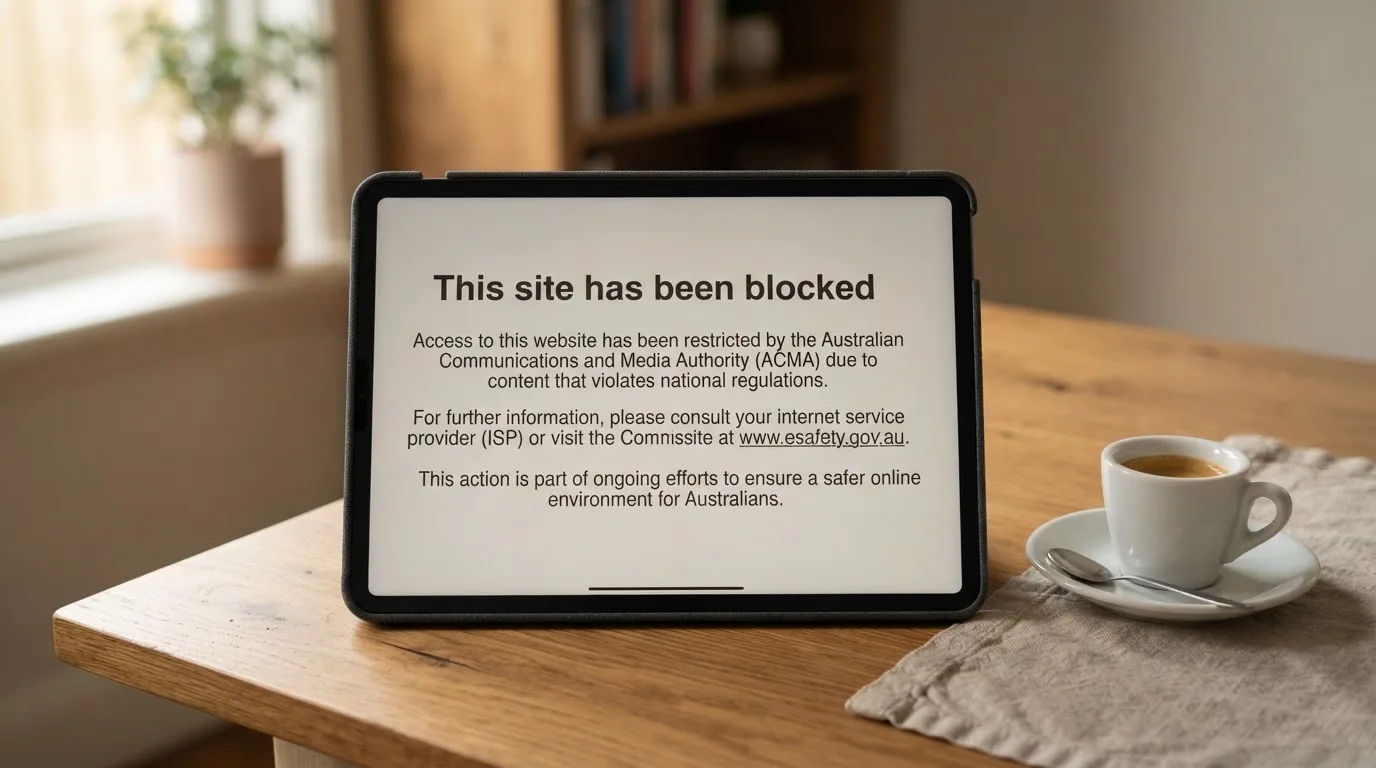
Enforcement sits with the Australian Communications and Media Authority. The ACMA investigates, issues formal warnings to operators and directs Australian internet service providers to block illegal sites. According to igamingbusiness.com reporting on the ACMA’s blocking round of 26 June 2026, a cumulative total of 1,751 illegal gambling and affiliate marketing websites had been blocked since the first blocking request in November 2019, and more than 230 unlicensed gambling services had left the Australian market since enforcement was strengthened in 2017. That same round added twelve more domains: 7Signs, ChromaBet, Donbet, Duospin, Freshbet, Slots Gem, Jacks Club, Lucky Start, Pointsbetz.com, Spinrise, Vinyl Casino and Wildsino.
A site that takes an Australian deposit is operating outside the framework. It carries no Australian consumer protection, no local complaints body, no chance of a regulator ordering it to pay a disputed withdrawal. It can also be added to a blocking list with player balances still on it. H2 Gambling Capital’s 2025 report, cited in the same igamingbusiness.com coverage, estimated that Australians lose about A$3.9 billion a year to illegal gambling sites, with the share of gambling going through legal channels falling from 74% in 2021 to 64%. That is the size of the market the “no minimum deposit” headline is competing for.
What enforcement has actually named, in order
The ACMA’s published formal-warning register is the closest thing to a public list of brands that have crossed the regulator’s desk. The dates matter: a 2022 warning may have been followed by years of silence from the regulator without the underlying conduct having changed. The order below follows the regulator’s own chronology, not the order in which the brands appear elsewhere on this page.
| Brand | ACMA action and date | Operator named by the ACMA | Subject support |
|---|---|---|---|
| Sky Crown | Formal warning under the IGA, 2022 | Hollycorn N.V. | — |
| Bambet, Dazard, Level Up, Rocketplay, Wild Tornado, Cobra Casinos | Formal warning under the IGA, May 2022 | Dama N.V. | — |
| Ignition Casino | Formal warning under the IGA, July 2025 | Bamboo Media | — |
| National Casino, Bizzo Casino | Formal warning under the IGA, July 2025 | Consolutetish S.R.L. | National Casino listings only (Gambling Insider, ACMA, AUSTRAC, BetStop) |
| Bizzo Casino (earlier round) | Formal warning under the IGA, 2022 | TechSolutions (CY) Group Limited and TechSolutions Group N.V. | Bizzo Casino listings only (Gambling Insider) |
| Casino Intense | Formal warning under the IGA, April 2025 | Sterplay Holding Ltd | Listings only (AUSTRAC, BetStop, Gambling Insider) |
| Woo Casino | Formal warning under the IGA, March 2025 | Dama N.V. | — |
| Spirit Casino | Formal warning under the IGA, May 2025 | Dama N.V. | — |
| Instant Casino | Formal warning under the IGA, February 2025 | EOD Code SRL | Listings only (ecoPayz, PayID) |
| Jackbit, CasinOK | Formal warning under the IGA, April 2026 | Ryker B.V. | — |
| Rocketplay.com.au | Formal warning under the IGA, March 2026 | Pulsup Ltd | Listings only (Gambling Insider) |
The brand-by-brand entries later in this page quote each warning individually. The table exists to show how the same operator can reappear under different names — Dama N.V. in 2022, 2025 and 2025 again — and how a brand the ACMA warned once (Bizzo Casino, in 2022) can be warned a second time under a different parent company (Consolutetish S.R.L., in 2025). The reader looking for reassurance in a fresh logo should read it as the same shape returning under a different wrapper.
Responsible gambling: what protection actually exists for an Australian player
Two things stop looking the same the moment an offshore site is in the picture: the self-exclusion register, and the credit-card ban.
BetStop, the National Self-Exclusion Register, has been live since August 2023. It binds Australian-licensed online and phone wagering services — meaning the licensed bookmakers under the Northern Territory, New South Wales, Victoria and other state regimes, plus the licensed sports and racing operators. A punter who registers excludes themselves across that licensed footprint at once. An offshore casino is not part of BetStop. Self-excluding with BetStop does not exclude the player from Rocketplay, Level Up, Woo, Spirit, National, Bizzo, Ignition, Instant, Jackbit, Casino Intense, Sky Crown or any of the dozens of similarly-positioned sites that have been the subject of ACMA formal warnings. The protection follows the licence, and the licence stops at the border.
The credit-card and credit-related-products ban has been in force since 11 June 2024. It applies to Australian-licensed online wagering. Operators who breach it face penalties up to A$247,500. Legal deposit routes for licensed wagering are debit card, bank transfer, PayID and Osko, and BPAY. A site asking an Australian for a credit card is already operating outside the Australian rules, and a site asking for a crypto deposit is doing the same, because crypto is a credit-related product for these purposes. The Interactive Gambling Act 2001 as amended in 2023 makes that explicit. The deposit method is itself a signal of where the operator sits.
For someone who recognises they have a problem, the National Gambling Helpline is 1800 858 858 — free, 24/7, with web chat at Gambling Help Online. For a self-managed cooling-off, the major Australian banks also offer gambling transaction blocks:
- Westpac blocks transactions at card level, refusing authorisation of any merchant-category-coded as “Betting/Casino Gambling” on eligible personal credit and debit cards.
- ANZ’s gambling block, activated in the ANZ app, also covers a Gambling Transaction made through a digital wallet such as Apple Pay on an eligible card, and removing the block carries a 48-hour cooling-off period; the bank warns that not all gambling transactions will be blocked and some non-gambling transactions might be blocked in error.
- Commonwealth Bank offers a gambling lock in the CommBank app for eligible cards, with the same caveat that it cannot guarantee every gambling-related purchase will be stopped.
These blocks are useful against licensed operators and against a chunk of the offshore market that processes through the Australian card networks. They are not a substitute for not depositing with an unlicensed site in the first place.
The crypto detour, and why it changes nothing for the player
A reader who reaches for bitcoin, ethereum or USDT to fund an offshore casino is solving the deposit-channel problem and creating a different one. The interactive gambling framework in Australia treats crypto as a credit-related product for the purposes of the IGA, so an Australian-licensed operator cannot accept it; an offshore site will take it gladly, but the offshore status is unchanged. Crypto does not legitimise an unlicensed venue. It does not give the player an Australian complaint path. It does not shield the balance from a blocking round that takes the site offline mid-session.
It does add a layer of fees the fiat path does not carry. Every on-chain transfer pays a network fee to the miners or validators. On Bitcoin and on Ethereum mainnet those fees are quoted in dollar terms that swing with congestion, and a “no minimum deposit” combined with a network fee that itself can run into double digits means the headline has nothing to do with the actual entry price. Some sites swallow the fee and pass it on later through an unfavourable exchange rate; some require a minimum in coin terms that translates to a moving dollar figure. The maths on a “no minimum” claim is rarely the maths the player is doing.
There is also no chargeback. A debit card that goes to a legitimate-looking but unlicensed casino can in some cases be disputed through the issuer; an on-chain payment cannot, because the ledger entry has no address to return funds to. Speed works in only one direction. Theft and reversal work in the other.
Payment rails and the cost of getting money in
The Australian payments stack is built for speed and identification, not for the “deposit A$1 and play” marketing claim. The mechanics are worth understanding because they explain why the offshore minimum is rarely the smallest spend the player makes.
PayID and Osko run over the New Payments Platform, which became accessible to the public on 13 February 2018 and is owned by New Payments Platform Australia Ltd, a non-profit whose shareholders include the Reserve Bank of Australia and the major banks. With Osko, a transfer between participating Australian banks arrives in under a minute, 24/7 including weekends, whether addressed to a BSB and account number or to a PayID. More than 25 million PayID identifiers had been registered on the platform as of April 2025, and PayID-based instant transfers are available at over 100 Australian financial institutions. The platform’s monthly outages are capped at two minutes.
A PayID transfer shows the recipient’s account name before the payer authorises it. Australian Payments Plus, the operator, warns that being asked to transfer money to a PayID on an illegal gambling site almost certainly means a scam site. The friction is built in on purpose: a punter who has to type a name into a confirmation box is harder to mislead than one who reads a banner ad and clicks.
BPAY is the older bill-payment rail, run by Australian Payments Plus alongside PayID and Osko. Launched on 18 November 1997, it sits inside the online banking of more than 140 Australian banks and financial institutions and is in use by over 95,000 businesses. The payer enters a Biller Code and a Customer Reference Number printed on the bill. It is the wrong rail for a casino deposit — it is built to send money to a biller with an account reference, not to fund a wagering account — but offshore operators have been known to use biller-style identifiers in PayID labels to look Australian.
Card surcharges matter because they shape what “no minimum” means at the entry point. The Reserve Bank of Australia’s July 2025 review proposes removing surcharges on eftpos, Mastercard and Visa transactions — and explicitly leaves American Express outside the scope of the proposed surcharge ban. American Express runs a three-party network rather than Visa and Mastercard’s four-party one, and Amex traditionally issues cards and processes transactions itself rather than through partner banks. For an Australian depositing with Amex, the surcharge is the difference between what the casino advertises and what the bank charges on top.
Digital wallets now carry a meaningful share of Australian card payments. By the end of 2025, Apple Pay, Google Pay and Samsung Pay transactions collectively accounted for around 45% of all card payments in Australia by number. The IGA’s credit-card ban constrains gambling use of linked digital wallets like Apple Pay. Apple itself does not charge consumer fees for using Apple Pay; any surcharge is the merchant’s own card-processing cost. Transaction limits and PIN requirements are set by the card issuer or the merchant, not by Apple. The wallet is a pass-through: the same restrictions on credit-card gambling apply on whichever device fronts the card.
AUSTRAC’s threshold-transaction-report rule, and why it does not bite ordinary players
AUSTRAC requires reporting of physical-cash transfers of A$10,000 or more. Ordinary electronic bank transfers are not subject to that per-transaction reporting threshold, regardless of the amount sent. The bank will see the deposit — it is the bank’s own transfer — but the transaction does not trigger an AUSTRAC report on its own. Reporting obligations sit with the receiving institution, not the sender. For the licensed operators, AUSTRAC enrolment and reporting are part of the cost of holding a licence. For an offshore site with no Australian presence, the receiving institution is whatever e-money or payment-service entity sits between the punter and the operator, and AUSTRAC’s reach is limited by where that entity is licensed.
What the banks block and what slips through
A typical Australian deposit to an offshore casino — Visa or Mastercard debit, Apple Pay or Google Pay on top of those — runs through a card-rail merchant category code that Australian banks have learned to recognise. Westpac’s card-level block refuses authorisation of any merchant-category-coded transaction in “Betting/Casino Gambling”. ANZ’s block extends to digital-wallet transactions on the underlying card. Commonwealth Bank offers the same lock in-app. The block fires on the merchant code, not on the casino name; an operator with a single merchant account could find its other products blocked too, and an operator that has routed around the code through a non-gambling MCC still goes through — until the bank updates its rules. The offshore industry has spent the last several years finding workarounds, and the banks have spent the same period tightening them. The dynamic is uneven, which is one reason a punter relying on the bank to enforce the line is relying on a moving line.
The cryptocurrency route bypasses the card block entirely. It also bypasses chargeback rights. The player’s recourse, on a balance they can see but not withdraw, is whatever the offshore operator’s complaints address eventually writes back.
The eleven brands the ACMA has named: a closer read
Each entry below is built from the ACMA’s published formal warnings and from the operator’s own public materials, where research carried them. The warnings are the regulator’s; the licence claims on the casino websites are the operators’. The two rarely line up.
1. RocketPlay — Dama N.V. legacy, Pulsup Ltd successor
RocketPlay was the subject of an ACMA formal warning in May 2022 as part of the Dama N.V. group covering six brands, and again in March 2026 under Pulsup Ltd over the Rocketplay.com.au domain. Two warnings, four years apart, against two different parent companies and the same brand name. The licence the site displays is the holder of one of the small offshore jurisdictions; none of them are Australian. Subject support: research carries only Gambling Insider listings, and these reflect how the brand has been marketed to Australian-facing traffic rather than what the operator offers locally. The verdict: the brand’s persistence across parents is itself the headline, and a punter looking at RocketPlay is looking at the same operational template under fresh letterhead.
2. Level Up Casino — first warned in 2022
Level Up Casino was named in the May 2022 Dama N.V. formal warning. No second ACMA action has been published against the Level Up brand itself, although Dama N.V. has continued to attract attention at the group level — Woo and Spirit Casino were both warned in 2025. Research carries only Westpac listings for Level Up, which is the bank’s gambling-block documentation rather than operator-supplied terms. The verdict: a 2022 warning without a follow-up is not a clean bill of health; it is the regulator having decided the warning was sufficient at the time. Re-emergence under a new owner is the typical pattern, not the exception.
3. Woo Casino — Dama N.V. again, March 2025
Woo Casino received an ACMA formal warning under Dama N.V. in March 2025, three years after the same parent company was warned over a six-brand block. Research carries no additional subject support for Woo — the brand operates, like most of the offshore list, without a published Australia-facing footprint. The verdict: Woo is the same parent company the regulator warned over in 2022, which makes the 2025 warning a follow-up the regulator did not have to issue.
4. Spirit Casino — Dama N.V., May 2025
Spirit Casino received an ACMA formal warning in May 2025 under Dama N.V., the second Dama N.V. warning that year. No published subject-support data is available for Spirit Casino through research. The verdict: the regulatory position is identical to Woo’s — the parent company has been warned repeatedly, and the licence the casino displays is not Australian.
5. National Casino — warned July 2025
National Casino received an ACMA formal warning in July 2025 under Consolutetish S.R.L.. Subject support is listings only — the ACMA, AUSTRAC, BetStop and Gambling Insider all appear in research as carrying National Casino content, none of which is the operator’s own marketing. AUSTRAC and BetStop show up because the brand has been linked to anti-money-laundering discussions and to self-exclusion coverage, not because the brand is enrolled in either. The verdict: National Casino’s footprint in the listings is itself the story. A brand that is named on AUSTRAC discussion pages and the regulator’s warning list is operating in the territory the regulator polices.
6. Bizzo Casino — warned twice, four years apart
Bizzo Casino is the brand on this page with the longest warning history. The ACMA issued a formal warning over Bizzo in 2022, addressed to TechSolutions (CY) Group Limited and TechSolutions Group N.V.. The regulator came back in July 2025 with a second formal warning, this time addressed to Consolutetish S.R.L.. Two operators, four years apart, the same brand. Subject support is Gambling Insider listings only. The verdict: a brand the regulator has had to warn twice is a brand the regulator’s first warning did not change. The second warning is the regulator’s own acknowledgement that the first round did not stop the conduct.
7. Ignition Casino — Bamboo Media, July 2025
Ignition Casino received an ACMA formal warning in July 2025 under Bamboo Media. No published subject-support data is available in research. The verdict: a single formal warning, no prior history on the regulator’s register, places Ignition in the same legal category as the rest of the list — an offshore operator advertising to Australians — but with a thinner history than the brands the ACMA has had to revisit.
8. Instant Casino — EOD Code SRL, February 2025
Instant Casino received an ACMA formal warning in February 2025 under EOD Code SRL. Subject support is listings only on the ecoPayz and PayID rails. The PayID listing is significant: a brand that surfaces in PayID context is a brand that has tried to take Australian bank transfers directly, which is the rail an Australian punter is most likely to use without thinking about it. The verdict: Instant Casino is one of the closer fits to the “deposit A$1 and play” promise the rest of the list gestures at, which is also the reason it is on the regulator’s list.
9. Jackbit — Ryker B.V., April 2026
Jackbit was named in an ACMA formal warning in April 2026 along with CasinOK, under Ryker B.V.. The licence Jackbit displays is not Australian. No published subject-support data is available. The verdict: the more recent the warning, the more likely the operator has been advertising actively to Australian traffic in the period leading up to it. Jackbit’s April 2026 warning is fresh on the register.
10. Casino Intense — Sterplay Holding Ltd, April 2025
Casino Intense received an ACMA formal warning in April 2025 under Sterplay Holding Ltd. Subject support is listings only on AUSTRAC, BetStop and Gambling Insider. The AUSTRAC and BetStop listings sit alongside the regulator’s warning, which is the same combination National Casino carries: a brand that the regulator and the wider anti-money-laundering and self-exclusion ecosystem have all had occasion to discuss. The verdict: a brand that the regulator has warned and that surfaces in those two registers is operating in the territory the regulator polices, with no Australian licence to set against it.
11. Sky Crown — Hollycorn N.V., 2022
Sky Crown was the subject of an ACMA formal warning under Hollycorn N.V., published as a PDF in September 2022, alongside Hollycorn’s Blue Leo brand. No published subject-support data is available. The verdict: Sky Crown is the oldest warning on this page after the Dama N.V. 2022 group, and it is the brand whose Australian-facing activity has had the longest time to either wind down or relocate. The fact that the brand is still listed under Hollycorn N.V. in current research suggests the latter.
How fast does the ACMA actually block sites?
The blocking rate is the only quantitative angle this page has, and it is the one that lets the reader convert the regulator’s catalogue into a pace. The ACMA’s published total sits at 1,751 blocked sites since the first blocking request in November 2019, and the most recent blocking round added twelve more on 26 June 2026. The arithmetic the page is in a position to do is the average pace of blocking across the years that figure spans, presented as a band because the annual rate is not steady.
Between November 2019 and June 2026 is roughly six and a half years, or 78 months. The 1,751 sites over 78 months gives an average of around 22 sites per month across the whole enforcement window, but that is the average for the entire window including the early years when the regulator was building the process. In practice, blocks have come in published rounds of varying size, and the round-by-round rate has accelerated as the ACMA’s blocking infrastructure has matured. The reader-facing answer is therefore not a single monthly figure but a band: somewhere between the slow start of the early years, when single-digit round sizes were the norm, and the more recent rounds, where the per-month pace runs well into double digits and the 26 June 2026 round alone added twelve. A reasonable reading of the published record is a current pace of roughly fifteen to thirty sites blocked per month, with the historical average across the full window sitting lower.
The band matters more than a single figure because it tells the reader that the regulator’s tempo has not slowed. A brand that took a deposit from an Australian last week is operating in a window during which more sites have been added to the blocking list than in any comparable period before. The asymmetry is what makes the deposit decision irreversible: a blocked site with a balance still on it is a balance the punter is not getting back through any channel the regulator can reach.
The legal layer behind every ad
A second bill has now passed the Parliament. The Interactive Gambling Amendment (Gambling Reform) Bill 2026 passed on 19 August 2026; its advertising and inducement measures commence on 1 January 2027. On this page, which is published before the commencement date, that bill is law with a future start date — not yet in force. Once it is in force, the inducement language of the kind this page describes is the next front of the regulator’s enforcement. Until then, the ACMA’s existing powers under the Interactive Gambling Act 2001 as amended in 2017 are what the reader is operating against.
The minimum age for any wagering in Australia is 18. Recreational gambling winnings are not assessable income under section 6-5 ITAA 1997, and losses are not deductible; the position changes only if the person carries on a business of gambling, which is not the model for the reader of a no-minimum-deposit review. Tax is a non-issue for the typical deposit; the IGA’s reach is the issue.
On BetStop and what it covers
BetStop is the practical enforcement arm of responsible gambling for licensed operators, and the practical gap for unlicensed ones. A punter who registers with BetStop is excluded across every Australian-licensed online and phone wagering service at once. They are not excluded from the eleven brands on this page, nor from any other offshore operator advertising to Australians. The line BetStop draws is the same line the IGA draws: the licence.
On payment methods that should raise the alarm
A site asking for a credit card is asking for a payment method banned for Australian-licensed wagering since 11 June 2024. A site asking for a credit-related product — and that includes cryptocurrency for IGA purposes — is in the same position. A site taking deposits only via crypto, or only via a card route that involves a non-Australian intermediary, is signalling where it sits in the regulatory frame. The licensed alternatives — debit card, bank transfer, PayID, Osko, BPAY — are not on offer because the site is not licensed. The absence of those rails is the signal.
Comparison of the eleven brands, side by side
The columns below mirror the table earlier in this page and add a fifth column — the ACMA standing as of the latest published action. This is the only comparison the reader can do with confidence, because every other dimension the brands claim in their marketing is a marketing claim, not a regulator-confirmed fact. Where research carries no data for a brand, the cell stays blank.
| Brand | Latest ACMA action | Operator named by the ACMA | First warning | Subject support |
|---|---|---|---|---|
| Sky Crown | Formal warning under the IGA, 2022 | Hollycorn N.V. | 2022 | — |
| Bambet | Formal warning under the IGA, May 2022 | Dama N.V. | May 2022 | — |
| Dazard | Formal warning under the IGA, May 2022 | Dama N.V. | May 2022 | — |
| Level Up Casino | Formal warning under the IGA, May 2022 | Dama N.V. | May 2022 | — |
| RocketPlay | Formal warning under the IGA, March 2026 | Pulsup Ltd | May 2022 | Listings only |
| Wild Tornado | Formal warning under the IGA, May 2022 | Dama N.V. | May 2022 | — |
| Cobra Casinos | Formal warning under the IGA, May 2022 | Dama N.V. | May 2022 | — |
| Casino Intense | Formal warning under the IGA, April 2025 | Sterplay Holding Ltd | April 2025 | Listings only |
| Ignition Casino | Formal warning under the IGA, July 2025 | Bamboo Media | July 2025 | — |
| National Casino | Formal warning under the IGA, July 2025 | Consolutetish S.R.L. | July 2025 | Listings only |
| Bizzo Casino | Formal warning under the IGA, July 2025 | Consolutetish S.R.L. | 2022 | Listings only |
| Instant Casino | Formal warning under the IGA, February 2025 | EOD Code SRL | February 2025 | Listings only |
| Woo Casino | Formal warning under the IGA, March 2025 | Dama N.V. | March 2025 | — |
| Spirit Casino | Formal warning under the IGA, May 2025 | Dama N.V. | May 2025 | — |
| Jackbit | Formal warning under the IGA, April 2026 | Ryker B.V. | April 2026 | — |
| Rocketplay.com.au | Formal warning under the IGA, March 2026 | Pulsup Ltd | March 2026 | Listings only |
The pattern is plainest at the parent-company level. Dama N.V. accounts for eight of the entries here. Hollycorn N.V. accounts for one. Consolutetish S.R.L. accounts for two. Each cluster is the regulator telling one operator to stop, and the operator either winding down, restructuring, or re-emerging under a new parent within a few years. The brand survives; the parent does not.
Frequently asked questions
What is the smallest deposit a casino can realistically accept before payment fees make it pointless?
Below roughly A$5 the cost of moving the money to the operator starts to outweigh the size of the deposit itself, because every payment rail takes a cut — fixed per transaction on the crypto networks, percentage-based on the card rails — and the smallest meaningful stake on most slot machines runs at A$0.20 to A$0.50 per spin, so a A$1 deposit gives the player a session measured in single-digit spins. The “no minimum” headline is the absence of a casino-imposed floor, not the absence of a cost.
Does a crypto casino with no minimum deposit behave any differently to a fiat one with the same claim?
The headline is the same; the underlying mechanics are not. A crypto casino is processing on-chain transactions that pay a network fee every time, and the fee is unrelated to the deposit size, so the ratio of fee to deposit gets worse as the deposit shrinks. Fiat routes carry a percentage-based card fee rather than a fixed network fee, and the licensed Australian rails — PayID, Osko and BPAY — carry no consumer fee at all. The crypto route also removes any chargeback route, which is the route the fiat punter has if the operator refuses a withdrawal.
Is any casino advertising “no minimum deposit” actually licensed to accept Australian players?
No. The Interactive Gambling Act 2001 makes online casino games and online pokies prohibited interactive gambling services, and no state or territory licenses them. Every brand on this page is an offshore operator that has been the subject of an ACMA formal warning for offering prohibited services to Australians. The licences those operators display on their websites are issued by other jurisdictions and carry no force in Australia.
How does a bitcoin casino’s “no minimum deposit” claim interact with blockchain network fees?
It collides with them. The on-chain transfer pays a fee to miners or validators, and the fee is quoted in dollar terms that swing with network congestion. On Bitcoin and on Ethereum mainnet that fee can run into double-digit dollars at busy periods, which dwarfs a “no minimum” claim. Some sites quote a minimum in coin terms — a fixed number of satoshis or gwei — rather than a dollar floor, and the dollar equivalent of that minimum moves with the exchange rate. The advertised “no minimum” is rarely the smallest dollar amount a player can actually send and have arrive at the casino credited to their balance.
Why do “no minimum deposit” casino ads specifically say “no minimum” rather than a dollar figure?
Because a dollar figure can be compared, and “no minimum” cannot. A player who reads A$1 understands the deposit size in their own currency; a player who reads “no minimum” is invited to assume the casino has decided cost is no object. The cost is in the payment rail, the wagering requirements, the bonus terms and the network fee, and the absence of a stated minimum is the operator’s way of not starting that conversation. The phrase is a marketing line, and it works the same way other marketing lines do.
What should someone compare before trusting a “no minimum deposit” claim across several sites?
Three things, none of which appear in the headline. First, whether the operator is licensed to take Australian players at all — and the answer across this category is no. Second, the rail on which the deposit moves and what that rail costs at the smallest sensible deposit. Third, the regulator’s standing with the operator, which in Australia means the ACMA’s formal-warning register and the blocking list. A site that does not appear on either has not been put to the test; a site that does appear has. The “no minimum” line itself tells the reader nothing useful either way.