
Live baccarat online in Australia: the cost behind the stream
A live baccarat table streamed from a studio in Curaçao or the Philippines looks the part: a real dealer, real cards, a chat box running alongside the bet layout. The picture it sells is the picture of an evening at the baccarat pit in Melbourne, except that the player is on the couch, the bet is in bitcoin, and the regulator named on the site footer is somewhere else entirely. For an Australian resident, that picture carries a price tag the marketing page does not print. The Interactive Gambling Act 2001 treats a live-dealer baccarat hand the same as a computer-generated one: both are prohibited. The Australian Communications and Media Authority has spent six years quietly telling offshore operators the same thing, and the operators keep changing names.
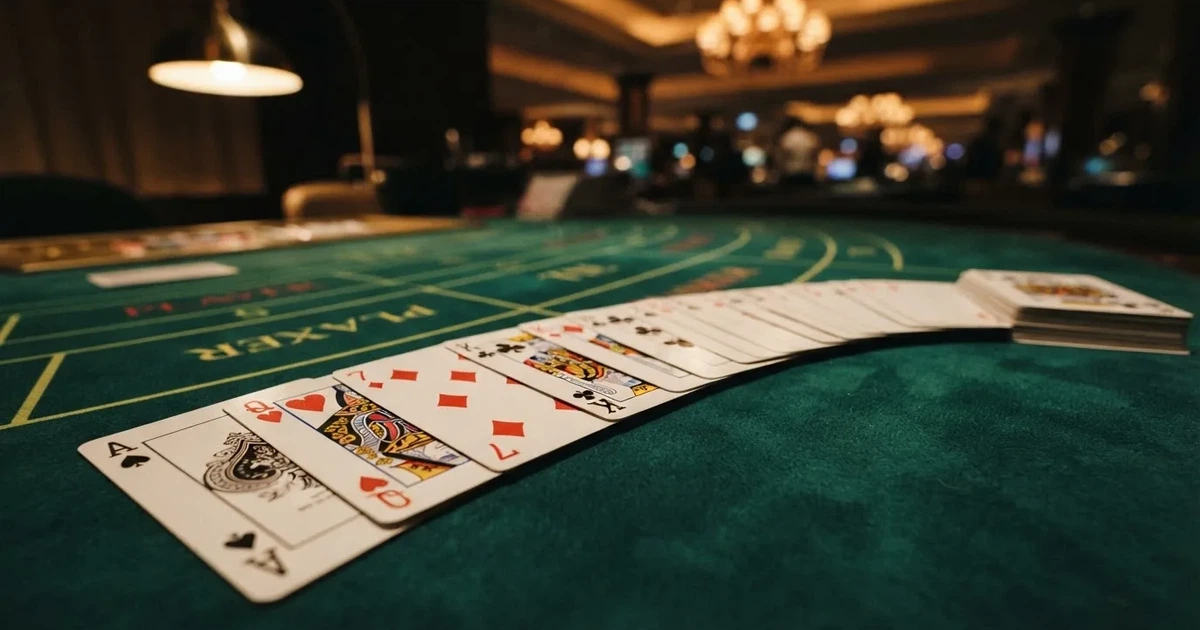
This page is built around that fact rather than around it. The fundamentals of the game are short and worth stating cleanly — the Banker bet carries a 1.06% house edge, the Player bet 1.24%, and the Tie bet 14.36%.
| Bet | House Edge |
|---|---|
| Banker | 1.06% |
| Player | 1.24% |
| Tie | 14.36% |
What sits beside those numbers is a regulator’s tally of 1,751 blocked websites, an estimated A$3.9 billion a year lost to illegal sites, and a list of eleven specific operators the ACMA has formally warned. Each of those warnings names a real operating company and a real Australian-facing brand. None of them offer what the marketing claims to offer, because what the marketing claims to offer is itself the thing that is prohibited.
The data in this page is current as of 29 October 2026 and was checked against the ACMA’s published list of formal warnings and blocking actions.
Table of Contents
- Legality and regulation: the Interactive Gambling Act 2001, in plain terms
- Responsible gambling: what the pace of the shoe does
- Bitcoin, crypto and the payment-rail question
- Live tables, providers and the game itself
- The blocked and warned list: how the ACMA tally is shaping up
- The operators: eleven brands, eleven formal warnings
- Landscape: what the picture looks like as a whole
- Overview: what the player is actually choosing between
- Frequently asked questions
Legality and regulation: the Interactive Gambling Act 2001, in plain terms
Australia’s online gambling regime has one sentence that does most of the work: the Interactive Gambling Act 2001 makes it an offence to provide online casino-style games, including live-dealer baccarat, to customers physically present in Australia. The Interactive Gambling Amendment Act 2017 turned that sentence into something the ACMA can enforce. The individual player is not the target. The provider is. Corporations face penalties of up to A$1.1 million per day and individuals up to A$220,000 per day for supplying a prohibited interactive gambling service to an Australian. What is licensable, and what licensed Northern Territory operators like Sportsbet, Bet365 and Ladbrokes actually offer, is wagering on racing and sport before the event, plus lotteries and keno. A live baccarat table is none of those.

That sentence is short, but the practice around it is not. The ACMA’s enforcement goes through three channels. It investigates complaints. It issues formal warnings to operators, which carry no direct fine but start a record that escalates into blocking. And it asks Australian internet service providers to block specific domains. According to the ACMA as reported in June 2026, 1,751 illegal gambling and affiliate marketing websites have been blocked since the first blocking request in November 2019. More than 230 unlicensed gambling services have left the Australian market since enforcement was strengthened in 2017. Those are not round numbers the regulator pulled from the air; they are the running total of what enforcement has actually done, six years in.
In the round reported on 26 June 2026, the ACMA asked ISPs to block 12 more sites in one batch: 7Signs, ChromaBet, Donbet, Duospin, Freshbet, Slots Gem, Jacks Club, Lucky Start, Pointsbetz, Spinrise, Vinyl Casino and Wildsino. A live baccarat table runs on at least some of those brands. The site footer that says “Curacao eGaming” or “Antillephone N.V. authorised” does not change the answer, because the licence that matters is the one that allows the operator to take bets from Australia, and there is no such licence for online casino games.
What an Australian resident actually faces is narrower than the prohibition sounds. Playing a hand of live baccarat from a Sydney apartment is not itself a criminal offence; the IGA targets the provider. What the player loses is the consumer protection layer that a licensed operator is required to give. There is no Australian complaints body. There is no local recourse if a withdrawal is refused or a bonus balance is voided. And if the ACMA blocks the domain while a balance is still sitting on the account, the player has no Australian channel through which to recover it. That is the practical price of the stream.
A second piece of regulation cuts in at the payment layer. Since 11 June 2024, credit cards, credit-related products and digital currency have been banned as payment for licensed online wagering in Australia, with penalties up to A$247,500 for the operator taking them. The legal deposit routes for a licensed wagering account are debit card, bank transfer, PayID and Osko, and BPAY. A site asking an Australian player for a credit card or a crypto deposit is, by definition, not an Australian-licensed operator — because a licensed operator cannot legally take that payment. The bitcoin-funded live baccarat table that ranks well in a search result is doing so because the operator is not under Australian rules, not because bitcoin is a clever workaround.
A third piece is the reform that has passed Parliament but has not yet started. The Interactive Gambling Amendment (Gambling Reform) Bill 2026 passed Parliament on 19 August 2026. Its advertising and inducement measures commence on 1 January 2027. On a 2026 page, that is a law with a start date, not yet in force: it shapes what 2027 will look like but does not change what an Australian resident can do in 2026.
Responsible gambling: what the pace of the shoe does
Live baccarat is unusually fast for a table game. A dealer running a shoe of six or eight decks through the punto banco drawing rules — Banker draws a third card on totals of 0-2 and stands on 7, Player draws on 0-5 and stands on 6-8, with the more complex Banker stand-on-third rules layered on top — finishes a hand every thirty to forty seconds in a well-run studio. The pace is built in, not added: the dealer’s two hands are played out by fixed rules with no decision from the punter after the initial bet. That is what makes the game attractive to the operator, and what makes it dangerous to a session budget that was set in good faith an hour earlier.

Australia’s responsible-gambling architecture is built around three things a player can use. The first is BetStop, the National Self-Exclusion Register. It went live in August 2023. It binds every Australian-licensed online and phone wagering service, which means every bookmaker licensed by the Northern Territory Racing and Wagering Commission and every state lottery operator connected to the register. An offshore casino is not connected to BetStop. Self-excluding through BetStop does not stop a single Bitcoin-funded live baccarat hand being placed at a Curaçao-licensed site; it stops the licensed Australian bookmakers from taking a bet, which is a different category of bet. The architecture assumes the operator is in scope. Most live baccarat operators are not.
The second is the National Gambling Helpline on 1800 858 858. It is free, it runs 24 hours a day, and it has a chat option through Gambling Help Online. It is not a gambling operator and it is not a regulator; it is a counselling service. For a player who has lost track of a session, or who suspects they have, it is the most useful number on this page.
The third is a session limit set before the stream starts. The arithmetic that justifies this is unglamorous but real: at forty seconds per hand, a one-hour session contains roughly ninety hands. At the lowest practical chip size, that is a fixed hourly exposure; at a higher chip size, the bankroll can disappear in the time it takes to make a cup of tea. Setting the limit before the first card is dealt is not a moral statement; it is the practical acknowledgement that the pace of the shoe does not pause for a budget review.
A point that is often missed: the offshore site’s own responsible-gambling tools, where they exist, are not enforced by anyone with a duty to the player. A “deposit limit” set on a Curaçao-licensed brand is a feature of that brand’s own software, with that brand’s own incentives behind it. An Australian resident relying on it is relying on the same operator that just took an illegal bet.
Bitcoin, crypto and the payment-rail question
The marketing around bitcoin baccarat is built on a simple substitution: the same dealt cards, the same paytable, only the payment rail changed. That substitution is real at the technical level — a crypto deposit at a live baccarat table buys chips that pay the same 1.06% on the Banker bet and the same 14.36% on the Tie. What the substitution does not change is the legal status of the table itself. Bitcoin is the rail; the Interactive Gambling Act 2001 is the law. A bitcoin deposit to a Curaçao-licensed live dealer studio is still a deposit to a prohibited interactive gambling service.
The Australian-side picture is sharper than the rail picture. The 11 June 2024 ban on credit cards and digital currency as payment for licensed online wagering is an Australian rule about Australian-licensed operators. It says: if you are licensed in Australia, you cannot take bitcoin or a credit card from a punter. A site taking bitcoin from an Australian resident is, by that ban alone, not in the Australian-licensed set. The ban does not need to be enforced against the player; it just narrows the licensed field by one payment method at a time.
For a player, the practical differences are three. First, a bitcoin deposit is irreversible in the way a debit card transaction is not: a chargeback through an Australian bank is not an option for a transfer that has already cleared on-chain. Second, the operator’s KYC burden is the operator’s choice, not the regulator’s: an Australian player sending bitcoin to a site that does not verify identity has given up the only consumer protection the law might have offered through the payment rail. Third, a crypto-funded balance has no Australian complaints body behind it. If the operator refuses to pay a withdrawal, the punter is left with whatever dispute mechanism the site itself publishes, which is not a binding mechanism at all.
What the rail change does deliver, fairly, is speed. A bitcoin deposit clears faster than a bank transfer, often within minutes rather than the next business day. For an Australian resident who has decided to play anyway, that is a real operational benefit. The arithmetic underneath it is unchanged: the house edge is 1.06% on Banker, 1.24% on Player, 14.36% on Tie, and the operator’s house edge does not move because the deposit was in BTC rather than AUD.
Live tables, providers and the game itself
Live baccarat is a video stream of a human dealer running a shoe through a fixed set of drawing rules, with bets placed through an on-screen chip layout. The cards are real; the dealing is real; the chat box on the side of the screen is sometimes answered by the dealer between hands. The differences from a computer-generated baccarat game are practical, not fundamental: the dealing is slower (the shoe physically runs out), the social layer is present (the dealer is a person, not an RNG), and the casino’s overhead is higher (a studio, a shift rota, several cameras per table). For the player, the pace moves from a click-to-spin feel to a half-second-pause-per-hand feel.
Punto banco, the variant played at virtually every live baccarat table online, is the form the game takes once it left the European chemin de fer tradition. In punto banco, the casino banks the game at all times: both hands are dealt according to fixed drawing rules with no decision from the punter after the bet. That is what makes the game suited to a live-stream format — there is nothing for the player to do but place the bet. Chemin de fer, the French variant the game grew out of, lets the players take turns banking and lets the punter choose whether to draw a third card; it is almost never the version streamed.
The mechanics are short. Cards 2-9 count at face value, tens and the face cards count as zero, and aces count as one. Hand totals are taken modulo ten, so a hand of 7 and 8 is worth 5 and a hand of 13 and 9 is worth 2. Punto banco is dealt from a shoe of six or eight decks. Three bets are on the layout. Betting on Banker pays even money, less a 5% commission the house takes on a winning bet, and carries the 1.06% house edge. Betting on Player pays even money with no commission, and carries the 1.24% house edge. Betting on Tie pays 8 to 1 (occasionally 9 to 1 in some rule sets) and carries the 14.36% house edge. There is no strategy decision after the initial bet: the punter picks a side and watches the cards.
Where players sometimes go wrong is in reading “no decision” as “no information”. The shoe, run from six or eight decks, has structure: the composition of cards remaining changes as the shoe depletes, and serious counters do track it. That is not a strategy an Australian punter at an offshore live baccarat table will run; it is something a casino in Melbourne runs as a matter of course, with a floor supervisor monitoring the action across the pit. The live stream gives the punter none of that surveillance — it gives the punter a video of a shoe and a chip layout, and nothing else.
The history of the game is brief. Some accounts place baccarat in nineteenth-century France; others trace it to Italy at the end of the fifteenth century, during the reign of Charles VIII, with the writer David Parlett considering the game Macao its immediate precursor. Punto banco was developed in Havana in the 1940s; chemin de fer, French for “railway”, emerged from baccarat banque in the late nineteenth century and was named for being quicker to play than the original. None of that matters to a bet placed tonight, but it explains why the Australian regulator’s reference point — Crown Melbourne’s three baccarat variants (Traditional Baccarat, Crown Baccarat and 2 to 1 Baccarat), approved by the Victorian Gambling and Casino Control Commission which replaced the VCGLR as Victoria’s casino regulator on 1 July 2022 — looks the way it does.
The blocked and warned list: how the ACMA tally is shaping up
The ACMA publishes a running tally of formal warnings and a separate tally of blocking requests, and the two together describe what offshore operators are doing to Australian residents in any given quarter. The numbers are not the regulator’s opinion; they are the regulator’s record. A formal warning is a published notice that names the operator company, the brand, the date, and the legal basis for the warning. A blocking request is the regulator’s next move, taken when a warning does not move the operator off Australian-facing business.
H2 Gambling Capital’s 2025 report, cited by the industry press, estimates that Australians lose about A$3.9 billion a year to illegal gambling sites, and that the share of gambling going through legal channels fell from 74% in 2021 to 64%. That is the demand-side number: what Australian residents actually do, in aggregate, with the offshore market that the IGA prohibits. The supply-side number is the blocking tally — 1,751 blocked sites since November 2019 — and the warnings tally, which is published brand by brand on the ACMA website. The two sets describe different things and they reinforce each other: the more sites the ACMA blocks, the more aggressively the surviving operators market, and the more Australians lose to them.
The arithmetic that the page owes the reader is the blocking rate itself. The 1,751 figure covers the period from the first blocking request in November 2019 to the June 2026 publication date. Working it out: roughly 1,751 blocks across roughly 80 months, which gives a running average in the low twenties per month over the full window — but the rate is not flat. Early rounds moved slowly; later rounds, after the 2017 amendments and the ACMA’s expanded enforcement remit, have moved faster, with the 26 June 2026 round alone adding 12 sites in one batch. Stated as a band rather than a single number: the regulator has been adding illegal gambling and affiliate marketing sites to the block list at a rate that has ranged from single digits in the early period to roughly 12 or more in the most recent published rounds, with no sign yet of a slowdown.
What the rate means for a player is what the rate means for an offshore operator. Each site on the block list is a domain Australians cannot reach through a normal ISP, and each new blocking round signals that the regulator is willing to ask ISPs to add new names rather than wait for the old ones to age out. For a player, that is the regulator doing what the IGA asks it to do. For an offshore operator, that is the cost of doing business in Australia, and it is why the operator list is long and rotates.
The operators: eleven brands, eleven formal warnings
The eleven brands below are not a ranking. They are not a recommendation. They are a set of offshore operators the ACMA has formally warned for offering prohibited interactive gambling services to Australian residents, drawn from the regulator’s own published list. The page describes them; it does not advertise them. Each entry names the operating company the ACMA named, the date of the warning, and the relevant fact. The takeaway for a reader is not “which one is best”; it is “these are the operators the regulator is currently telling to stop”.
RocketPlay
RocketPlay sits at the top of the ACMA’s enforcement record because it has been warned twice. The first warning was issued in May 2022 to Dama N.V., covering six brands including Rocketplay along with Bambet, Dazard, Level Up, Wild Tornado and Cobra Casinos. The second warning, dated March 2026, was issued to Pulsup Ltd specifically over Rocketplay. The second warning is the ACMA picking up where the first left off: when one operating company moves the brand, the regulator follows it to the new company and warns again. The pattern repeats across most of this list. The site’s own marketing describes bonuses and tournaments; the operator’s own regulatory record describes two formal warnings in four years.
Level Up Casino
Level Up Casino is one of the six Dama N.V. brands named in the May 2022 warning. The brand surfaces on third-party listings of baccarat-compatible sites, but the only subject support the regulator’s own materials carry is the warning itself: the IGA applies, the warning was issued, the brand has not been removed from Australian-facing business. There is no ACMA-published update that Level Up has changed ownership since 2022.
Woo Casino
Woo Casino is the second Dama N.V. brand to appear on the ACMA’s published list after a fresh formal warning, dated March 2025. The 2025 warning sits alongside the May 2022 warning as evidence of the regulator’s habit of returning to the same operator: a 2022 warning is not the last word, and a 2025 warning against the same operator for a different brand carries the same legal weight. Woo’s own footer describes Curaçao licensing; the regulator’s own record describes a prohibited service to Australians.
Spirit Casino
Spirit Casino is the third Dama N.V. brand to receive a standalone formal warning, dated May 2025. Two years and a month separates the 2022 multi-brand warning from the 2025 Spirit Casino warning, which suggests the operator responded to the 2022 warning by continuing under a different brand rather than by leaving Australia. That is the pattern the regulator’s record shows across most of the list.
National Casino
National Casino is one of two Consolutetish S.R.L. brands named in a formal warning dated July 2025, the other being Bizzo Casino. The brand surfaces on third-party listings as a baccarat-compatible site; the ACMA’s record describes a prohibited service. National Casino is the second of the two Consolutetish brands, and the warning sits alongside the 2022 warning to TechSolutions (CY) Group Limited and TechSolutions Group N.V. over Bizzo, which means the regulator has tracked this operator across two corporate structures in three years.
Bizzo Casino
Bizzo Casino has the longer ACMA file of the two Consolutetish brands. A formal warning was issued to TechSolutions (CY) Group Limited and TechSolutions Group N.V. over Bizzo in 2022, and a second formal warning was issued to Consolutetish S.R.L. over Bizzo in July 2025. Two warnings, two corporate vehicles, one brand: that is what the regulator’s record shows when an operator tries to stay in Australian-facing business by changing the company name on the footer.
Ignition Casino
Ignition Casino is named in a formal warning issued in July 2025 to Bamboo Media. The brand positions itself for Australian-facing traffic through an offshore corporate structure; the ACMA’s published warning describes a prohibited service to Australian residents. The brand name carries poker and casino verticals; the warning covers the casino offering.
Instant Casino
Instant Casino is named in a formal warning issued in February 2025 to EOD Code SRL. The brand is one of the more recent entries on the regulator’s published list, and the formal warning is the only public record of the regulator’s engagement with this operator.
Jackbit
Jackbit is one of two brands named in a formal warning issued in April 2026 to Ryker B.V., the other being CasinOK. The April 2026 warning is among the most recent on the published list, and the regulator’s record is the only public confirmation that the brand has been offering prohibited services to Australians.
Casino Intense
Casino Intense is named in a formal warning issued in April 2025 to Sterplay Holding Ltd. The brand surfaces on Australian-facing media coverage and on third-party listings; the ACMA’s record describes a prohibited service. The April 2025 warning is the only formal action published for this brand.
Sky Crown
Sky Crown is one of two Hollycorn N.V. brands named in a formal warning, the other being Blue Leo. The warning is the oldest on this list, dating to September 2022, and it is also the one for which the ACMA’s record carries the most supporting documentation — including the published PDF that the regulator uses as a standard format for formal warnings. Sky Crown has not been the subject of a fresh warning since 2022, but the absence of a fresh warning is not an Australian licence; the original warning stands, and the IGA applies regardless.
Landscape: what the picture looks like as a whole
Putting the eleven operators side by side is the comparison the ACMA’s published list itself runs. The columns that matter are the date the regulator last acted, the operating company named in the warning, and whether the brand carries any subject support from the regulator’s own materials or only from third-party listings.
| Brand | ACMA action and date | Operator named by the ACMA | Subject support |
|---|---|---|---|
| RocketPlay | Formal warning, March 2026 (and May 2022) | Pulsup Ltd (March 2026); Dama N.V. (May 2022) | — |
| Level Up Casino | Formal warning, May 2022 | Dama N.V. | Listings report baccarat availability |
| Woo Casino | Formal warning, March 2025 | Dama N.V. | — |
| Spirit Casino | Formal warning, May 2025 | Dama N.V. | — |
| National Casino | Formal warning, July 2025 | Consolutetish S.R.L. | Listings report baccarat availability |
| Bizzo Casino | Formal warning, July 2025 (and 2022) | Consolutetish S.R.L. (July 2025); TechSolutions (2022) | — |
| Ignition Casino | Formal warning, July 2025 | Bamboo Media | — |
| Instant Casino | Formal warning, February 2025 | EOD Code SRL | — |
| Jackbit | Formal warning, April 2026 | Ryker B.V. | — |
| Casino Intense | Formal warning, April 2025 | Sterplay Holding Ltd | Listings report baccarat availability |
| Sky Crown | Formal warning, September 2022 | Hollycorn N.V. | — |
The pattern the table carries is the same pattern the page has been describing. The same operating company names appear multiple times under different brands. The same brand appears under different operating companies at different dates. The regulator follows both moves. None of the eleven entries carry a subject support line drawn from the regulator’s own materials; the three entries that carry any subject support at all do so only on the strength of third-party listings. That is what the picture looks like when the regulator’s own record is the only authoritative source.
The cost of the picture, for a reader, is what the picture is for. A punter comparing the eleven brands as though they were a menu of options is reading the table the wrong way. The table is a list of operators the ACMA has told to stop; the comparison between them is not “which has the best bonus” but “how many formal warnings has this one accumulated, and how recently”. A player who reads the table as a menu has already misread it.
Overview: what the player is actually choosing between
Strip the offshore market back to its bones and an Australian resident has three options, not eleven. The first is to play at a licensed Australian venue. Crown Melbourne offers three baccarat variants — Traditional Baccarat, Crown Baccarat and 2 to 1 Baccarat — under Victorian Gambling and Casino Control Commission approval. The variants are regulated under section 66 of the NSW Casino Control Act 1992 in NSW and the equivalent provisions in other states, which require the regulator to approve the game and its rules and the operator to make those approved rules available on request. Under NSW law, a casino operator must not permit baccarat to be played unless the game and its rules are approved. The Victorian equivalent, in the Casino Control Act 1991, requires the VGCCC to approve any rules for table games before they are introduced at the Melbourne casino. The player at Crown Melbourne is gambling under a regime the player can read.
The second option is not to gamble on casino games online at all. The licensable online activities in Australia are wagering on races and sport before the event, lotteries and keno. A live baccarat hand is none of those. A player who wants a regulated experience has a clear set of options — licensed bookmakers for racing and sport, Crown Melbourne and equivalent venues for table games, state lotteries for lotteries and keno — and live baccarat is not on the menu.
The third option is to play at an offshore live baccarat site anyway. This is what the eleven brands above offer. The picture is what the picture has been: the ACMA has formally warned each of them; the regulator has blocked more than 1,750 sites since 2019; the share of gambling going through legal channels has fallen from 74% to 64% since 2021; bitcoin deposits clear faster than bank transfers but offer no Australian consumer protection; and the bet is still on a prohibited service.
Each option carries a different cost. The licensed venue carries the cost of getting there and the social cost of being in the room. The regulated online activity carries the cost of doing without the live dealer. The offshore site carries the cost of being on the regulator’s list, of having no Australian complaints body, and of the site itself being one blocking round away from being unreachable through an Australian ISP with whatever balance is still on the account. The reader’s job is to weigh those costs honestly. The arithmetic on this page is the arithmetic that makes the weighing possible.
Frequently asked questions
Is it legal to play live baccarat for real money at an online casino in Australia?
No. The Interactive Gambling Act 2001, as tightened by the Interactive Gambling Amendment Act 2017, makes it an offence to provide online casino-style games, including live-dealer baccarat, to a person in Australia. The ACMA targets the provider, not the player, but an offshore site gives no Australian consumer protection, no local complaints body and no recourse if a withdrawal is refused. The site can also be blocked with a balance still on it.
How does a live-dealer baccarat table differ from a computer-generated one?
Both use the same punto banco rules and the same paytable: Banker 1.06% house edge, Player 1.24%, Tie 14.36%. The live version is dealt by a person from a real shoe of six or eight decks and streamed to the player’s screen, with the dealer’s two hands played out by fixed drawing rules. The pace is slower and the social layer is present; the underlying mathematics is unchanged. Neither version is legal for an Australian resident under the Interactive Gambling Act 2001.
Does a bitcoin-funded live baccarat table use a different card-dealing process?
No. The cards are dealt from the same shoe by the same dealer using the same punto banco drawing rules; only the payment rail has changed. The 1.06% house edge on Banker and 14.36% on Tie are the same whether the deposit is in bitcoin or in Australian dollars. What bitcoin changes is the consumer-protection layer: a crypto deposit is not reversible through an Australian bank, the operator’s KYC burden is the operator’s choice, and there is no Australian complaints body behind the withdrawal.
What is the difference between betting on Banker, Player and Tie in baccarat?
Banker pays even money less a 5% commission on a winning bet and carries a 1.06% house edge, the lowest on the table. Player pays even money with no commission and carries a 1.24% house edge. Tie pays 8 to 1 in most rule sets and carries a 14.36% house edge, the worst by a wide margin. There is no decision after the initial bet: punto banco plays both hands out by fixed drawing rules.
Can a live baccarat session be joined mid-shoe, or only at the start?
A live baccarat table is open continuously: a player can join at any point in the shoe and bet on the next hand. The shoe does not pause between hands, and the dealer does not wait for late arrivals. The practical effect is that a session can begin at any time a punter chooses, with no scheduled start. The pace at a well-run studio is roughly one hand every thirty to forty seconds.
How fast do consecutive hands typically run at a live baccarat table?
A well-run live baccarat studio finishes a hand every thirty to forty seconds, with the dealer running the shoe through the fixed punto banco drawing rules on each hand. A one-hour session at that pace contains roughly ninety hands. The pace is built into the game: both hands are played out by fixed rules with no decision from the punter, which is what makes the game suited to a stream and what makes session limits worth setting before the first card is dealt.