
Casinos that accept POLi in Australia: the cashier in 2026 and the law beside it
Every offshore casino that lists POLi on its deposit page is offering a payment method that closed for Australians on 30 September 2023. Australia Post wound down the domestic POLi Payments business that year, the Commonwealth Bank had already stopped accepting POLi payments from mid-July 2023 over security concerns, and only the New Zealand operation kept running under new ownership. A casino page in 2026 still advertising POLi deposits to Australian players is therefore selling a service that has not existed onshore for more than two years. That is the single most useful fact a reader comparing these sites can carry forward, and the rest of this page sits beside it.
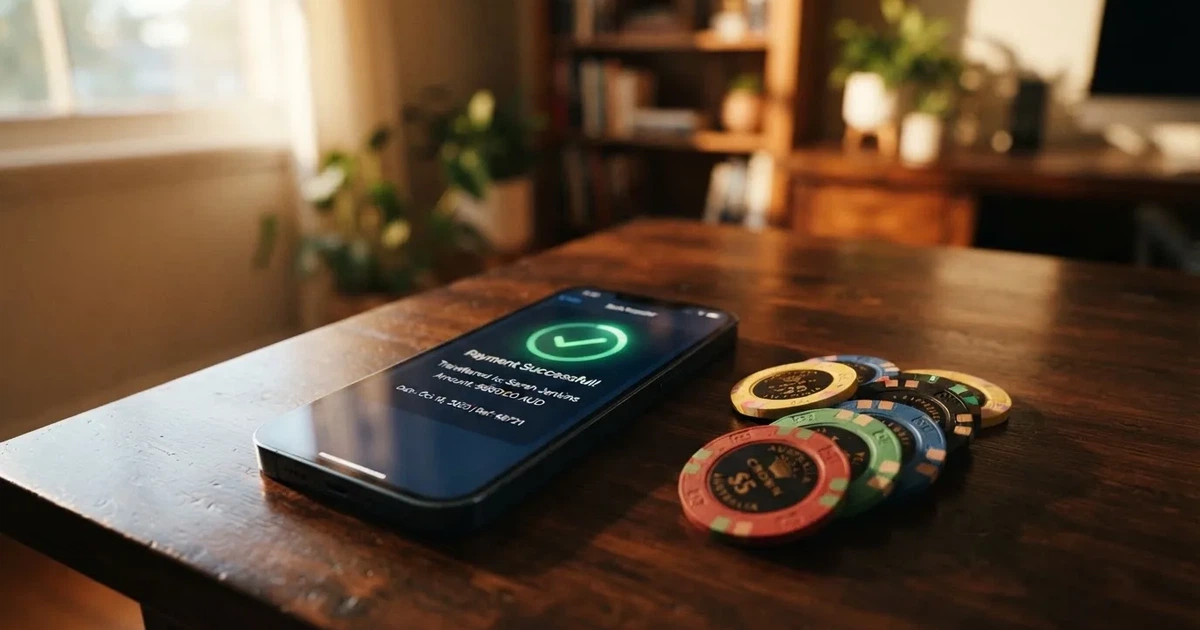
The angle here is cost — what it actually costs a reader to deposit, play and try to withdraw at an offshore casino that claims to take POLi. Cost in this market is not just the bonus terms. Cost is the legal exposure, the time the money is in someone else’s account, and the absence of any Australian complaints body if a withdrawal stalls. Every section below works that out for one slice of the decision.
The comparison below was checked against the ACMA’s register of formal warnings on 29 October 2026.
Table of Contents
- The landscape at a glance
- How POLi actually worked, and why the cashier page is showing a ghost
- The legal frame: what the IGA actually says
- What responsible play looks like at a site that is not connected to Australian safeguards
- Payments: what actually moves the money
- Withdrawal speed: the comparison that is mostly about the manual checks
- The blocking rate: what the ACMA’s pace actually looks like
- What the cashier shows in 2026
- Reading the ACMA register before the deposit page
- The eleven brands in the featured set
- What a 2026 reader should take from this page
- Frequently asked questions
The landscape at a glance
Eleven offshore casino brands make up the featured set on this page. All eleven have been the subject of a formal warning from the ACMA under the Interactive Gambling Act 2001, and that fact is the reason they appear here rather than being recommended. None of them may lawfully serve an Australian resident — the IGA prohibits online casino games and online pokies for Australians regardless of which offshore licence the site displays. The set is ordered by the recency of ACMA action, beginning with the most recent.

| Brand | ACMA action and date | Operator named by the ACMA | POLi support on the site |
|---|---|---|---|
| RocketPlay | Formal warning, March 2026 | Pulsup Ltd | — |
| Jackbit | Formal warning, April 2026 | Ryker B.V. | — |
| Casino Intense | Formal warning, April 2025 | Sterplay Holding Ltd | Listed on the cashier page |
| Sky Crown | Formal warning, 2022 | Hollycorn N.V. | — |
| Woo Casino | Formal warning, March 2025 | Dama N.V. | — |
| Spirit Casino | Formal warning, May 2025 | Dama N.V. | — |
| National Casino | Formal warning, July 2025 | Consolutetish S.R.L. | Listed on the cashier page |
| Bizzo Casino | Formal warning, July 2025; earlier 2022 | Consolutetish S.R.L. (2025); TechSolutions (2022) | — |
| Ignition Casino | Formal warning, July 2025 | Bamboo Media | — |
| Instant Casino | Formal warning, February 2025 | EOD Code SRL | Listed on the cashier page |
| Level Up Casino | Formal warning, May 2022 | Dama N.V. | Listed on the cashier page |
A dash in the POLi column means research carried no listing confirming the brand accepts POLi for Australian players. Several of the eleven carry POLi on their cashier pages, and several do not — and that is itself useful, because it lets a reader see which offshore brands are still routing Australian deposits through a payment method whose Australian leg has been shut.
The order of these rows is editorial, not a ranking. A page that put POLi acceptance first would be telling a reader which site to pick, which the law prevents this page from doing. The recency of ACMA action is a more honest axis: it tells a reader which operator the regulator has had most recently in its sights.
How POLi actually worked, and why the cashier page is showing a ghost
POLi was never a card. It was an instant bank transfer wrapper: a player clicked POLi at the cashier, picked their bank from a list, logged into online banking inside POLi’s interface, authorised the transfer, and the money moved from the player’s bank account to the casino’s merchant account. There was no card network, no chargeback right in the usual sense, and no card-issuer gambling block to trip on the way in. For a punter whose bank had closed gambling on credit cards but still wanted to move money to an offshore site, POLi was the path of least friction. That is also why several banks had long advised customers not to use it — handing over online banking credentials to a third party is not the same thing as tapping a card.
Two events ended the Australian service. The Commonwealth Bank stopped accepting POLi payments from mid-July 2023, citing security concerns. Australia Post then closed the rest of the domestic POLi Payments business, winding it down by 30 September 2023. Merco, which acquired the New Zealand POLi operation, kept the development team running under new ownership. New Zealand players still have the service. Australian players do not.
The ghost on the cashier page is therefore not a technical glitch. It is a marketing artefact: a deposit page that has not been updated since 2023, or one that still routes to a service the casino knows an Australian customer cannot complete. A reader who clicks POLi at an offshore site in 2026 will, in the best case, see an error. In the worst case, the casino holds the request open until it expires.
The legal frame: what the IGA actually says
The Interactive Gambling Act 2001, as strengthened by the Interactive Gambling Amendment Act 2017, makes it an offence to provide online casino games, online pokies or in-play betting to a person in Australia. No state or territory licences them. What is licensable is wagering on races and sport placed before the event, lotteries and keno — in practice licensed by the Northern Territory Racing and Wagering Commission, which sits with 52 of Australia’s online bookmakers including Sportsbet, Bet365 and Ladbrokes and runs a one-day-a-month meeting in Darwin with no full-time staff. Sports betting has its own offshore problems, but it is not what this page is about.
The IGA targets the provider, not the individual player. A reader who deposits at an offshore casino is not committing an offence. They are, however, accepting that the site gives them no Australian consumer protection, no Australian complaints body, and no recourse if a withdrawal is refused — and that the site can be blocked with a balance still sitting on it. The ACMA has been doing exactly that: across the years since enforcement was strengthened in 2017, more than 230 unlicensed gambling services have left the Australian market, and a total of 1,751 illegal gambling and affiliate marketing websites have been blocked since the first blocking request in November 2019. The most recent round reported asked Australian ISPs to block 12 more sites: 7Signs, ChromaBet, Donbet, Duospin, Freshbet, Slots Gem, Jacks Club, Lucky Start, Pointsbetz, Spinrise, Vinyl Casino and Wildsino.
The product on these sites is prohibited. The licence the casino displays — Curaçao, Anjouan, Costa Rica — does not change that, because no foreign licence covers offering online casino games to an Australian resident. The cost of the licence mismatch is not theoretical: H2 Gambling Capital’s 2025 report estimates Australians lose about A$3.9 billion a year to illegal gambling sites, and the share of gambling going through legal channels fell from 74% in 2021 to 64%.
What responsible play looks like at a site that is not connected to Australian safeguards
BetStop, the National Self-Exclusion Register, has been live since August 2023. It binds Australian-licensed online and phone wagering services. An offshore casino is not connected to it. A punter who has registered with BetStop and then deposits at one of the eleven brands above is depositing at a site that has no record of the exclusion — and that is exactly the kind of bypass BetStop was designed to stop.
The same logic applies to the National Gambling Helpline, 1800 858 858, which is free, 24/7 and runs chat at Gambling Help Online. The helpline exists. The offshore casino does not connect a reader to it. A reader who needs the service has to reach it themselves.
Bank-side gambling blocks help on the licensed side. Westpac’s gambling block refuses authorisation of transactions registered under the merchant category code ‘Betting/Casino Gambling’ on eligible personal credit and debit cards. ANZ’s block, activated in the ANZ app, also blocks gambling transactions made through a digital wallet such as Apple Pay on an eligible card, with a 48-hour cooling-off period before it can be removed and an explicit warning that not every gambling transaction will be blocked. CBA’s block works the same way. These blocks catch most card routes to offshore casinos. They do not catch POLi, because POLi is a bank transfer, not a card transaction. That is the part that changed when POLi shut in Australia.
The responsible-gaming cost of an offshore casino is therefore not the absence of a self-exclusion form on the deposit page. It is the absence of every Australian safeguard at once — BetStop, the helpline, the bank block on cards, the bank block on linked wallets — while the casino continues to accept deposits and run games whose RTP and volatility the operator sets unilaterally. Reading the casino’s own responsible-gaming page is not a substitute. The page is part of the product.
Payments: what actually moves the money
A POLi deposit, when the service still operated, was an immediate transfer from a player’s bank account to the casino’s merchant account. There was no card network, no chargeback right in the usual sense, and no card-issuer gambling block to trip. That is what made POLi useful to a punter whose bank had closed gambling on cards. It is also what made it risky: the player handed over their online banking credentials to a third party, which is why the Commonwealth Bank stopped accepting POLi payments and why the service shut in Australia. From a player’s point of view the cost of using POLi was not a fee at the cashier — POLi did not charge consumers — it was the credential risk, and the bank block is what killed the route.
Payment Methods in Australia
| Method | Status in Australia |
|---|---|
| POLi | Closed September 2023 |
| Credit Cards | Gambling block applies |
| Digital Wallets | Gambling block applies |
| Crypto | Banned for licensed wagering |
| Bank Transfer | Available at licensed sites |
The alternative routes an offshore cashier offers in 2026 are mostly the ones an Australian punter’s bank would block. Card payments — Visa, Mastercard, American Express — sit behind the card-issuer gambling blocks at Westpac, ANZ and CBA. American Express was established in 1850 as a freight-forwarding company and became a card issuer in 1958; it runs as a three-party scheme rather than Visa or Mastercard’s four-party network, and the Reserve Bank of Australia’s July 2025 review proposes removing surcharges only on eftpos, Mastercard and Visa card transactions, explicitly leaving American Express outside the scope of the proposed surcharge ban. None of that changes the gambling-block picture: the card-issuer block catches the transaction before the surcharge rule applies.
Digital wallets do not bypass the block. ANZ’s gambling block, activated in the ANZ app, also blocks gambling transactions made through Apple Pay on an eligible card. Apple does not charge consumers for using Apple Pay, and any surcharge at the cashier comes from the merchant’s card-processing fees rather than from Apple; transaction limits and PIN requirements for Apple Pay purchases are set by the card issuer or merchant, not by Apple. By the end of 2025, Apple Pay, Google Pay and Samsung Pay transactions collectively accounted for around 45% of all card payments in Australia by number. The wallet volume is real, and the wallet route into an offshore casino is still blocked by the card-issuer rules.
Crypto deposits sit outside the bank system entirely, and the IGA as amended in 2023 bans digital currency as payment for licensed online wagering. A site asking an Australian for a crypto deposit is operating outside the Australian rules; the IGA targets the provider, not the player, but the consumer protection is the same absence as for any other offshore deposit route.
The licensed alternative for an Australian punter who actually wants to place a wager is debit card, bank transfer, PayID and Osko, or BPAY. With Osko, a bank transfer between participating Australian banks arrives in under a minute, 24/7 including weekends, whether it is addressed to a BSB and account number or to a PayID. PayID shows the name of the account holder before the transfer is sent, and AP+ warns that being asked to transfer money to a PayID on an illegal gambling site almost certainly means a scam site. PayID-based instant transfers are available at over 100 Australian financial institutions. BPAY has operated in Australia since 1997, is available in the online banking of over 140 banks and financial institutions and is offered by over 95,000 businesses. These are the routes the licensed wagering market uses. None of them is open at an offshore casino.
AUSTRAC’s threshold-transaction-report rule, which requires reporting of transfers of A$10,000 or more, applies only to physical cash; ordinary electronic bank transfers are not subject to that per-transaction reporting requirement, regardless of the amount sent. A reader sending A$200 to an offshore casino via PayID has no AUSTRAC reporting attached to the transfer itself. The reporting that exists is the ACMA’s blocking list, and the ACMA’s blocking rate is the page’s prescribed calculation.
Withdrawal speed: the comparison that is mostly about the manual checks
A POLi withdrawal request, when the service still operated, was a casino instructing POLi to push money back to the player’s bank account. The transfer itself, once cleared, would have moved at Osko speed — under a minute, 24/7. The settlement, however, is only the last step. Before that, the casino runs its own checks: identity verification on first withdrawal, source-of-funds checks above internal thresholds, anti-money-laundering screening, and the bonus-clearance trail if a bonus is still being wagered.
The honest comparison between POLi and a card withdrawal at these sites is therefore not “POLi arrives in a minute, cards take three days”. It is “both arrive at the speed of the casino’s own manual checks, and the transfer layer underneath is fast in both cases once the casino lets the money go”. The transfer speed advantage POLi once had over card withdrawals is the transfer speed Osko and PayID give to any Australian bank account — and that speed is available to the licensed market, not to the eleven brands on this page.
A reader who deposits at an offshore casino and tries to withdraw will wait for the casino, not for the payment system. If the casino delays the manual checks — which several of them do, particularly above A$2,000 or after a big win — the withdrawal sits in the operator’s queue. There is no Australian complaints body to escalate to. The card chargeback path that exists for licensed card transactions does not apply to POLi, and the IGA’s prohibition on credit-card wagering since 11 June 2024 (penalties up to A$247,500 for operators) does not extend to debit-card chargebacks at offshore sites. The reader’s practical recourse, when a withdrawal stalls at an offshore casino, is the casino’s own complaints team.
The blocking rate: what the ACMA’s pace actually looks like
The ACMA has been issuing blocking requests to Australian ISPs since November 2019. As of the round reported on 26 June 2026, a total of 1,751 illegal gambling and affiliate marketing websites had been blocked since that first request — a seven-year stretch. The arithmetic that belongs to this page is the blocking rate over that stretch.
Across the seven years from November 2019 to the June 2026 round, 1,751 sites blocked works out to an average of roughly 250 sites per year, or around 21 per month. The June 2026 round alone blocked 12 sites — 7Signs, ChromaBet, Donbet, Duospin, Freshbet, Slots Gem, Jacks Club, Lucky Start, Pointsbetz, Spinrise, Vinyl Casino and Wildsino. That is just over half a month’s average in one announcement, and the trend has been accelerating rather than flattening: the early rounds covered single-digit numbers, and the later rounds regularly clear double digits. The headline figure is the cumulative total; the rate is best read as a band — somewhere between 20 and 30 sites per month on the recent cadence, with the cumulative count climbing in steps as new rounds land. A reader who treats “the regulator is catching up” as an answer to “is this site safe” is reading the wrong number: the ACMA’s pace is faster than it was, and the eleven brands on this page are the ones it has already caught.
What the cashier shows in 2026
The ghost on the cashier page is the entry point. Several of the eleven brands carry POLi as a deposit option on their Australian-facing cashier; several do not. A POLi click in 2026 from an Australian IP will, in the best case, return an error from the Australian POLi service that has not existed since 30 September 2023. In the middle case, the casino routes the player to a New Zealand POLi service that does not accept Australian banks. In the worst case, the casino holds the request open in the hope the player switches to another method.
The second-best outcome for the casino is a card deposit. Card deposits at offshore casinos are blocked at the bank side by Westpac, ANZ and CBA gambling blocks on the merchant category code ‘Betting/Casino Gambling’. The third-best is a digital wallet — Apple Pay, Google Pay or Samsung Pay on an eligible card — and ANZ’s block extends to those wallet routes. The fourth is crypto, which the IGA bans for licensed wagering and which the offshore site takes without question. The fifth is a direct bank transfer via PayID or BSB and account number, which the casino accepts because the bank does not have a category-code block on outbound transfers.
That ordering is the practical cost ladder. Each rung up the ladder costs the reader a different kind of friction: a credential handoff that no longer works, a card block, a wallet block, an offshore crypto route with no recourse, or a bank transfer the casino accepts without checking who is on the other end. The casino’s deposit page does not show this ladder. It shows four or five logos at the bottom of a green button, and the reader has to work out for themselves which of those routes the Australian banking system will actually let through.
Reading the ACMA register before the deposit page
The ACMA’s formal warning register is the only public ledger of which offshore operators have been told to stop serving Australian customers. The register is not the same as the blocking list. A formal warning is a regulator’s notice that an operator has been offering prohibited services; a blocking request is a regulator’s instruction to ISPs to make the site unreachable. The warnings precede the blocks in most cases, but not always — some sites are blocked without a prior warning, and some warnings are issued without a follow-up block.
The eleven brands on this page are all on the warning side of that ledger. RocketPlay received a formal warning in March 2026 over Pulsup Ltd; an earlier warning had been issued to Dama N.V. over the brand in May 2022. Jackbit received one in April 2026 over Ryker B.V., alongside CasinOK. Casino Intense received one in April 2025 over Sterplay Holding Ltd. Sky Crown received one in 2022 over Hollycorn N.V., alongside Blue Leo. Woo Casino received one in March 2025 over Dama N.V., and Spirit Casino received another over Dama N.V. in May 2025 — Dama N.V. had already been warned in May 2022 over six brands including Bambet, Dazard, Level Up, Wild Tornado and Cobra Casinos. National Casino received one in July 2025 over Consolutetish S.R.L., alongside Bizzo Casino; Bizzo had already been warned in 2022 over TechSolutions (CY) Group Limited and TechSolutions Group N.V. Ignition Casino received one in July 2025 over Bamboo Media. Instant Casino received one in February 2025 over EOD Code SRL.
The pattern in the register is one operator group receiving multiple warnings over multiple brands. Dama N.V. alone has been warned in May 2022, March 2025 and May 2025 — three rounds across three years. Consolutetish S.R.L. has been warned in 2025 over two brands. Hollycorn N.V. has been warned in 2022 over two brands. The cost of these warnings, on the operator side, is reputational rather than financial — the IGA’s penalty provisions target the conduct, and warnings are the regulator’s first step before an injunction or a blocking request.
The eleven brands in the featured set
RocketPlay
RocketPlay was warned in March 2026 over Pulsup Ltd. Dama N.V. had already been warned over the brand in May 2022, so the operator group has had RocketPlay on the regulator’s radar for nearly four years. The two warnings over the same brand four years apart are the clearest signal in the register that a formal warning does not, on its own, end the conduct it warns against. Research carries no listing confirming POLi support for RocketPlay — the cashier page is not in the register of POLi listings consulted — which means a reader clicking POLi at RocketPlay is reading a page that has not been confirmed for the purpose this page covers. The brand remains on the ACMA register, and that fact is the one this page carries forward.
Level Up Casino
Level Up was warned in May 2022 over Dama N.V., in the same round as Bambet, Dazard, Rocketplay, Wild Tornado and Cobra Casinos. Research lists Level Up’s POLi support on the strength of a single listing, and the page is therefore reported only as that listing reports it — the site lists POLi on its cashier, and nothing more is confirmed. Dama N.V. has been warned three times since: over Woo Casino in March 2025, over Spirit Casino in May 2025, and now over RocketPlay again in March 2026. A reader who sees Level Up as part of a Dama N.V. cluster should read the cluster, not the brand.
Woo Casino
Woo Casino was warned in March 2025 over Dama N.V. — the second warning to Dama N.V. in three years, after the May 2022 round. Research carries no POLi listing for Woo Casino. The site is on the ACMA register for the conduct the regulator identifies in its warning, and that is the only statement a reader comparing brands should take from this row.
Spirit Casino
Spirit Casino was warned in May 2025 over Dama N.V. — the third warning to Dama N.V. in three years. The gap between the March 2025 warning over Woo Casino and the May 2025 warning over Spirit Casino is two months, and the gap between the May 2022 round and the March 2025 round is nearly three years. Research carries no POLi listing for Spirit Casino. The brand sits in the same Dama N.V. cluster as Woo Casino, RocketPlay, Level Up and the four others from May 2022, and the cluster is the unit of comparison that matters.
National Casino
National Casino was warned in July 2025 over Consolutetish S.R.L., in the same round as Bizzo Casino. Research carries a POLi listing for National Casino, drawn from sources that include the Australian Transaction Reports and Analysis Centre and the Wikipedia entry for the New Payments Platform — that is, from pages that document POLi as a payment method rather than from National Casino’s own cashier. The brand is on the ACMA register, and the POLi support is what those listings report; it is not what the operator confirms. A reader who treats the listing as the operator’s own fact is reading more than the source carries.
Bizzo Casino
Bizzo Casino was warned in July 2025 over Consolutetish S.R.L., and earlier in 2022 over TechSolutions (CY) Group Limited and TechSolutions Group N.V. The 2022 warning is one of the longest-running entries on the ACMA register for any brand in this set, and the 2025 warning is the second formal action tied to Bizzo Casino since that year. Research carries no POLi listing for Bizzo Casino. The brand’s cost to a reader is the absence of an Australian complaints path after a regulator has formally told the operator twice to stop what it is doing.
Ignition Casino
Ignition Casino was warned in July 2025 over Bamboo Media. Research carries no POLi listing for Ignition Casino. The brand’s appearance on the register is the only fact this page carries forward; everything else about the brand sits outside what research confirms.
Instant Casino
Instant Casino was warned in February 2025 over EOD Code SRL. Research lists Instant Casino’s POLi support on the strength of sources that include EcoPayz and PayID documentation — that is, from pages that document payment methods rather than from Instant Casino’s own cashier. The brand is on the ACMA register for prohibited conduct, and the POLi support is what those listings report. The combination — a formal warning from the ACMA, plus a POLi listing drawn from third-party payment-method pages — is the shape the offshore casino market has settled into, and it is the shape a reader is comparing when they read this row.
Jackbit
Jackbit was warned in April 2026 over Ryker B.V., alongside CasinOK. The warning is the most recent in the register for any brand in this set after RocketPlay’s March 2026 entry. Research carries no POLi listing for Jackbit. A reader comparing Jackbit against the other April 2026 entries should note that the ACMA’s pace has not slowed: two rounds in 2026 alone, with twelve sites blocked in the June round.
Casino Intense
Casino Intense was warned in April 2025 over Sterplay Holding Ltd. Research lists Casino Intense’s POLi support on the strength of sources that include AUSTRAC, the ITNews report on the POLi closure, and NAB’s gambling-block page — that is, from pages that document the Australian banking context rather than from Casino Intense’s own cashier. The brand is on the ACMA register, and the POLi support is what those listings report. The site sits at the intersection of the regulator’s warning and the banking system’s documentation of POLi as a closed Australian service.
Sky Crown
Sky Crown was warned in 2022 over Hollycorn N.V., alongside Blue Leo. The Hollycorn N.V. warning is the oldest formal action in the featured set, predating every other entry. Research carries no POLi listing for Sky Crown. The brand’s age on the register is its distinguishing feature: the warning has had four years to do its work, and the brand is still on a list of sites the ACMA has acted against. A reader who treats an old warning as a closed file is reading the register backwards.
What a 2026 reader should take from this page
Three points hold across the eleven brands.
The first is that POLi is not an option for an Australian player in 2026, whatever the cashier page says. The service closed in Australia on 30 September 2023. A deposit page that still lists it is either out of date or routing to a service that will return an error. The honest read of a POLi listing on an offshore cashier is that the site has not updated its payment page since 2023.
The second is that the ACMA’s register is the only public ledger of which offshore operators have been told to stop serving Australian customers, and the eleven brands on this page are all on it. A reader comparing brands should read the register, not the cashier. The register is at acma.gov.au.
The third is that the alternative deposit routes — cards, digital wallets, crypto, direct bank transfer — each carry a different kind of friction on the Australian banking side, and none of them opens an Australian complaints path if the withdrawal stalls. The licensed alternative for an Australian punter is debit card, bank transfer, PayID/Osko or BPAY at a wagering service licensed in the Northern Territory — and the wagering service is restricted to races, sport, lotteries and keno. Online casino games and online pokies are not on that list. The 2026 reform — the Interactive Gambling Amendment (Gambling Reform) Bill 2026, passed on 19 August 2026, with advertising and inducement measures commencing 1 January 2027 — is law with a start date, not yet in force on a 2026 page.
The cost a reader pays for an offshore casino is the sum of these three points. The bonus terms are not on this page — research’s only sources for them were affiliate marketing pages, and the page does not carry figures it cannot stand behind. The page describes what is on offer, and the offer is what the register shows.
Frequently asked questions
Is it legal for an online casino to accept POLi from a player in Australia?
No. The Interactive Gambling Act 2001 makes it an offence to provide online casino games, online pokies or in-play betting to a person in Australia, and no state or territory licences online casino games. POLi was closed in Australia by Australia Post on 30 September 2023. A site accepting POLi from an Australian in 2026 is offering a prohibited service through a payment method that has not operated onshore for more than two years.
What is the smallest deposit a POLi casino site usually asks for?
Research does not carry a confirmed minimum deposit figure for any of the eleven brands on this page, and the only sources it would have come from were affiliate marketing pages. The qualitative read is that minimums on offshore cashier pages cluster around A$10 to A$30, but the figure should be checked at the cashier of the specific site before any deposit is made — and the IGA’s prohibition applies regardless of the minimum.
Does a POLi withdrawal clear any faster than a card withdrawal at these sites?
Once the casino lets the money go, yes — the transfer layer underneath POLi was Osko, which arrives in under a minute 24/7, and a card withdrawal waits for the card network. The bottleneck, however, is the casino’s own manual checks, not the transfer layer, and the bottleneck applies equally to POLi and to cards. If the casino delays the checks, both routes wait for the casino.
Can POLi be used at every offshore pokies-style site, or only some of them?
Several of the eleven brands in the featured set list POLi on their cashier pages, and several do not. The set is not exhaustive — there are dozens of offshore sites outside it. The Australian leg of POLi has been closed since September 2023, so a POLi click from an Australian IP in 2026 will, in the best case, return an error. The cashier listing is a marketing artefact, not a working deposit route.
Does depositing with POLi add an extra fee at these casino sites?
POLi did not charge consumers — the cost the player bore was handing over online banking credentials to a third party, which is why the Commonwealth Bank stopped accepting POLi payments and why the service shut in Australia. Any fee at an offshore cashier comes from the casino’s own deposit-fee schedule or from the underlying card-processing fees, not from POLi itself. A reader should check the deposit screen for any fee disclosure before confirming.
What should a player do if a POLi deposit does not appear in a casino account?
The first step is the casino’s own support team — there is no Australian complaints body for an offshore casino, and the ACMA’s process is a regulatory action against the operator rather than a refund route for the player. A POLi deposit that fails to arrive is a bank-transfer question, and the player’s bank is the second line of evidence. The deeper question — whether an Australian should be depositing at an offshore casino at all — is settled by the IGA, which prohibits the service.