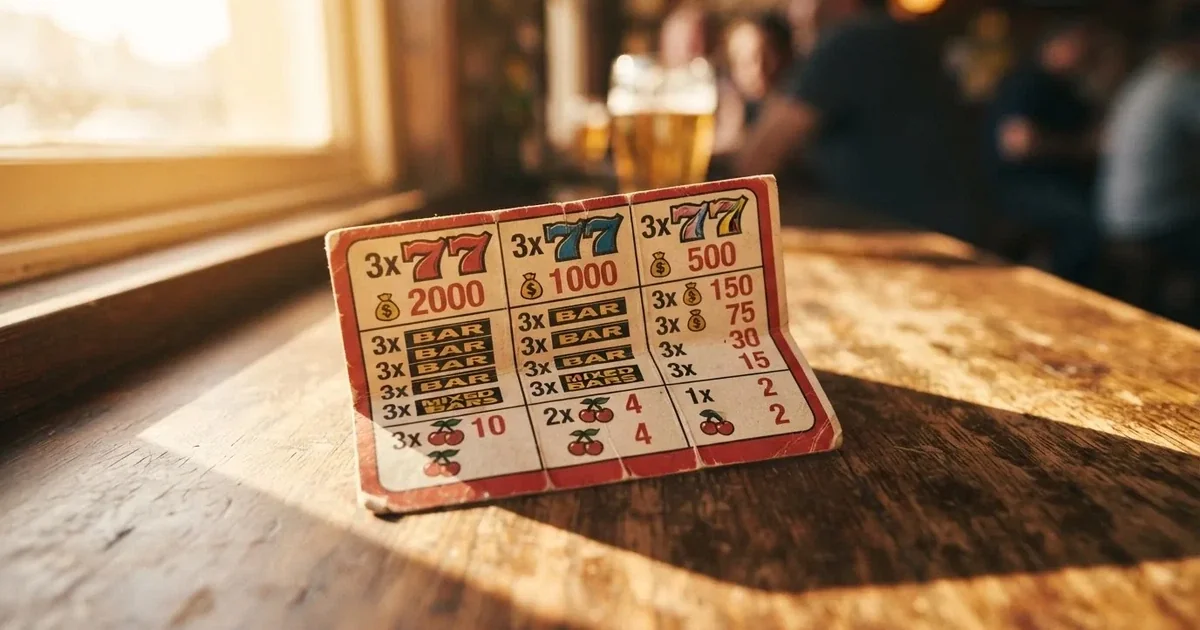
The 5-reel slot in Australia is an offshore product, and that fact decides everything else
 Available in US
A 5-reel slot machine is one of the most recognisable shapes in gambling: a printed strip of symbols, a paytable beside it, and the small arithmetic of stake multiplied by line against a prize. In an Australian pub or club the machine is real, the printed rules are real, and the regulator behind them is named on the side of the cabinet. Online, that recognition carries a problem. The Interactive Gambling Act 2001 makes it an offence to provide online casino games — including 5-reel slots — to a person physically in Australia, and no state or territory issues a licence for them. Every 5-reel online slot offered to an Australian player is therefore an offshore product, served by an operator outside Australian law, and the rest of this page is the consequences of that one fact.
Currency stamp: data current as of 23 September 2026, checked against the ACMA’s published register of formal warnings and the Interactive Gambling Act 2001.
Table of Contents
- The legal frame around online 5-reel slots in Australia
- What a 5-reel slot actually is, and how it differs from a modern five-reel video slot
- The ACMA’s blocking record, and what the running total now reads
- What the ACMA’s formal warnings actually name
- Payment methods and what an offshore 5-reel slot site actually asks for
- What a fair comparison of offshore 5-reel slot sites would actually weigh
- Responsible gambling for the player who is still considering offshore play
- The mechanics of a 5-reel slot paytable, in plain language
- What a fair reader comparison looks like when no product is licensed
- What the page does not do, and why
- FAQ
The legal frame around online 5-reel slots in Australia
The Interactive Gambling Act 2001, tightened by the Interactive Gambling Amendment Act 2017, prohibits the supply of “prohibited interactive gambling services” to customers in Australia. Online casino games and online pokies sit squarely in that prohibited category. The Act does not punish the individual player — it targets the provider — but a player who signs up with an offshore site gives up every protection an Australian licence would have provided: no complaints body, no local recourse if a withdrawal stalls, and no guarantee the site will not be blocked while a balance sits on it.

What Australia does license is wagering on racing and sport placed before the event, plus lotteries and keno. The Northern Territory Racing and Wagering Commission holds the bulk of those wagering licences — 52 online bookmakers, including Sportsbet, Bet365 and Ladbrokes — though the commission has no full-time staff and meets only once a month in Darwin. None of those licences covers an online slot machine of any reel count.
The ACMA — the Australian Communications and Media Authority — is the body that enforces the prohibition. It investigates complaints, issues formal warnings to operators it identifies as serving Australians, and can direct Australian internet service providers to block sites. A formal warning is not a court order; it is a public notice, on the ACMA’s own register, naming the company behind a brand and the date the warning was issued. The legal value of a warning sits in what comes after: repeated warnings are followed by blocking requests, and blocked sites drop out of reach for Australian customers overnight.
What a 5-reel slot actually is, and how it differs from a modern five-reel video slot
“5-reel” describes the number of rotating columns of symbols a slot uses. The first automatic slot machine, built by Charles Fey in San Francisco in the late 19th century, had three reels with five symbols each — horseshoes, diamonds, spades, hearts and the Liberty Bell — and three bells in a row paid the top prize of ten nickels. Bally’s “Money Honey” in 1963 added a bottomless hopper and automatic payout of up to 500 coins without an attendant, and the slot machine as a stand-alone cabinet was born. The first video slot was developed in 1976 by Fortune Coin Co. in Kearny Mesa, California, replacing physical reels with a screen.

The label “5-reel slot” today covers two quite different formats. A classic or “traditional” 5-reel slot is the simpler one — five reels, three rows of symbols, a handful of fixed paylines, often a single bonus feature, and a paytable that fits on one screen. A modern video slot is also five reels, but with 50 or more symbols per reel, hundreds or thousands of ways to win, layered bonus mechanics and odds against the top combination as long as 300 million to one. The reel count is the same; the experience inside it is not.
For a player, the practical difference shows up in three places. First, the paytable: a classic 5-reel game usually shows every symbol value clearly, while a modern video slot may bury the meaningful returns inside free-spin rounds or pick’em features. Second, volatility: a classic 5-reel slot tends toward smaller, more frequent wins, while a five-reel video slot concentrates its payouts in features that may not trigger for hundreds of spins. Third, the bet structure: classic 5-reel games typically take a single stake across a fixed number of lines, while modern video slots ask the player to choose coin value, bet level and sometimes whether to buy the bonus outright. The reel count is the headline; the design behind it is what the player actually pays for.
In the United States, state regulators set minimum payout percentages that vary by jurisdiction — Nevada at least 75%, Mississippi at least 80%, New Jersey at least 83%. Australia has no equivalent statutory floor for online slots because no online slot is licensed for real-money play in Australia at all.
The ACMA’s blocking record, and what the running total now reads
The ACMA’s enforcement numbers, reported in June 2026, put the running total of blocked illegal gambling and affiliate sites at 1,751 since the first blocking request in November 2019. More than 230 unlicensed gambling services have left the Australian market since the 2017 strengthening of the Interactive Gambling Act. In the round reported on 26 June 2026 the ACMA asked Australian ISPs to block a further 12 sites: 7Signs, ChromaBet, Donbet, Duospin, Freshbet, Slots Gem, Jacks Club, Lucky Start, Pointsbetz, Spinrise, Vinyl Casino and Wildsino.
Behind those figures sits H2 Gambling Capital’s 2025 estimate that Australians lose about A$3.9 billion a year to illegal gambling sites, and that the share of gambling going through legal channels fell from 74% in 2021 to 64%. The legal share is shrinking because the illegal share is growing, and the ACMA’s blocking record is the regulator’s answer to that drift.
The arithmetic the page can offer is this: 1,751 blocked or withdrawn sites across roughly six and a half years of enforcement works out to an average of around 270 sites a year, or roughly one site taken out of reach every working day since November 2019. The 26 June 2026 round of 12 blocks, taken alone, is one morning’s enforcement output. None of those numbers is a forecast; they describe the pace at which the regulator has been closing the gap, and they tell an Australian player that an offshore site is not a stable address. A brand can be reachable one week and blocked the next.
What the ACMA’s formal warnings actually name
A formal warning is the ACMA’s first public step, before a blocking request. The register publishes the operating company behind a brand and the date the warning was issued, and that record is what this page leans on. Eleven brands appear in the register relevant to 5-reel slot play, and the table below is the ACMA’s own list, not a ranking.
| Brand | ACMA action and date | Operator named by the ACMA |
|---|---|---|
| RocketPlay | March 2026 | Pulsup Ltd (RocketPlay) |
| RocketPlay | May 2022 | Dama N.V. |
| Level Up Casino | May 2022 | Dama N.V. |
| Woo Casino | March 2025 | Dama N.V. |
| Spirit Casino | May 2025 | Dama N.V. |
| National Casino | July 2025 | Consolutetish S.R.L. |
| Bizzo Casino | July 2025 | Consolutetish S.R.L. |
| Bizzo Casino | 2022 | TechSolutions (CY) Group Limited and TechSolutions Group N.V. |
| Ignition Casino | July 2025 | Bamboo Media |
| Instant Casino | February 2025 | EOD Code SRL |
| Jackbit | April 2026 | Ryker B.V. |
| Casino Intense | April 2025 | Sterplay Holding Ltd |
| Sky Crown | September 2022 | Hollycorn N.V. |
The pattern is plain. The same operating company — Dama N.V. alone appears four times in the table — rebrands into a fresh “casino” name after each warning, and the ACMA’s register catches up to the new name a year or two later. RocketPlay and Bizzo Casino have been warned twice each, under different corporate shells. Sky Crown and Blue Leo share a Hollycorn N.V. warning. The cost of the rebrand is borne by the next round of customers who signed up not knowing the brand had already been on the regulator’s list.
A second pattern sits in the dates. The earliest warning in the set is Hollycorn N.V. over Sky Crown in September 2022; the most recent is Pulsup Ltd over RocketPlay in March 2026. Four years apart, the same enforcement tool, applied to a continuous stream of brands. The blocking record in the section above is the cumulative result of this kind of repeated action.
Payment methods and what an offshore 5-reel slot site actually asks for
A licensed Australian wagering service cannot accept credit cards, credit-related products or digital currency as payment for online wagering — that prohibition took effect on 11 June 2024, with penalties of up to A$247,500 for operators. The legal deposit routes for licensed wagering are debit card, bank transfer, PayID/Osko and BPAY. A site asking an Australian customer for a credit card or a crypto deposit is operating outside the Australian rules, and that fact alone is a useful signal — credit-card acceptance in this market is a marker of an offshore operator, not a service upgrade.
For an offshore casino the deposit screen looks different: e-wallets the Australian customer has never heard of, cryptocurrencies by name, and voucher systems that route through intermediaries. The IGA does not punish the player for using any of these methods, but the funds are moving to an unlicensed operator under no Australian supervision. If the operator refuses a withdrawal, the player’s bank will not reverse the transaction through any Australian complaints process. The recourse is whatever the operator’s own terms say, and those terms favour the house.
BetStop — the National Self-Exclusion Register, live since August 2023 — is the self-exclusion tool for Australian-licensed online and phone wagering. It binds licensed operators; an offshore casino is not connected to it. A player who has registered with BetStop and then opens an account with an offshore site has stepped outside the perimeter the exclusion was designed to cover. The same gap applies to complaint and dispute resolution, which exists for licensed wagering through the relevant state or territory body and does not exist for offshore casino play.
What a fair comparison of offshore 5-reel slot sites would actually weigh
For any other Australian consumer product, a comparison would weigh price, quality and trust. For offshore 5-reel slot sites, trust is the variable the comparison cannot close. The Interactive Gambling Act 2001 makes the supply of the product itself unlawful in Australia, so the comparison starts from a market where every brand is operating outside Australian law and outside any Australian complaint mechanism. The ACMA’s warnings are the only authoritative scoring the regulator publishes, and they score every warned brand identically: the brand has offered a prohibited service to Australians, and the regulator has said so in writing.
A useful comparison on this side of the law therefore weighs three things. First, the ACMA record: has the operator been warned once, twice, or under multiple corporate shells, and how recently. Second, the payment surface: does the brand accept credit cards or cryptocurrency, both of which mark it as offshore. Third, the practical accessibility: how long after signup the site tends to stay reachable from Australia, given the ACMA’s blocking pace.
The comparison cannot weigh bonus generosity, because no bonus terms for any of these brands appear in research that does not come from affiliate marketing pages, and those pages exist to drive signups. It cannot weigh payout speed, because no independent benchmark for these specific brands appears in research. It cannot weigh game library breadth, because research does not list the catalogue any of these brands carries. The honest comparison is the one the regulator’s register already makes: every brand in the table has been formally warned, every one is offshore, and the difference between them is the date the warning was issued and the company behind it.
Responsible gambling for the player who is still considering offshore play
For an Australian player considering offshore 5-reel slot play, the formal protection routes look like this. Gambling Help Online provides free, confidential support around the clock, with chat available. The National Gambling Helpline is 1800 858 858, free and answered 24/7. Both are funded to help people who feel their gambling is becoming a problem, and neither requires the player to be using a licensed site to call.
BetStop, the National Self-Exclusion Register, applies to Australian-licensed online and phone wagering — it does not bind offshore casinos. The registration process takes a few minutes and the exclusion applies across every licensed operator simultaneously. A player who has registered with BetStop and continues to gamble at an offshore site is, in practical terms, gambling outside the perimeter the exclusion covers.
The financial lever the player still holds is the choice not to deposit. The Interactive Gambling Act does not prohibit an individual from playing an offshore game; it prohibits the offshore operator from offering one. The player who stops at the deposit screen has used the only lever Australian law gives them, and the offshore operator has no power to override it. The arithmetic of expected loss is the same on every 5-reel slot in this market: the house keeps an edge, and over enough spins the player loses.
For a player who feels the decision has stopped being a decision — who is chasing losses, gambling money set aside for something else, or hiding play from family or colleagues — the right next step is the helpline, not another site. Gambling Help Online and 1800 858 858 are free, confidential and staffed.
The mechanics of a 5-reel slot paytable, in plain language
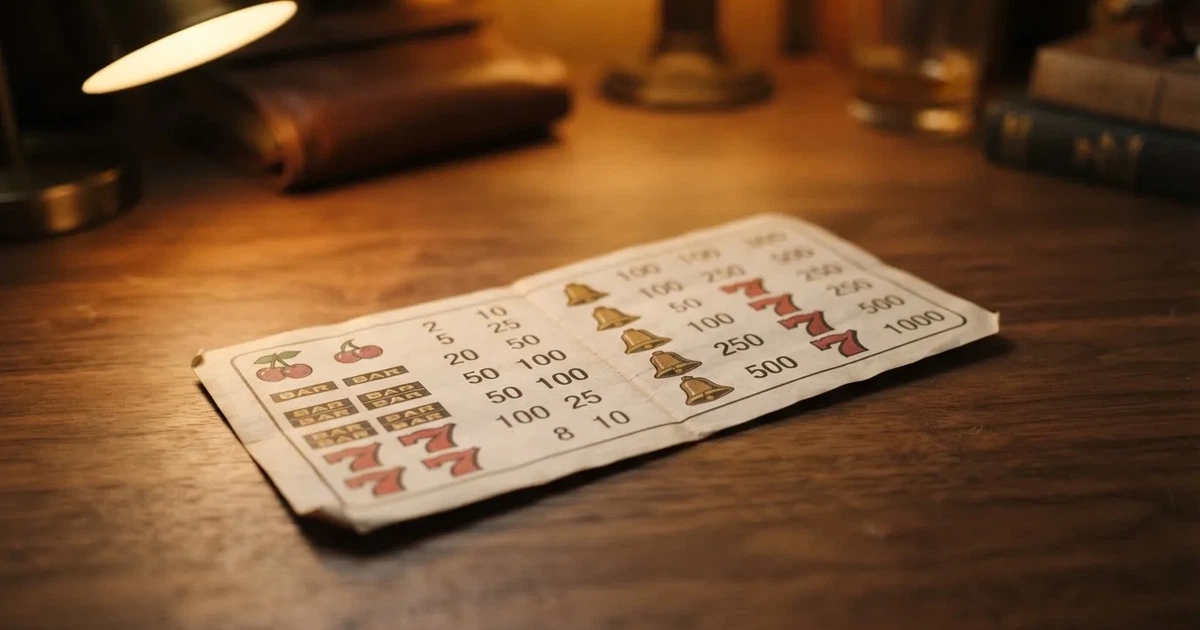
A 5-reel slot’s paytable is the printed chart that lists every symbol and the prize for lining up a winning combination on an active payline. For a classic 5-reel game with three rows, the payline is usually a straight line across the middle row, with variations like V-shapes and zig-zags added by the operator. The paytable will show, for each symbol, the prize for three, four and five of that symbol on an active payline, multiplied by the stake on that line.
A few features recur across most classic 5-reel games. A wild symbol substitutes for other symbols to complete a winning line, usually paying nothing on its own. A scatter symbol pays anywhere on the reels regardless of paylines, and three or more scatters typically trigger the bonus feature. The bonus feature on a classic 5-reel slot is usually a set of free spins, sometimes with a multiplier attached. A modern five-reel video slot may layer additional mechanics — expanding reels, cascading wins, gamble features, pick’em bonuses — and the paytable alone does not describe those; the game’s help screen does.
Volatility, sometimes called variance, describes how a slot distributes its payouts. A low-volatility slot pays small wins frequently; a high-volatility slot pays larger wins infrequently. A 5-reel classic slot is usually in the low-to-medium volatility range, which is one reason it survives as a format: the bankroll moves slowly, the bonus round triggers often enough to feel reachable, and the printed paytable still describes most of what the player will see. The modern video slot, by contrast, can be high-volatility to a degree that the paytable’s headline prize is reached by fewer than one spin in tens of millions.
What a fair reader comparison looks like when no product is licensed
A reader comparison in this market cannot honestly rank the brands in the ACMA’s register, because the register ranks them all identically — every brand has been formally warned for offering a prohibited service. The honest comparison ranks the reader’s options, not the brands.
The first option is a licensed Australian venue: a pub, club or casino with physical slot machines, where the regulator is named on the side of the cabinet and the printed rules are the actual rules. New South Wales alone had 87,298 pokies-style slot machines outside casinos as of June 2023, with Victoria at 26,380 (2021–22), Queensland at 21,122 (October 2023), South Australia at 11,672 (September 2023) and the ACT at 3,587 (November 2023). Australia operates around 200,000 slot machines outside casinos — a per-capita rate roughly five times that of the United States. The cabinet is the licensed product, and it is the only product whose rules the player can read on the spot.
The second option is licensed Australian online wagering on racing and sport — a market where deposit routes are regulated, complaints have a body to go to, and BetStop applies. It is not a 5-reel slot, and the comparison is not suggesting it is. It is the only online gambling product an Australian can use with the regulator’s framework intact.
The third option is offshore 5-reel slot play. The product is the one the reader is searching for, but the operator is outside Australian law, the deposit method is outside Australian rules, and the regulator’s enforcement tool is to block the site. The ACMA’s blocking pace — roughly 270 sites a year since November 2019, and 12 in a single round in June 2026 — is the pace at which an offshore site can disappear.
The honest page writes the comparison in that order: licensed venue, licensed wagering, offshore slot. The order is the page’s value to the reader, because it puts the regulated options first and the unregulated one last, and it explains why.
What the page does not do, and why
This page does not recommend a brand, because recommending any of the eleven brands in the ACMA’s register would mean recommending a product the regulator has publicly warned over. It does not list bonus terms, because the only sources for those terms were affiliate marketing pages, and affiliate pages exist to drive signups, not to inform them. It does not rank the brands against each other on payout speed, game count or welcome offer, because research carries no independent benchmark for any of those figures for these specific brands, and a comparison built on numbers the page does not have is a comparison the reader cannot trust.
The page does carry the ACMA’s published record, because that record is on the regulator’s own website and is what the regulator wants the public to see. It does carry the payment rules under the Interactive Gambling Act, because those are the law. It does carry the responsible-gambling contacts, because those exist for exactly the reader who reaches this page.
FAQ
What makes a 5-reel slot different from a modern five-reel video slot?
Both use five reels, but a classic 5-reel slot has three rows of symbols, fixed paylines, a paytable that fits on one screen and usually a single bonus feature. A modern five-reel video slot adds 50 or more symbols per reel, hundreds or thousands of win ways and layered features, with odds against the top combination reaching 300 million to one. The headline reel count is the same; the design inside it is not.
Can 5-reel slot machines be found in licensed Australian pubs and clubs?
Yes. Australia operates around 200,000 slot machines outside casinos — 87,298 in New South Wales as of June 2023, 26,380 in Victoria in 2021–22, 21,122 in Queensland in October 2023, 11,672 in South Australia in September 2023 and 3,587 in the ACT in November 2023. New South Wales legalised them in 1956, and the regulator is named on the cabinet. Online, the same game is offered by offshore operators only.
Do 5-reel slots pay out differently from newer five-reel formats?
Typically yes, because volatility is usually lower on a classic 5-reel slot. A classic game tends toward smaller, more frequent wins and a simpler bonus structure, while a modern five-reel video slot concentrates its payouts in features that may not trigger for hundreds of spins. The paytable on a classic 5-reel slot also describes most of what the player will see, which the help screen of a modern video slot often does not.
Is a 5-reel slot online the same game as a 5-reel machine on a casino floor?
The reel count and the symbol set can be identical, but the regulatory frame is not. A casino-floor machine is licensed by the relevant state or territory regulator, with printed rules and a complaints body. An online 5-reel slot offered to an Australian is operated offshore under no Australian licence, with no local recourse if a withdrawal is refused and no guarantee the site will not be blocked while a balance sits on it.
Are 5-reel slots for real money available legally from an Australian-based site?
No. The Interactive Gambling Act 2001, strengthened by the Interactive Gambling Amendment Act 2017, prohibits the supply of online casino games — including 5-reel slots — to a person in Australia, and no state or territory issues a licence for them. What is licensed is wagering on racing and sport placed before the event, plus lotteries and keno. Every online 5-reel slot offered to an Australian is therefore an offshore product, served by an operator outside Australian law.
Does a slot’s reel count change how its paytable and volatility are usually described?
Yes, in practice. A 5-reel classic slot’s paytable typically lists every symbol value for three, four and five on a line, which lets the player read most of what the game will do. A modern five-reel video slot usually hides the meaningful returns inside bonus rounds, free-spin features or pick’em games, and the paytable alone does not describe those. Volatility tracks the same split: classic 5-reel slots sit in the low-to-medium range, modern video slots often run high.
Prepared by the Casino Venues Info editorial staff.