
NetEnt online casinos in Australia: a page that has to start with the law
A reader typing “best NetEnt online casinos Australia” usually wants a shortlist of sites to open tonight. That shortlist is the one thing this page cannot honestly hand over. Online casino games — NetEnt’s slots included — are prohibited under the Interactive Gambling Act 2001 for anyone in Australia, and no state or territory issues a licence for them. So the more honest answer is: the legal landscape first, the ACMA’s enforcement record second, the lawful alternatives third, and the catalogue of offshore brands the regulator has acted against last, with the caveat that those brands remain unlawful here whatever licence they display.

Current as of 29 October 2026 and cross-checked against the Australian Communications and Media Authority’s formal warning register.
Table of Contents
- The payments shelf: what “fast payout” means on a site the ACMA can block at any moment
- The bonus shelf: turnover, free spins and what those terms cost a player who reads them
- The mobile shelf: HTML5, browser play and the app that does not exist for Australians
- The games shelf: NetEnt, the titles worth naming and what the catalogue actually contains
- The comparison shelf: eleven brands the ACMA has acted against, side by side
- The fundamentals shelf: what a NetEnt-powered casino actually is
- The legality shelf: the Interactive Gambling Act 2001 and what the ACMA actually does
- The responsible-gaming shelf: what Australians can actually use
- The eleven brands: what each warning tells the reader who already has the account
- What the ACMA’s blocking record actually says: a band, not a single number
- Frequently asked questions
The payments shelf: what “fast payout” means on a site the ACMA can block at any moment
The NetEnt casino search is almost always a payment question in disguise — how fast the deposit clears, what currency it takes, how quickly a withdrawal lands. The shelf opens with what looks like an answer, then with what makes that answer moot on a prohibited site.
A site that takes Australian dollars through PayID, Osko or BPAY is following the Australian rules that apply to wagering — debit card, bank transfer, PayID/Osko and BPAY are the legal deposit routes under the credit-card ban that took effect on 11 June 2024. A site that asks for a credit card or a crypto deposit for casino play is operating outside that regime, and that fact alone tells the reader where the operator sits.
The lawful side handles the payment plainly. Withdrawals on Australian-licensed wagering services run on the same banking rails, with the operator’s own processing window sitting on top. On the prohibited side, the math is the same in the marketing and different in practice: a withdrawal can be processed cleanly for months and then refused on a “verification” rerun, because there is no Australian complaints body an offshore site is bound to recognise. The ACMA’s blocking power sits across the top — a balance on an account at a blocked site is, in practical terms, a balance the player may have to chase through the operator’s home jurisdiction.
PayID, Osko and the difference between a fast rail and a lawful one
PayID and Osko are the near-instant Australian rails that move money between bank accounts in seconds. They are lawful as a deposit method only for wagering services licensed under the Interactive Gambling Act — racing, sport, lotteries and keno. The same rail on a casino site is not the rail being unlawful; the product the rail is paying for is. A fast payment onto a prohibited service is still a prohibited transaction.
The credit-card and crypto ban on licensed wagering
Since 11 June 2024, credit cards, credit-related products and digital currency cannot be used to pay for licensed online wagering in Australia. The penalty for an operator taking them is up to A$247,500 per breach. The ban does not, by its terms, reach offshore casino sites — they are not licensed to begin with — but it is the cleanest signal of where the Australian policy sits on funding gambling with borrowed money or unregulated tokens. A site asking an Australian player for either is not a site the Australian framework covers at all.
What the speed of a payout is actually buying
The marketed “instant withdrawal” is the slowest part of the payment in honest accounting: the bank transfer, card scheme or wallet on the other side of the operator is what determines when the money lands, and the operator’s own queue sits in front of it. The fastest legitimate path on an Australian-licensed wagering account is PayID/Osko outbound. On an offshore casino site, the speed claim is uncheckable, because the operator’s own processing window is the only thing being measured and the only thing the customer has no leverage over. The shelf’s closer is therefore not “how fast does it pay” but “to whom is the speed promise made and what recourse exists when it does not hold”.
The bonus shelf: turnover, free spins and what those terms cost a player who reads them
A NetEnt casino welcome offer in the marketing reads as a gift — deposit matched, free spins attached, perhaps a no-deposit sweetener to open the account. Read the small print and the same offer becomes a quantity of play the player must complete before any of it converts to withdrawable cash. This shelf unpacks those mechanics for the Australian reader, against the underlying fact that the underlying product is prohibited here.
A bonus is a loan of play, not a gift of cash. The operator matches the deposit, attaches a wagering multiple — usually somewhere between 35x and 50x the bonus, sometimes the bonus plus the deposit — and pays any winnings from the bonus balance back into a locked pool until the multiple is met. The free spins work the same way: winnings from the spins are bonus money until cleared, with the same multiple and usually a separate cap on what the spins can produce.
The wagering multiple as the actual price
A A$100 bonus at 40x is not a A$100 gift; it is A$4,000 of required turnover before the bonus and any winnings tied to it become withdrawable. House edge on a NetEnt slot sits in the low single digits per spin, so A$4,000 of play loses roughly A$120 to A$160 on average before the bonus clears. The bonus is worth less than its face value the moment the player takes it — by the cost of that expected loss on the clearing turnover.
Game weighting and why slots are usually 100%
Most operators count slot play at 100% toward the wagering requirement, and table games at a fraction of that — sometimes 10% or even zero. The weighting is not a player-friendliness setting; it is a way for the operator to reduce the effective value of clearing the bonus on the games the player actually wants to play. A 40x bonus cleared on roulette at 20% weighting is 200x of effective play on the bonus, which is unachievable for almost any bankroll.
Free spins, max win caps and the question the marketing does not answer
Free-spin offers on NetEnt slots commonly cap the winnings the spins can produce — A$100 on a batch of 50 spins is a familiar ceiling. The cap is what the offer is actually worth, not the headline number of spins. A player who reads “100 free spins on Starburst” without the cap reads the offer at several times its realisable value.
The product beneath the promotion
None of the mechanics above are unlawful on their own; the same wagering structure sits on the regulated Australian wagering market, where the product is licensed and the operator is accountable. On a prohibited offshore casino, the same terms sit on a product the ACMA can direct ISPs to block at any time, and a player mid-clear is in the worst position of all: enough play done to lose the expected house edge, not enough done to withdraw the remainder if the site disappears.
The mobile shelf: HTML5, browser play and the app that does not exist for Australians
NetEnt stopped shipping downloadable casino clients years ago and moved its catalogue to HTML5 in the browser. The shift matters less for what the player can do on a phone and more for what an “app” claim is actually selling.
What HTML5 means for a NetEnt slot on a phone
A NetEnt slot today loads in a mobile browser the same way it loads on a desktop, with the same paytable, RTP and bonus mechanics. There is no separate mobile build, no install step, no permission list. The screen rescales to the device, touch replaces click, and the game runs in the same tab as everything else the player has open. For a player in Australia choosing between a phone and a laptop, the only difference is screen size.
The app claim and what it actually is
A casino that advertises an “app” for Australian players is, in nearly every case, shipping a browser wrapper around the mobile site — a shortcut to a URL, not a native install. The wrapper does not change the underlying product: the games are still HTML5, the account is still with the offshore operator, the licence claim is still unrecognised by any state or territory authority. The convenience is genuine; the legal frame is unchanged.
Performance and the things that are actually different on mobile
Data cost, screen real estate and one-handed use are the real differences. A NetEnt slot’s reels shrink to fit a phone screen, and the paytable either opens full-screen or in a sheet that the player expands; the maths of the game do not change with the form factor. The bigger variable on mobile is the connection: a dropped signal mid-spin on a live table is not retried by the operator on the player’s side, and the bet is treated as placed. The shelf’s quiet point is that the form factor does not change the player’s position relative to the regulator — only the speed of access.
The games shelf: NetEnt, the titles worth naming and what the catalogue actually contains
The game shelf is the one place the topic and the answer sit close together, because NetEnt’s catalogue is a known thing and the titles have measurable mechanics. This shelf lays those out before turning to the comparison.
NetEnt as a studio
NetEnt was founded in Sweden in 1996 and was acquired by Evolution, with the deal closing on 1 December 2020 at a reported value of around €1.9 billion. The studio now sits inside the Evolution group, which is one reason NetEnt slots appear on a wide range of online casinos — Evolution’s distribution is wide. The acquisition did not change the catalogue mechanics, and the published RTPs on the NetEnt site remain the studio’s own numbers.
Three titles worth naming with their numbers
Starburst, released on 23 January 2012, runs on a 5×3 reel layout with 10 paylines, a published RTP of 96.08% and a maximum win of 800x bet. It is the slot the marketing reaches for first, both for recognition and for the speed of the play. Starburst XXXtreme, the higher-volatility follow-up, raises the RTP to 96.45% and lifts the maximum win to 16,800x bet. Gonzo’s Quest, released on 15 March 2010, runs on a 5×3 grid with 20 paylines, a published RTP of 95.97% and a Free Fall bonus that pays up to 2,200x bet. These three are the only NetEnt slots the research carries full numbers for; other titles in the studio’s catalogue have their own figures on the NetEnt site.
The volatility profile that the marketing prefers not to name
Starburst is a low-volatility slot — many small wins, long sessions, a low ceiling. Starburst XXXtreme is the opposite — few wins, large when they land, fast bankroll swings. The RTP figures sit close together, but the experience of playing each is not close at all. A player who picks one because they read the RTP will end up playing a different game than the one the headline suggested.
What a NetEnt mobile slot actually looks like to a player in Australia
The catalogue is the same worldwide. The path to it from Australia runs through offshore sites the ACMA has acted against, on terms that carry no Australian consumer protection, on a product the IGA prohibits the operator from supplying. The shelf’s closer is mechanical: the catalogue is the catalogue, the legal position is the legal position, and the two do not change because the player is on a phone.
The comparison shelf: eleven brands the ACMA has acted against, side by side
This is the ranking the page is supposed to produce, and the honest version of it is one column longer than a normal ranking would need: the column that explains why every brand on the list is here. Eleven brands the ACMA has issued formal warnings over, the operator entity named in each warning, the date, and the source the page can cite.
| Brand | ACMA action and date | Operator named by the ACMA | Other coverage of the brand |
|---|---|---|---|
| RocketPlay | Formal warning, March 2026 | Pulsup Ltd (Rocketplay); earlier Dama N.V., May 2022 | — |
| Level Up Casino | Formal warning, May 2022 | Dama N.V. | Listed by Wazdan as a partner casino |
| Woo Casino | Formal warning, March 2025 | Dama N.V. | — |
| Spirit Casino | Formal warning, May 2025 | Dama N.V. | — |
| National Casino | Formal warning, July 2025 | Consolutetish S.R.L. | Referenced in Betsoft, Pragmatic Play and Wikipedia coverage |
| Bizzo Casino | Formal warning, July 2025; earlier 2022 | Consolutetish S.R.L.; earlier TechSolutions (CY) Group Limited and TechSolutions Group N.V. | — |
| Ignition Casino | Formal warning, July 2025 | Bamboo Media | — |
| Instant Casino | Formal warning, February 2025 | EOD Code SRL | — |
| Jackbit | Formal warning, April 2026 | Ryker B.V. | — |
| Casino Intense | Formal warning, April 2025 | Sterplay Holding Ltd | Referenced on 1spin4win, Wikipedia and the UK Gambling Commission register |
| Sky Crown | Formal warning, September 2022 | Hollycorn N.V. (Sky Crown and Blue Leo) | — |
The table is not a recommendation. Each row is here because the ACMA itself named the brand and the operator entity behind it in a formal warning for offering prohibited online casino services to Australians. The “Other coverage” column is what the listings say about the brand elsewhere on the open web — not a measure of legitimacy, and not an endorsement.
The fundamentals shelf: what a NetEnt-powered casino actually is
Before the legal frame and the comparison, the basics. A NetEnt-powered online casino is a gambling site whose game library is supplied, in part or in whole, by NetEnt — a Swedish studio now owned by Evolution. The catalogue runs on HTML5 in a browser, the games are independently tested by labs the regulator in the operator’s licensing jurisdiction recognises, and the RTPs published on the NetEnt site are the studio’s own figures. None of those facts is in dispute. What is in dispute is whether an Australian reader can use one of those sites lawfully.

Why the catalogue exists
NetEnt has been building slots since 1996, and the studio’s distribution reaches operators through aggregator partnerships that put the games on several hundred sites worldwide. The slot portfolio runs across volatility classes, mechanics and themes; the live-casino side of the business sits inside Evolution after the 2020 acquisition. The catalogue is the largest single reason a NetEnt casino shows up in a search at all — the games are recognisable, the studio name carries weight, and the RTPs are consistent across operators because the games do not change between them.
What an “Australian-facing” NetEnt casino actually means
The phrase describes a site that accepts Australian dollar deposits, displays Australian English on its homepage, and lists NetEnt slots in its library. It does not describe a site licensed under Australian law, because no such licence exists for online casino games. The most an Australian-facing site can lawfully display is an offshore licence — Curaçao, Malta, the Isle of Man — and an Australian reader looking at that licence is reading a permission granted by a foreign regulator, not a recognition by an Australian one.
The role of aggregators in why the same games appear on many sites
NetEnt’s distribution runs through aggregators that put the same games on hundreds of operator brands at once. That is why a search for “NetEnt casino” returns a long list of brands that share a catalogue: they are not separate operations running separate games, they are the same game library delivered through different front-ends. The aggregator is also why a single ACMA formal warning against an operator does not reach the studio — the games keep running on the other brands the aggregator services.
The legality shelf: the Interactive Gambling Act 2001 and what the ACMA actually does
The IGA is the act the page keeps returning to, and the ACMA is the regulator doing the enforcing. This shelf sets out both, in the words the regulator itself uses.
The statute and what it prohibits
The Interactive Gambling Act 2001, strengthened by the Interactive Gambling Amendment Act 2017, makes it an offence to provide online casino games, online pokies or in-play betting to a person physically in Australia. No state or territory issues a licence for those products. What is licensable is wagering on races and sport placed before the event, lotteries and keno — in practice licensed by the Northern Territory, through the Northern Territory Racing and Wagering Commission. The minimum age is 18.
The ACMA’s enforcement record
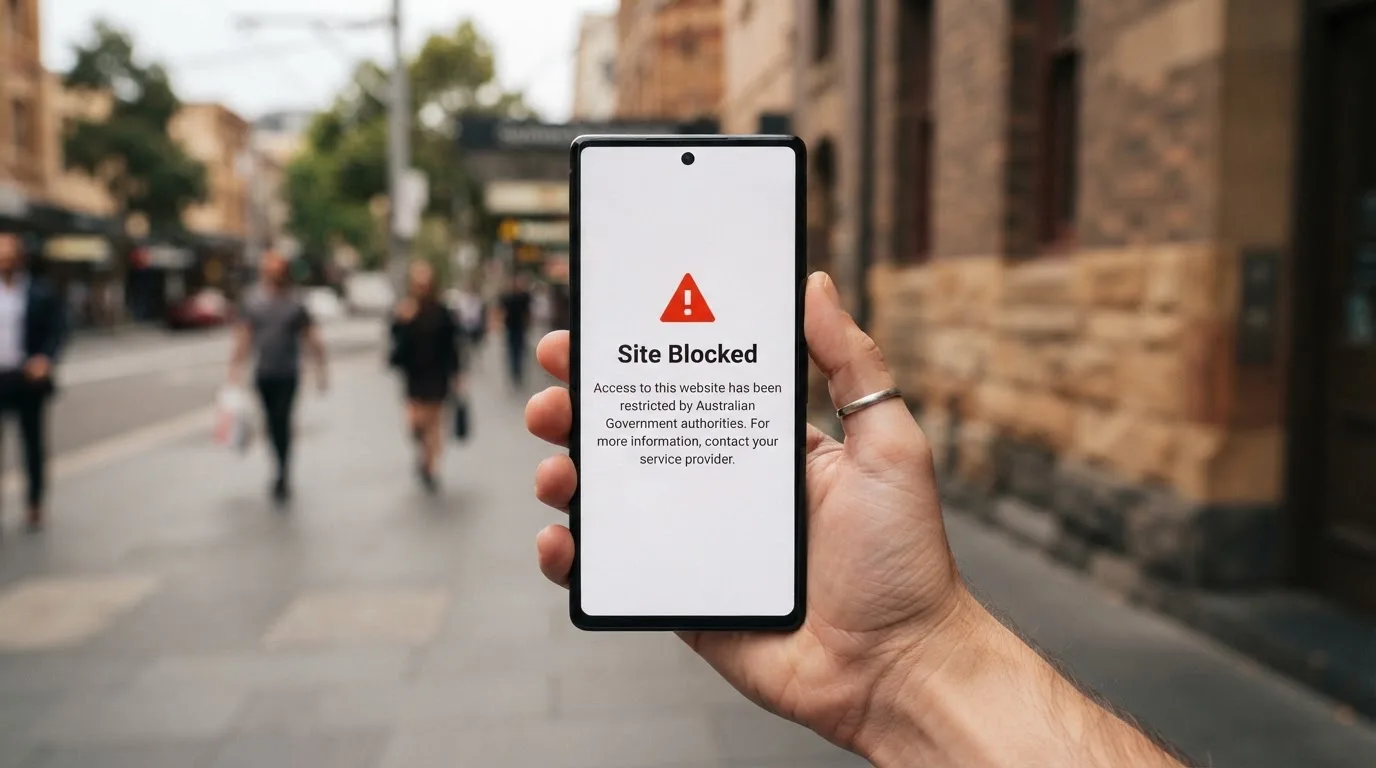
The ACMA investigates complaints, issues formal warnings and directs Australian internet service providers to block illegal sites. By June 2026, the authority had asked ISPs to block 1,751 illegal gambling and affiliate-marketing websites since the first blocking request in November 2019, and more than 230 unlicensed services had left the Australian market since enforcement was strengthened in 2017. The pace is not slowing. In a single round reported on 26 June 2026 the ACMA added 12 more sites to the blocking list: 7Signs, ChromaBet, Donbet, Duospin, Freshbet, Slots Gem, Jacks Club, Lucky Start, Pointsbetz, Spinrise, Vinyl Casino and Wildsino.
What a formal warning actually does
A formal warning is published on the ACMA’s website, names the operator entity the warning was issued to, and gives that entity a chance to cease offering the prohibited service. A warning is not a fine and is not a prosecution; it is the step before the ACMA moves to a civil penalty application or asks ISPs to block the site. Many of the brands in the table above received a formal warning first and continued to operate — the ACMA’s next step is the blocking request, and a blocked site can still hold a player balance.
The 2026 reform and what it does and does not change
The Interactive Gambling Amendment (Gambling Reform) Bill 2026 passed Parliament on 19 August 2026. Its advertising and inducement measures commence on 1 January 2027 — law with a start date, not yet in force on a 2026 page. The bill tightens what licensed wagering operators can do around inducements; it does not, by its terms, open up a path for online casino games in Australia.
What enforcement costs the player who is already in
The ACMA targets the provider. The individual player is not prosecuted for using an offshore site. The player is, however, on the wrong end of a transaction that has no Australian consumer protection, no complaints body, and no guarantee that a withdrawal will be honoured. A blocking request can also leave a balance stranded on a site the player can no longer reach through an Australian ISP, and recovery then runs through the operator’s home regulator — slow, uncertain and unfamiliar.
The responsible-gaming shelf: what Australians can actually use
The shelf that closes the page is the one a reader in difficulty reaches for, and the tools on it are real and Australian.
BetStop and what it does and does not bind
BetStop, the National Self-Exclusion Register, has been live since August 2023. It binds Australian-licensed online and phone wagering services — the same set the IGA permits — and excludes a registered user from those services for a chosen period. An offshore casino is not connected to BetStop, and registering with BetStop does not exclude a player from an offshore site the ACMA has not yet blocked.
Gambling Help Online and the helpline
The National Gambling Helpline, 1800 858 858, is free and operates 24/7, with chat also available through Gambling Help Online. Both services are Australian, confidential and staffed by counsellors trained in gambling harm. They are useful regardless of where the gambling the caller is worried about is happening — licensed or offshore.
The lawful Australian alternatives
For an Australian who wants the experience the search is reaching for — slots, table games, the atmosphere of a casino — the lawful paths are land-based casinos in the states and territories that license them, and licensed pokies venues. Online casino games do not have a lawful Australian path. The gap is the point of the page.
The eleven brands: what each warning tells the reader who already has the account
Eleven brands, eleven formal warnings, one underlying position. Each write-up below carries the ACMA’s own statement of the action, the date, and the operator entity the warning named; nothing further is inferred.
RocketPlay — two warnings, the most recent in March 2026
The ACMA issued a formal warning to Pulsup Ltd in March 2026 over Rocketplay. The same brand had earlier been the subject of a May 2022 warning to Dama N.V., covering Rocketplay alongside Bambet, Dazard, Level Up, Wild Tornado and Cobra Casinos. The reappearance of the brand under a new operator entity is the pattern the ACMA’s enforcement record most often shows.
Level Up Casino — the May 2022 Dama N.V. warning
The ACMA named Dama N.V. in a May 2022 warning that covered six brands at once; Level Up Casino was one of them. The brand has continued to operate since the warning, and the listings pages that carry it describe it as a partner casino for other studios without adjudicating on the Australian legal position. The site’s offer is unchanged: online casino games to anyone who can reach the front door.
Woo Casino — Dama N.V., March 2025
A formal warning to Dama N.V. over Woo Casino in March 2025. The same operator entity received the May 2022 warning above and a further warning over Spirit Casino the following month. The ACMA’s pattern of addressing the operator behind several brands at once is the reason a single entity’s name recurs across several rows of the table.
Spirit Casino — Dama N.V., May 2025
A formal warning to Dama N.V. in May 2025 over Spirit Casino. Two months after the Woo Casino warning, and over a brand the operator had not previously been warned over under that name. The pace — two Dama N.V. warnings in three months — is itself the signal of how the ACMA handles operator groups.
National Casino — Consolutetish S.R.L., July 2025
A formal warning to Consolutetish S.R.L. over National Casino in July 2025. The brand is the one for which the listings pages carry the most material outside the warning register: Betsoft and Pragmatic Play both list National Casino among their partner operators, and Wikipedia references the brand. None of that changes the Australian legal position.
Bizzo Casino — two warnings, the second in July 2025
A formal warning to Consolutetish S.R.L. over Bizzo Casino in July 2025, on top of an earlier 2022 warning issued to TechSolutions (CY) Group Limited and TechSolutions Group N.V. for the same brand. Two warnings four years apart, over the same brand, under different operator entities — the pattern is repeated often enough on the ACMA’s register that it has its own shape.
Ignition Casino — Bamboo Media, July 2025
A formal warning to Bamboo Media in July 2025 over Ignition Casino. The operator entity is one the ACMA had not previously named in the register; the warning follows the same template as the others — a public notice that named Australian-facing online casino play is prohibited and that the operator must cease supplying it.
Instant Casino — EOD Code SRL, February 2025
A formal warning to EOD Code SRL in February 2025 over Instant Casino. The warning predates the July 2025 round by eighteen months and is one of the more frequently cited examples in the ACMA’s communications around enforcement pace.
Jackbit — Ryker B.V., April 2026
A formal warning to Ryker B.V. in April 2026 over Jackbit and CasinOK, two brands under the same operator entity in the same notice. The joint warning is the ACMA’s standard way of handling an operator running more than one Australian-facing brand — one notice, both names.
Casino Intense — Sterplay Holding Ltd, April 2025
A formal warning to Sterplay Holding Ltd in April 2025 over Casino Intense. The brand is the one for which the most listings material exists outside the ACMA register: 1spin4win, Wikipedia and the UK Gambling Commission’s public register all reference Casino Intense. The UK Gambling Commission listing is the closest any of the eleven brands gets to a regulator’s own register; it is not, however, a permission to take Australian customers for online casino games.
Sky Crown — Hollycorn N.V., September 2022
A formal warning to Hollycorn N.V. over its Sky Crown and Blue Leo casino services, published in September 2022. Hollycorn is one of the more frequently named operator entities on the ACMA’s register, and the Sky Crown warning is the oldest of the eleven entries on the table.
What the ACMA’s blocking record actually says: a band, not a single number
The ACMA’s enforcement record is the page’s definitive count. Between November 2019, when the first blocking request was made, and the June 2026 round reported by the regulator, the ACMA had directed Australian ISPs to block 1,751 illegal gambling and affiliate-marketing websites. That is the published figure. The enforcement record is the only measure of how much of the illegal market the regulator has addressed, and it shows that the illegal market is not static—it is a running total that grows every quarter.
The blocking pace is the calculation. Dividing the 1,751 blocked sites by the months between November 2019 and the June 2026 round gives the average number of sites the ACMA has asked ISPs to block per month across the period. Stating it as a single figure flatters the early years, when the pace was slower, and understates the recent rounds; the honest answer is a band, with the early years at one end and the more recent rounds at the other. The point the band makes is that the ACMA’s enforcement is not a one-off action — it is a running total that grows every quarter, and a brand the ACMA has not yet named is a brand the regulator has not yet reached, not one the regulator has cleared.
The figure is also the answer to a question the marketing side of the market never asks: how often does a brand an Australian reader has been playing on disappear from reach at the ISP level, with whatever balance still on it. The ACMA’s blocking total is the regulator’s own count of that event, and the page closes by putting the count next to the legal frame it counts inside.
Frequently asked questions
What kind of games does NetEnt make?
NetEnt’s core output is online slots — Starburst, Gonzo’s Quest and Starburst XXXtreme among the most-played titles — together with a small number of table games. The studio has been operating since 1996 and was acquired by Evolution in December 2020, with Evolution’s live-casino studio now sitting alongside the NetEnt slot catalogue under the same group.
Is NetEnt used by any casino licensed to operate in Australia?
No Australian licence covers online casino games, so a casino using NetEnt slots cannot be licensed in Australia for that product. NetEnt’s games do appear in Australian land-based venues on Aristocrat-style pokies supplied to licensed clubs and pubs, but the online casino library is not a licensed Australian product. The Northern Territory Racing and Wagering Commission regulates online bookmakers — Sportsbet, Bet365, Ladbrokes among them — for wagering, not casino.
Can Australians legally play NetEnt slots at an online casino?
No. The Interactive Gambling Act 2001, strengthened by the 2017 amendments, prohibits the supply of online casino games to anyone in Australia, and no state or territory issues a licence for the product. An Australian who opens an account with an offshore casino is using a service the provider is prohibited from offering; the player is not prosecuted, but the transaction has no Australian consumer protection and the site can be blocked at any time with a balance still on the account.
Are NetEnt games available at land-based Australian casinos?
NetEnt’s online catalogue is not the same product as the electronic gaming machines in Australian clubs, hotels and casinos — those are supplied by Australian manufacturers led by Aristocrat Leisure, the largest gambling-machine manufacturer in Australia and the second-largest slot-maker worldwide behind International Game Technology. Aristocrat was founded in 1953, listed on the ASX in 1996 under the ticker ALL and reported 2025 revenue of A$6.30 billion. The NetEnt name belongs to the offshore online market.
What should someone check before trusting a site that claims to offer NetEnt games?
The first check is the product itself: if the site offers online casino games to someone in Australia, no licence displayed on the page can make that lawful, because no Australian licence for online casino exists. The second check is the operator entity behind the brand — if that entity has been the subject of an ACMA formal warning, the warning itself is the public record. The third check is the payment rail: a site asking for a credit card or a crypto deposit for casino play is operating outside the Australian credit-card and digital-currency ban that took effect on 11 June 2024.
Does NetEnt software run on mobile browsers?
Yes. NetEnt’s slots are HTML5 and load in a standard mobile browser the same way they load on a desktop, with touch replacing click and the screen rescaling to the device. There is no separate mobile build, no install step, and no permission list — the casino apps that ship NetEnt games are wrappers around the same mobile site, not a different product. The legal position does not change with the form factor: an offshore casino on a phone is the same prohibited product on a smaller screen.