
Wazdan casinos in Australia in 2026: what the offshore shelf actually delivers
Australian players searching for Wazdan slots meet the same wall every time. Wazdan is a real studio with real games and real licences in dozens of jurisdictions, and every site offering its catalogue to an Australian IP address is breaking the Interactive Gambling Act 2001. The Australian Communications and Media Authority has now issued formal warnings to more than a dozen operators over exactly that conduct, and has directed Australian ISPs to block 1,751 illegal gambling and affiliate sites since November 2019. This page sorts that landscape into what it costs the punter, what the regulator has already done, and what still stands as a legal alternative for someone who wants Wazdan-style play.
Data current as of 29 October 2026, cross-checked against the ACMA’s formal-warning register and blocking notices as published by the regulator.
Table of Contents
- Payment rails and how long a Wazdan withdrawal really takes
- Bonus mechanics wrapped around Wazdan titles
- Mobile play and app availability
- The Wazdan catalogue and what the paytables actually say
- Landscape
- What the ACMA’s blocking rate actually shows
- The legal frame around an Australian-facing Wazdan site
- What Australian players can use instead
- Responsible gambling supports available to an Australian player
- The picture behind the regulator’s record
- Closing read on the Australian Wazdan shelf
- Frequently asked questions
Payment rails and how long a Wazdan withdrawal really takes
The offshore sites that advertise Wazdan titles in Australia accept the same handful of deposit rails the broader offshore market accepts: debit cards through an offshore processor, a handful of e-wallets, and increasingly cryptocurrencies. None of these is a rail a regulated Australian wagering service can lawfully accept any more. The federal ban on credit cards, credit-related products and digital currency as a payment for licensed online wagering came into force on 11 June 2024, with penalties of up to A$247,500 per breach for the operator. An Australian-facing site that still asks for a card or a crypto deposit is therefore operating outside the rules, and the rail that takes the deposit is itself a tell.

The deposit experience on those sites is fast, because the operator wants it fast. Card deposits typically post inside a few minutes; e-wallet and crypto deposits are credited after a fixed number of blockchain confirmations, often under an hour. The withdrawal is the part that takes the time, and the time depends on the queue inside the operator and the rail chosen. Card withdrawals route through the issuing bank and frequently take three to five business days once approved; e-wallet withdrawals are faster, often inside twenty-four hours of approval; bank transfers can stretch to a week if the receiving bank sits outside the operator’s standard payout list. None of this is regulated in Australia for an offshore operator — the speed is a house policy, not a consumer guarantee, and a refusal at payout is something the player has no Australian body to complain to.
A second rail problem sits underneath the speed. Most offshore Wazdan sites run KYC only on withdrawal, not on deposit. A player who deposits with crypto and then tries to withdraw to a debit card can find themselves blocked by an internal “method-match” rule — the operator insisting the card was not the deposit method and demanding a different rail. Switching to a bank transfer at that point pulls the timeline out to a week, and the player has no leverage. A punter who plans ahead and matches deposit and withdrawal rail at the start is the one who avoids the slowdown.
The crypto rail raises a separate issue. Australian-licensed wagering services cannot lawfully accept digital currency. An offshore site that does accept it is not just unlicensed, it is on the wrong side of a federal payment rule that the operator has chosen to ignore. The balance the player holds there is held in whatever wallet the operator runs, not in anything the player controls. If the regulator blocks the site, the balance sits on the wrong side of the block.
Bonus mechanics wrapped around Wazdan titles
Offshore Wazdan sites run the same promotional machinery as every other offshore casino: a deposit match on the first three or four deposits, a bundle of free spins tied to a named Wazdan title, and a recurring reload that arrives by email. The headline numbers are large because they need to be — the ACMA’s own figures put Australian losses to illegal sites at about A$3.9 billion a year, and the inducements that drive that loss are the inducements these bonuses are.
Two clauses do almost all of the work in the small print. The first is the wagering requirement, expressed as a multiple of the bonus or of the bonus plus deposit, and usually set somewhere between thirty-five and fifty times. A A$500 bonus with a forty-times turnover requirement obliges the player to push A$20,000 through the games before the bonus converts to withdrawable cash. The second is the game weighting: slots typically contribute 100% of each spin to the turnover, but Wazdan’s higher-volatility Hold the Jackpot series can sit at a lower weight, sometimes 20% or zero. A player who assumes the spin counts in full and finds it counts at zero has cleared none of the requirement and has spent the bonus without progressing. The bonus terms are written so that the headline figure and the realised cost sit far apart.
Free-spin bundles attached to Wazdan titles carry their own narrowing. The spins are usually locked to a single named slot — 9 Coins, Power of Gods: Hades, Sizzling Eggs — and any winnings are paid as bonus money, not cash, and then run through the same wagering requirement as the deposit match. There is almost always a maximum cashout cap on free-spin winnings, often a low one, and there is almost always a maximum bet per spin while the bonus is active, often A$5. A player who wins something on a free spin and then bets above the cap voids the bonus and any winnings attached to it.
The reload offers are the inducement that keeps showing up in the inbox. They look smaller because they are smaller — fifty per cent up to a low cap, twenty free spins on a new release — but they run on the same mechanic and the same small print. A punter who wants to see the offer for what it costs reads the wagering multiple, the game weighting, the max cashout and the max bet per spin before any deposit, and reads them on the operator’s own terms page rather than on a marketing email.
Mobile play and app availability
Wazdan’s catalogue is built in HTML5, and the studio has been mobile-first for years; the games run on a phone browser at the same paytable the desktop client sees. The issue at the Australian end is not the game — it is the site that hosts it. Offshore operators serve Australian mobile traffic through the same browser-based product they serve everywhere else, sometimes wrapped in a thin native shell that the app stores will not accept because the underlying product is unlicensed. A punter who finds a “Wazdan casino app” in an Australian app store is looking at either a social-casino wrapper that does not pay real money or at an APK sideloaded from the operator’s own site, which the phone’s security settings will block by default.
Browser play is the realistic path, and it carries three frictions worth knowing about. The first is the geo-block that the operator itself applies: a site registered in Curaçao will read the IP address and either refuse service or push the player into a stripped-down “fun mode” the moment the connection looks Australian. The second is the ACMA block, which is applied at the ISP level — a player on a major Australian ISP who tries to reach one of the 1,751 blocked domains sees a regulator’s notice rather than the site. The third is the mobile site’s own volatility, which on offshore sites is often a thin HTML5 port of a desktop product and stutters under the load a Hold the Jackpot bonus round places on it.
For a punter who wants Wazdan-style mobile play without any of those frictions, the licensed alternative is a state-and-territory-regulated poker-machine app from a club or pub, plus the social-casino apps Wazdan’s Australian peers publish through Apple and Google. Those do not pay real money; they do run the same mechanic.
The Wazdan catalogue and what the paytables actually say
Wazdan describes itself as a Malta-registered studio founded in 2010, holding an MGA B2B licence (MGA/B2B/206/2011) and a UK Gambling Commission account (48872), with 300-plus titles and a footprint of more than 2,500 casino sites across twenty-plus markets. The studio is licensed in more than thirty jurisdictions, including New Jersey, Michigan, West Virginia, Ontario, Sweden, Romania, Greece and Denmark — a regulatory profile that does not extend to Australia, because Australia does not license online casino games.
The studio’s signature features matter to anyone comparing one Wazdan title to another. The proprietary Volatility Levels feature, introduced in 2018, lets the player switch a slot’s volatility between Low, Standard and High from inside the game. The Hold the Jackpot series clusters a sticky-coin bonus mechanic across a dozen titles, and the Collect to Infinity / Cash Infinity mechanic lets a coin trail extend across respins. These are the reasons Wazdan titles look and play differently from the rest of the offshore lobby, and they are the reason the same studio keeps showing up in marketing emails aimed at Australian addresses.
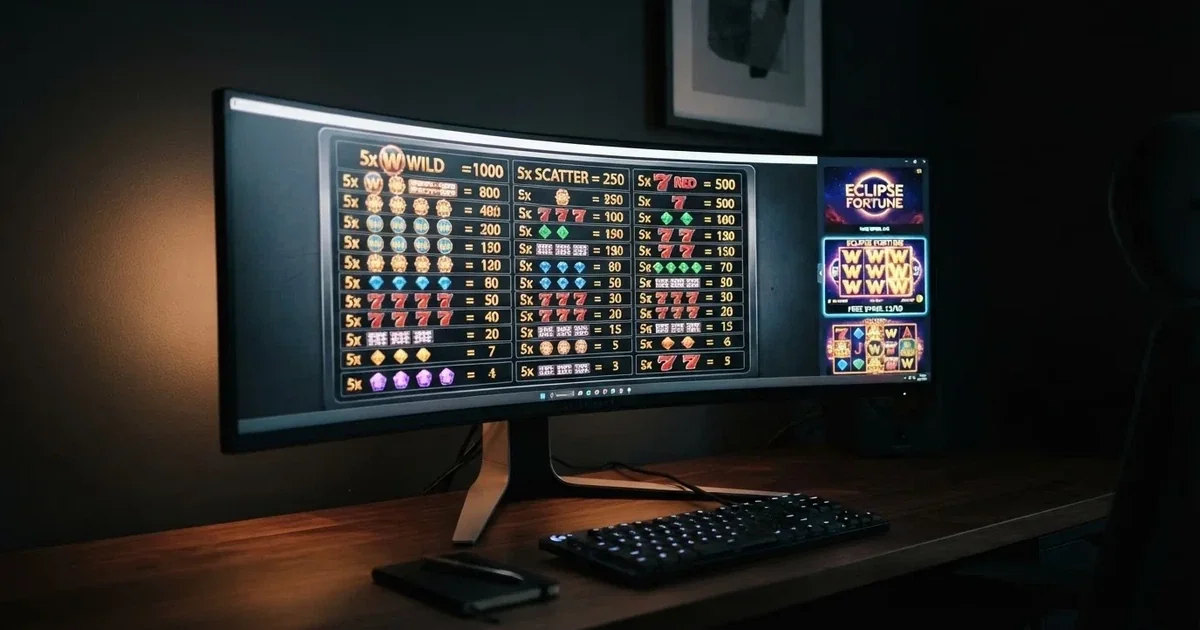
The flagship 9 Coins is the cleanest illustration of how a Wazdan paytable actually behaves. The published RTP is 96.06%, the volatility is medium-high, and the maximum win is 500x the bet. The base game pays nothing — every prize sits inside the Hold the Jackpot bonus round. A player who reads that paytable and chooses to play is choosing a slot where most spins return zero and the win, when it comes, is concentrated in one feature; the volatility switch in the game screen moves the size and frequency of that win across the three settings. Knowing that before the first spin is the difference between reading the marketing line and reading the math.
Two peer studios recur in the Wazdan lobby. 1spin4win, founded in 2021, is a Curaçao-licensed provider with a portfolio of more than 190 slots, more than 1,000 operator partnerships, and a stated 46% growth in total bet sum between the first halves of 2024 and 2025. Aristocrat Leisure, founded in 1953 and ASX-listed since 1996 under the ticker ALL, is Australia’s largest gambling-machine manufacturer and the second-largest slot-maker worldwide; its 2025 revenue was A$6.30 billion, and its regulated online arm is Aristocrat Interactive, formed in April 2024 from the merger of Anaxi and the acquired NeoGames group. Aristocrat is the Australian-listed manufacturer whose land-based pokies are the closest local analogue to the Wazdan online catalogue.
Landscape
| Operator | Warning count | Most recent action |
|---|---|---|
| Dama N.V. | 3 | May 2025 |
| TechSolutions/Consolutetish | 3 | July 2025 |
| Hollycorn N.V. | 1 | September 2022 |
| Ryker B.V. | 1 | April 2026 |
The eleven brands below are not a ranking. Each one appears because the ACMA itself issued a formal warning over it for offering prohibited interactive gambling services to Australians under the Interactive Gambling Act 2001. The table below is a record of regulator action, ordered by the action the regulator has taken. The page does not recommend any of them, because the law does not let any of them be lawfully offered to a person in Australia.
| Brand | ACMA action and date | Operator named by the ACMA | Subject support |
|---|---|---|---|
| RocketPlay | Formal warning, March 2026 (Pulsup Ltd); earlier warning, May 2022 (Dama N.V.) | Pulsup Ltd (March 2026); Dama N.V. (May 2022) | — |
| Level Up Casino | Formal warning, May 2022 | Dama N.V. | Listings report Wazdan titles offered (Wazdan.com) |
| Woo Casino | Formal warning, March 2025 | Dama N.V. | — |
| Spirit Casino | Formal warning, May 2025 | Dama N.V. | — |
| National Casino | Formal warning, July 2025 | Consolutetish S.R.L. | Listings report titles from Betsoft, Pragmatic Play and others (Betsoft.com, en.wikipedia.org, Pragmaticplay.com) |
| Bizzo Casino | Formal warning, July 2025 (Consolutetish S.R.L.); earlier warning, 2022 (TechSolutions) | Consolutetish S.R.L. (July 2025); TechSolutions (2022) | — |
| Ignition Casino | Formal warning, July 2025 | Bamboo Media | — |
| Instant Casino | Formal warning, February 2025 | EOD Code SRL | — |
| Jackbit | Formal warning, April 2026 | Ryker B.V. | — |
| Casino Intense | Formal warning, April 2025 | Sterplay Holding Ltd | Listings report titles from 1spin4win and others (1spin4win, en.wikipedia.org, gamblingcommission.gov.uk) |
| Sky Crown | Formal warning (date as published, September 2022) | Hollycorn N.V. | — |
The pattern in the table is the more useful thing than any single row. Three of the eleven warnings (Woo Casino, Spirit Casino, Level Up Casino) sit with the same operator — Dama N.V. — which the ACMA first warned in May 2022 over a different bundle of six brands and warned again in March and May 2025 over Woo and Spirit. A regulator naming the same corporate entity three times in four years, over different brand names, is the regulator telling the public that a warning to the parent does not stop the children. The same pattern repeats with TechSolutions and Consolutetish S.R.L. over Bizzo Casino and National Casino, where the same brand sits under two different operators across three years. For a punter reading the table, the corporate entity above the brand is the line that survives a name change.
Three of the brands carry “listings-only” subject support from the Wazdan catalogue: Level Up Casino appears in Wazdan’s own operator listings; Casino Intense carries titles from peer studios whose own operator pages list it; National Casino carries titles from Betsoft and Pragmatic Play reported on their own sites. The remaining eight carry no data — the Wazdan page does not list them and the peer pages do not either, which is not a denial but is also not an affirmation. The honest reading is that an offshore operator’s Wazdan coverage can change week to week, and the only durable record is the ACMA’s own warning register.
RocketPlay
The ACMA named RocketPlay twice. The first warning, in May 2022, was issued to Dama N.V. over six brands including RocketPlay. The second, in March 2026, was issued to Pulsup Ltd over Rocketplay.com.au specifically. Two warnings four years apart, two different operators, the same brand on the front of the site each time — the same pattern the regulator has used to signal that a brand-change does not put a site outside the Act. For a reader, the only durable read of RocketPlay is the regulator’s: it is not licensed to take an Australian deposit, and the warnings make clear that the corporate wrapper does not change that.
Level Up Casino
Level Up Casino sits inside the original May 2022 Dama N.V. warning and has not been re-warned since. The brand’s own marketing continued to operate, and Wazdan’s own operator listings include it among sites carrying the studio’s titles. The regulator’s silence since 2022 is not an endorsement; it is a regulator that has not yet had to act again. A reader who looks at Level Up should look past the Wazdan listing page to the ACMA register, where the original warning still stands.
Woo Casino
Woo Casino was named in the ACMA’s March 2025 warning to Dama N.V. — the second Dama N.V. warning, three years after the first. The pattern is the same as RocketPlay: the corporate wrapper changes, the brand on the front does not. Woo has no current listing as carrying Wazdan titles in the studio’s own coverage, but the offshore market’s line-up changes regularly and an absence today is not the same as an absence next month.
Spirit Casino
Spirit Casino was the other Dama N.V. brand named in the May 2025 warning. Like Woo, it carries no current Wazdan listing on the studio’s own site. The dual warning — same operator, same month, two different brand names — is the regulator’s clearest signal that a single warning letter covers the corporate group, not the individual brand.
National Casino
National Casino carries a July 2025 warning over Consolutetish S.R.L. Peer-studio listings on Betsoft and Pragmatic Play’s own pages show it carrying their catalogues, which means the site is operationally live and is updating its lobby; it is reasonable to assume Wazdan titles appear there as part of that rotation. The ACMA’s record is the binding one — the site is not licensed to take Australian play — and the lobby contents are the operator’s own claim.
Bizzo Casino
Bizzo Casino has the longest warning record of any brand in the table. The ACMA warned TechSolutions (CY) Group Limited and TechSolutions Group N.V. over it in 2022, then warned Consolutetish S.R.L. over the same brand in July 2025 — a second operator, the same front-of-house name, three years apart. A punter who sees Bizzo Casino marketed today is seeing a brand whose corporate wrapper has changed once already under regulator pressure. The brand can change operator again; the warning record does not.
Ignition Casino
Ignition Casino was named in the ACMA’s July 2025 warning to Bamboo Media. The site has long carried a peer-studio lobby and continues to operate offshore. The Bamboo Media naming is the regulator’s first action over the brand; readers should treat the warning as live and the brand as still under scrutiny.
Instant Casino
The ACMA’s February 2025 warning over Instant Casino, naming EOD Code SRL, is one of the regulator’s earlier 2025 actions and sits inside the same enforcement cycle as the Dama N.V. warnings. Instant Casino carries no current Wazdan listing on the studio’s own site; the brand’s broader catalogue is what the regulator was acting on.
Jackbit
Jackbit sits in the ACMA’s April 2026 warning to Ryker B.V., which also named CasinOK. The warning is the most recent in the table and is part of the same enforcement wave that produced the April 2026 round. For a reader looking at Jackbit today, the warning is fresh and the brand’s Wazdan coverage is whatever the lobby shows on the day.
Casino Intense
Casino Intense carries the ACMA’s April 2025 warning to Sterplay Holding Ltd. Peer-studio listings — 1spin4win’s own operator pages and the Gambling Commission’s public register — name Casino Intense among sites carrying their catalogues, which is the same operational pattern as National Casino: a live site with a rotating lobby.
Sky Crown
Sky Crown sits in the ACMA’s formal warning to Hollycorn N.V., which also named Blue Leo; the published record carries a September 2022 date. The Hollycorn warning predates the 2024–2026 wave, and Sky Crown’s continued operation under the same parent is the kind of continuity the regulator’s pattern of warnings is built to call out.
What the ACMA’s blocking rate actually shows
The ACMA has asked Australian ISPs to block 1,751 illegal gambling and affiliate marketing websites since the first blocking request in November 2019. The June 2026 round alone added twelve more: 7Signs, ChromaBet, Donbet, Duospin, Freshbet, Slots Gem, Jacks Club, Lucky Start, Pointsbetz.com, Spinrise, Vinyl Casino and Wildsino. Over 230 unlicensed services have left the Australian market since enforcement was strengthened in 2017.
Stated as a blocking rate against the period since the first blocking request, that is roughly between 260 and 290 sites per year across the six-and-a-bit years from November 2019 to the present, depending on the precise end date. That is a rolling average, not a steady rate — the regulator blocks in published rounds, with gaps between them, and a single round can add a dozen sites in one afternoon. The useful number for a reader is not the rate itself but the asymmetry it sits inside: the operator can stand up a fresh domain in minutes, and the regulator’s process to block it runs in weeks. The cumulative count of 1,751 is the public-facing number; the count of domains stood up across the same period is several times that and is not published.
H2 Gambling Capital’s 2025 estimates put Australian losses to illegal gambling at about A$3.9 billion a year, and the share of gambling going through legal channels fell from 74% in 2021 to 64% in 2025. That is the financial mirror of the blocking rate — every site the regulator blocks is a site that has already taken Australian play, and the losses outpace the enforcement.
The legal frame around an Australian-facing Wazdan site
The Interactive Gambling Act 2001, strengthened by the Interactive Gambling Amendment Act 2017, makes it an offence to provide online casino games, online pokies or in-play betting to a person physically in Australia. No state or territory licenses online casino games. What is licensable is wagering on races and sport placed before the event, lotteries and keno — and that is licensed, in practice, by the Northern Territory Racing and Wagering Commission, which regulates 52 of Australia’s online bookmakers including Sportsbet, Bet365 and Ladbrokes, runs with no full-time staff and meets once a month in Darwin. The minimum age is 18.
The individual player is not the target of the Act — the IGA names the provider, not the customer. An Australian who opens an account on an offshore Wazdan site is not prosecuted. What the player loses is the consumer protection an Australian licence carries: no Australian complaints body, no local recourse if a withdrawal is refused, and a real prospect that the site is blocked by an ISP with a balance still sitting on it.
The ACMA’s enforcement toolkit has three main parts. It investigates complaints. It issues formal warnings, which sit on the public register and follow the operator across brand changes. And it directs Australian internet service providers to block domains, which is how the 1,751-site count has accumulated. The June 2026 round is the most recent wave in a continuous enforcement programme.
From 1 January 2027, the advertising and inducement measures in the Interactive Gambling Amendment (Gambling Reform) Bill 2026 — passed by Parliament on 19 August 2026 — commence. The bill is law with a start date; on a 2026 page it is not yet in force. It tightens the rules around how operators can advertise and what inducements they can offer to Australians, and it is the next material change to the landscape the ACMA already polices.
The payment rules already in force matter to a punter choosing a rail. Since 11 June 2024, credit cards, credit-related products and digital currency cannot lawfully be used as payment for licensed Australian online wagering. Penalties run to A$247,500 per breach for the operator. Legal deposit routes for a licensed wagering service are debit card, bank transfer, PayID/Osko and BPAY. An offshore site asking for a card or a crypto deposit is not just unlicensed — it is on the wrong side of a payment rule the operator has chosen to ignore.
On tax, gambling winnings of a recreational player are not assessable income under section 6-5 of the ITAA 1997, and losses are not deductible, unless the person carries on a business of gambling. The ATO’s own guidance applies, and a punter whose activity looks anything like a trading pattern should look at that guidance before treating the winnings as tax-free.
What Australian players can use instead
The legal Australian alternative to an offshore Wazdan site is not, in practice, another casino. It is the licensed wagering services the NTRWC regulates — Sportsbet, Bet365, Ladbrokes and the other 49 — and the state-and-territory-regulated poker machines in clubs and pubs. The licensed wagering services take pre-event bets on sport and racing, take PayID and BPAY deposits, and connect to BetStop if a player wants self-exclusion. They do not carry Wazdan slots. The poker machines in clubs and pubs are electronic gaming machines regulated by state authorities, and the games are built by Aristocrat and other Australian-licensed manufacturers; the closest local analogue to a Wazdan Hold the Jackpot session is a multi-feature Aristocrat pokie in a licensed venue.
For someone who wants the Wazdan mechanic without the offshore wrapper, the social-casino apps published by Wazdan’s Australian peers through Apple and Google are the mobile option. They do not pay real money, and they run the same mechanic. They are not a substitute for real-money play; they are a separate product, marketed honestly.
Responsible gambling supports available to an Australian player
The supports that follow apply whether the player has been playing on an offshore Wazdan site, a licensed wagering service, or a poker machine in a pub. Gambling Help Online runs the National Gambling Helpline on 1800 858 858, free and open twenty-four hours a day, with live chat on the website. BetStop, the National Self-Exclusion Register, has been live since August 2023 and binds every Australian-licensed online and phone wagering service — the offshore sites the ACMA has warned are not connected to it, which is one of the structural reasons an Australian player who wants self-exclusion should move their play onto a licensed service. State and territory self-exclusion registers cover the poker machines in clubs and pubs; the relevant register depends on the state or territory the player lives in.
The point of these supports is not to suggest that every player who reads this page needs them. It is that the law has built them around licensed play, and an offshore Wazdan site sits outside that framework. A punter who wants the framework around their play — the complaints body, the self-exclusion, the helpline — takes their play onto a licensed service.
The picture behind the regulator’s record
The cumulative count of 1,751 blocked domains and 230-plus services that have left the market is the public face of the ACMA’s work. The less public face is the warnings register, which shows the same operators being warned again and again as they change brand names. The Dama N.V. sequence — six brands in 2022, then Woo Casino and Spirit Casino in 2025 — is the clearest illustration: the regulator names the parent, the parent re-shells, and the regulator names it again. The TechSolutions-to-Consolutetish sequence over Bizzo Casino is the same shape. A reader who wants to understand why an Australian-facing Wazdan site keeps reappearing under a new name is looking at exactly that pattern.
The H2 Gambling Capital estimate of A$3.9 billion a year in Australian losses to illegal sites is the other part of the picture. The regulator blocks in rounds; the losses run continuously. The 64% share of gambling going through legal channels in 2025, down from 74% in 2021, is the trend the regulator is trying to arrest, and the January 2027 commencement of the inducement rules is the next tool in that effort.
Closing read on the Australian Wazdan shelf
A punter searching for Wazdan slots in Australia meets a market that is regulated out of existence at the consumer end and enforced at the provider end. Wazdan is a real, multi-jurisdiction-licensed studio with a real catalogue and real paytables, and the catalogue is marketed to Australian IPs through sites the regulator has acted against. The brands the ACMA has named are not a recommendation — they are a record. The licensed alternative is a different product category, not a different brand in the same category. The next material change is the January 2027 commencement of the inducement rules, and the question the reader is sitting with is not which offshore site to choose but whether the licensed alternative is the right shelf to be on.
Frequently asked questions
Is Wazdan legally available to players in Australia?
No. The Interactive Gambling Act 2001 prohibits the supply of online casino games, including Wazdan slots, to a person in Australia, and no state or territory licenses them. An Australian-facing site offering the catalogue is breaking the Act, and the ACMA has warned or blocked more than a dozen operators for doing exactly that.
What kinds of games does Wazdan make?
Wazdan is an online slot studio founded in 2010 and registered in Malta, with more than 300 titles in release. The studio is known for the Volatility Levels feature, the Hold the Jackpot bonus series and the Collect to Infinity mechanic. Flagship titles include 9 Coins, with a 96.06% RTP and medium-high volatility, and a 500x maximum win concentrated in the bonus round.
Are Wazdan games offered at land-based venues in Australia?
No. Wazdan’s distribution is to online casino operators under multi-jurisdiction B2B licences. Australian land-based gaming is dominated by Aristocrat Leisure pokies in clubs and pubs, regulated by state and territory authorities; the Wazdan catalogue is a separate, online-only product.
How can Australians check whether a Wazdan title is fair before ever considering play?
A punter who wants to read the math can look at the published RTP and volatility on the studio’s own game page — 9 Coins at 96.06% with medium-high volatility is the clearest example — and can look at the studio’s licensing footprint, which includes MGA B2B licence MGA/B2B/206/2011 and a UK Gambling Commission account. What the punter cannot do, in Australia, is lawfully play the game at an unlicensed site; the math is readable, the play is not.
Why do offshore sites keep advertising Wazdan games to Australian visitors?
Because the inducement works. H2 Gambling Capital’s 2025 estimates put Australian losses to illegal gambling at about A$3.9 billion a year, and the share of gambling going through legal channels fell from 74% in 2021 to 64% in 2025. Offshore operators advertise because the Australian market is large and largely unreachable through licensed channels; the ACMA’s blocking rounds are the regulator’s response to that arithmetic.
What should an Australian do if they see a Wazdan game promoted by an unlicensed site?
The Australian can report the site to the ACMA, which is how the blocking list is built. The punter who has already deposited faces the structural problem the page has been over: the balance is held offshore, no Australian body will compel a withdrawal, and the site can be blocked with the balance still on it. The supports listed in the responsible-gambling section above — 1800 858 858, Gambling Help Online, BetStop — are the appropriate next call for anyone whose play has moved in a direction they did not intend.