
Best pokies in Geelong in 2026: what’s licensed, what isn’t, and what the difference costs
A reader searching for pokies in Geelong usually wants the pubs, clubs and casino floor where the machines actually run — and that is where this page starts. Alongside those venues sit eleven offshore brands the Australian Communications and Media Authority has formally warned Australians about for offering prohibited services, and they are covered here too. The licensed side answers where the money can lawfully be spent. The offshore side answers where the regulator has said it cannot. The difference between the two is the entire content of this page.
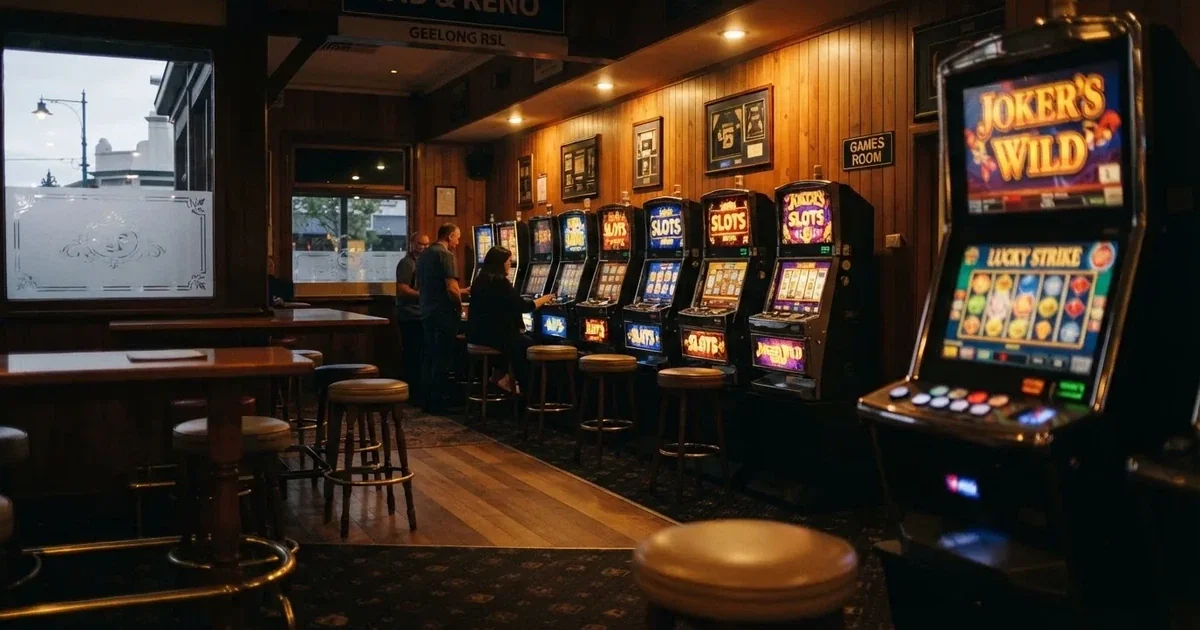
Data current as of 29 October 2026, checked against the ACMA’s formal-warning register and the Victorian Gambling and Casino Control Commission’s venue-level data.
Table of Contents
- Paytable mechanics, hours and cashless play at Geelong EGMs
- The eleven offshore brands on the ACMA’s warning list
- Fundamenta of Geelong’s licensed pokies landscape
- Prohibition on offshore pokies targeting Australian players
- Responsible play: help, registers and what a Geelong patron can use
- Land-based Geelong: where the licensed pokies actually live
- Payments, payout percentages and the cost of a session at the machines
- Frequently asked questions
Paytable mechanics, hours and cashless play at Geelong EGMs
Every electronic gaming machine in a Geelong pub or club runs the same kind of engine: a random number generator, a return-to-player percentage set per game title, and a maximum bet capped under Victorian law. There is no skill to learn. What changes between machines is the theme, the volatility — how lumpy the wins tend to be — and the size of the top jackpot. The underlying RTP sits inside a narrow band the regulator sets, and the variance between pubs and clubs is small.
In South Australia the minimum EGM return-to-player is set at 87.5% outside the casino, with a general maximum bet of A$5.00. Victoria does not publish a headline floor in the same form, but the practical effect for a player is comparable: each spin has a built-in house edge that compounds across a session. For every A$100 that goes in, the machine keeps on average somewhere between A$8 and A$15, depending on the title. Over an hour of play that adds up quietly — there is no single spin that warns you, and there is no pattern in the outcomes that a player can read ahead of time.
Volatility is the second lever. A low-volatility title pays smaller amounts more often; a high-volatility title holds the budget longer and pays in bigger, rarer bursts. Neither choice changes the long-run RTP. Over enough spins, both titles reach the same arithmetic mean. But they shape what a session feels like. A budget that lasts an hour on a low-volatility machine can vanish in ten minutes on a high-volatility one, with nothing to show for either outcome except a receipt and the balance that survived.
Hit frequency sits alongside volatility on the game’s information screen. A title with a 30% hit frequency produces a visible return on roughly one spin in three; a title with a 10% hit frequency produces a visible return on roughly one spin in ten. Neither number changes the RTP — both titles reach the same long-run house edge — but the hit frequency is what the player actually experiences in the first twenty minutes at the machine. The maths is the same. The feel is not.
Hours at Geelong’s licensed venues follow the standard pub and club pattern. Most open gaming from mid-morning and run until late evening, with the city’s hotels and taverns generally closing the gaming floor somewhere between midnight and 2 a.m. There is no 24-hour EGM in Geelong. Victoria’s licensed hours do not run that way outside Crown Melbourne’s Southbank complex. A player wanting machines around the clock has to drive to Crown, roughly 75 minutes up the M1, which is licensed for continuous gaming — or accept the local pub’s clock.
Cashless gaming is rolling out across Victorian venues under the YourPlay pre-commitment system, where a card caps daily, weekly or monthly spend before the machine accepts play. The setting is the player’s, not the venue’s. A patron who pre-commits to A$50 a day and reaches the cap will see the machine refuse further play until the limit resets — a useful boundary for anyone who wants the limit set before the first drink arrives. The system is opt-in at this stage, which means a player who does not load a card plays under the venue’s default settings, with no spend cap enforced by the machine itself.
The consequence shows up in the local ledger. Across the City of Greater Geelong and the Borough of Queenscliffe, pokies losses topped A$141 million in 2024–25 — the highest annual total recorded locally — averaging A$388,000 a day across every venue. That is what the maths of an 87.5%-class RTP looks like after enough patrons play enough spins. The machines do not need to beat anyone in particular to add up to that figure. The aggregate is the consequence.
The eleven offshore brands on the ACMA’s warning list
Eleven offshore casino brands sit on the ACMA’s published warning list for offering prohibited interactive gambling services to Australians. None of them is a Geelong pokies venue. None holds an Australian licence, and none can: online casino games and online pokies cannot be licensed anywhere in Australia under the Interactive Gambling Act 2001, regardless of what a footer on the site claims.
What follows is the regulator’s own list, in its own order, with each warning set out plainly: the brand, the date the ACMA acted, the corporate operator it named, and whether the brand surfaced in the listings consulted for this page. A column called subject support flags the brands whose names appeared in industry listings — Wikipedia, ABC News, the Victorian commission’s records — without any connection to a Geelong pokies venue.
What the warnings do not contain is what readers usually want: a payout speed, a bonus figure, a wagering multiple. The only sources for those numbers are the brands’ own affiliate pages, and quoting them would reproduce marketing. The reader can find any of those brands on a comparison site. They cannot find an Australian authority that has checked the offer behind it.
| Brand | ACMA action and date | Operator named by the ACMA | Earlier ACMA action on this operator | Subject support |
|---|---|---|---|---|
| RocketPlay | March 2026 | Pulsup Ltd | May 2022 (Dama N.V.) | — |
| Level Up Casino | May 2022 | Dama N.V. | — | Listings only |
| Woo Casino | March 2025 | Dama N.V. | — | Listings only |
| Spirit Casino | May 2025 | Dama N.V. | — | — |
| National Casino | July 2025 | Consolutetish S.R.L. | — | Listings only |
| Bizzo Casino | July 2025 | Consolutetish S.R.L. | 2022 (TechSolutions) | — |
| Ignition Casino | July 2025 | Bamboo Media | — | — |
| Instant Casino | February 2025 | EOD Code SRL | — | — |
| Jackbit | April 2026 | Ryker B.V. | — | — |
| Casino Intense | April 2025 | Sterplay Holding Ltd | — | Listings only |
| Sky Crown | September 2022 | Hollycorn N.V. | — | Listings only |
The order above is the regulator’s. What follows is each warning in turn, with what it actually changes for an Australian player. The reader looking for a payout time, a wagering multiple or a deposit match will not find any of those numbers here, because the only sources for them are the brands themselves.
RocketPlay — the operator behind the brand has changed twice
RocketPlay is the brand name on the latest warning, dated March 2026, with Pulsup Ltd as the corporate operator the ACMA named. The same brand sat on an earlier warning — May 2022 — when Dama N.V. was the operator. The site still takes Australian traffic and still displays a Curaçao-issued licence. Neither shield changes the underlying position under Australian law.
The product on offer is what the brand calls online pokies, but the term is borrowed. A real Australian pokie is an EGM in a Victorian pub, with a regulator, a published RTP and a venue to walk into. An offshore site calling its slots ‘pokies’ is borrowing the vocabulary for marketing, not the regulatory frame. The substitution reads as a courtesy to an Australian audience; it does not change the legal status of what the site is offering.
The consequence for a player is not subtle. Money deposited with RocketPlay is held by an entity the ACMA has twice warned, across two corporate operators, over a four-year span. If the balance is not returned on request, there is no Australian complaints body to take the case — the IGA targets the provider, and the provider is offshore. A player who chooses to play does so without local recourse. The site can be added to the next blocking round with whatever balance remains.
What does a brand do when the operator behind it keeps changing? Nothing the player can rely on. The name on the page is the same. The corporate entity and the licence are not.
Level Up Casino — the oldest warning in the set
Level Up Casino sits on the original Dama N.V. warning, dated May 2022, which covered six brands in a single notice — Bambet, Dazard, Level Up, Rocketplay, Wild Tornado and Cobra Casinos. Three of those names turn up again later in this list under fresh Dama N.V. warnings, which is itself a data point about how the operator responded to the first action.
The site displays a Curaçao-issued licence in its footer. As with every brand in this group, that licence does not authorise the offering of casino games or pokies to a person in Australia. The licence is real in the sense that it is issued by a jurisdiction that does issue licences. It is not real in the sense of providing any Australian protection. The distinction matters because the brands use the first sense to market to Australians while the second sense is what governs an Australian’s recourse.
Does a five-year-old warning still mean anything? Yes. The Interactive Gambling Act has not been amended to permit what it prohibits, and a warning from 2022 is a public record of what the regulator found at the time. The brand may have changed hands. The conduct the regulator cited remains the conduct named.
Woo Casino — a second Dama N.V. warning, two years on
Woo Casino carries a Dama N.V. warning dated March 2025, three years after the original six-brand notice that named Dama for the first time. The pattern is the same: the ACMA found the brand offering prohibited interactive gambling services to Australians, and named the operator behind it. The brand has continued to take Australian traffic since.
The site displays a Curaçao-issued licence in its footer. As with every brand in this list, that licence does not authorise the offering of casino games or pokies to a person in Australia. The IGA prohibits it, and the prohibition does not turn on what the offshore footer says. The footer is a marketing artefact, not an authorisation.
Is a 2025 warning different from a 2022 one in substance? Not in law — the IGA reads the same. In practical terms, it tells the player the regulator has come back to the same operator group and found the same conduct. That the regulator has done so twice is the message, not the date.
Spirit Casino — the third Dama N.V. warning in this set
Spirit Casino carries a Dama N.V. warning dated May 2025, two months after the Woo Casino warning and three years after the original six-brand notice. The three Dama warnings in this list span May 2022, March 2025 and May 2025 — the clearest signal the regulator has about how the operator group has responded to the first action and what it has done since.
The brand positions itself as an online casino with slot content, marketed under the ‘pokies’ label to Australian traffic. The footer carries an offshore licence. The site’s terms do not exclude Australians and the marketing does not pretend to. The product on offer is the standard offshore casino package.
What is a player actually risking by signing up here? The deposit is the most concrete loss. With no Australian complaints body, no local regulator to escalate to, and an offshore operator the ACMA has now warned three times, a refused withdrawal has nowhere to go but the regulator’s record. The brand’s reputation is not the player’s protection.
National Casino — a Curaçao-registered operator with no Australian standing
National Casino sits on a Consolutetish S.R.L. warning dated July 2025. The same Consolutetish entity was named the same month in a warning over Bizzo Casino, which makes the two a pair on the regulator’s list. Consolutetish is the corporate name; the two brands are the customer-facing labels.
The brand markets casino games and slots under the ‘pokies’ label and accepts Australian registrations. The footer carries an offshore licence, which the brand presents as if it were local authorisation. The IGA does not recognise the licence for the purpose of offering online casino games to Australians. Consolutetish’s licence is real in its own jurisdiction and irrelevant here.
Does a Curaçao-registered operator offer any protection to an Australian? Not under Australian law. The IGA targets the provider, and the only Australian remedy available is the ACMA’s enforcement against the site itself — a remedy that helps the next player, not the one whose withdrawal is currently stuck.
Bizzo Casino — twice warned, two operators, same conduct
Bizzo Casino carries a Consolutetish S.R.L. warning dated July 2025 and an earlier TechSolutions (CY) Group warning from 2022. The pattern is unusual in this list: the regulator has named two different corporate operators over the same brand, in two different years, for the same underlying conduct. The corporate wrapper changed; the conduct did not.
The product is the standard offshore casino offering: slots marketed as ‘pokies’, table games, a Curaçao footer, terms that do not exclude Australian residents. The brand has continued to operate across the change of corporate wrapper — which is itself the kind of detail the regulator’s repeat action tracks. A player looking at the brand today sees a fresh-looking licence and a familiar-looking product.
Why has this brand been warned twice? Because the operator behind it changed, not because the service changed. The conduct the regulator cited in 2022 is the conduct it cited again in 2025. Both belong to the same warning chain. The regulator’s record is the only consistent thread.
Ignition Casino — a brand with no Australian connection at any point
Ignition Casino sits on a Bamboo Media warning dated July 2025. It is one of the brands in this list with no prior Australian warning and no listing in the consulted sources as a Geelong-relevant venue — the subject support column shows it as no-data, which is the cleanest possible reading of where it sits relative to the page’s subject.
The site is positioned as an offshore online casino with slot content and a poker room. Australian traffic has been accepted, and the regulator has named the operator for offering prohibited services. The footer carries an offshore licence in the same way every other brand in this set does. The product range is wider than most — slots, tables, poker — but the legal position is identical to the rest.
Is there any version of this brand that is safe for an Australian? No. The IGA does not carve out exceptions by product type, by licence issuer or by operator name. An offshore casino is what it is, regardless of whether the brand adds ‘poker’ or ‘pokies’ to its title.
Instant Casino — the warning that preceded the broader 2025 enforcement round
Instant Casino sits on an EOD Code SRL warning dated February 2025, two months before the broader 2025 enforcement wave began. The brand has continued to operate, with the regulator’s notice a public record of what it found.
The product is the offshore casino pattern: slots labelled as pokies, table games, a Curaçao-class footer, terms that permit Australian registration. None of that changes the legal position for an Australian patron, which is that the service is prohibited and the provider is offshore. The marketing matches the regulator’s description.
What is the practical effect of a February 2025 warning? It is a step on the way to a blocking request, not the blocking itself. The ACMA’s enforcement pattern in recent years has run from formal warning to blocking direction within months. A player reading the warning today is reading the regulator’s most recent public note on the brand, with the next step likely to follow.
Jackbit — paired with CasinOK under the same operator
Jackbit sits on a Ryker B.V. warning dated April 2026, paired in the same notice with CasinOK. The pairing is the clearest signal: the regulator treats the two brands as one operation under one corporate entity. Two customer-facing brands, one corporate name, one warning.
The product is the standard offshore casino package — slots, table games, sports betting — marketed to Australian traffic under the ‘pokies’ label. The footer carries an offshore licence. The operator behind both brands has now been named by the regulator in a single notice, which is the regulator’s way of saying the two are not separate operations for the purposes of enforcement.
Why pair this with CasinOK in one warning? Because the two sites share an operator, and the ACMA names the operator, not just the brand. The player looking at either brand is looking at the same corporate entity under a different label. The warning covers both.
Casino Intense — the Sterplay Holding warning
Casino Intense sits on a Sterplay Holding Ltd warning dated April 2025. It is one of the brands in this list that surfaced in the listings consulted for this page — ABC News, the trade press, the South Australian regulator’s coverage — without any of those listings identifying it as a Geelong pokies venue. The subject support column reflects that: listings only.
The brand offers an offshore online casino with slots and table games. Australian traffic has been accepted, the operator has been named by the regulator, and the footer carries an offshore licence. There is no Australian licence and no Australian regulator behind the offer.
Does an April 2025 warning mean the brand is still operating? Possibly, and possibly under a new corporate wrapper. The ACMA names the operator it found at the time of the warning; if the operator has since changed, the regulator’s next action would name the new one. The player looking at the brand today should read the warning as a public record of what the regulator found, not as a guarantee that the same entity still sits behind the site.
Sky Crown — the oldest warning in the set
Sky Crown sits on a Hollycorn N.V. warning published in September 2022, alongside a sister brand called Blue Leo. It is the oldest formal warning in this list and the one with the longest passage of time since the regulator acted.
The brand markets slots and table games under the ‘pokies’ label. The footer carries an offshore licence. The site has continued to take Australian traffic, with the regulator’s 2022 notice still on its public register. The intervening years have not produced a fresh action, but they have not produced a clearance either.
What is the value of a 2022 warning in 2026? It still names the operator, the conduct and the date. The Interactive Gambling Act has not been amended to permit what it prohibits. A reader who finds the brand today and reads the 2022 warning is reading the regulator’s most recent public statement on the operator. The absence of a newer warning is not the same as a clearance.
Fundamenta of Geelong’s licensed pokies landscape
Geelong’s pokies are not an online product. They are electronic gaming machines sitting in pubs and clubs across the City of Greater Geelong and the Borough of Queenscliffe, governed under the Victorian Gambling and Casino Control Commission and reported through the venue-level data the VGCCC publishes. The frame is local and physical, and that frame is what shapes what a Geelong player can lawfully do.

The local scale is large. Across Greater Geelong and Queenscliffe, A$141 million was lost on pokies in 2024–25 — an average of A$388,000 a day, and the highest annual figure recorded locally. That is a single municipality’s spend across one year on one form of gambling, distributed across the pubs and clubs that hold a gaming licence. Victoria as a state carried 26,380 EGMs across 488 venues outside Crown Casino in 2021–22, with statewide annual player losses of A$3.02 billion in FY22–23 — A$446 per capita. The Greater Geelong figure is roughly A$650 per adult in the catchment, by the same kind of arithmetic, which is the kind of detail that explains why the VGCCC’s venue-level data matters more than the headline.
The local market looks different from the offshore one in almost every respect. A licensed venue publishes its opening hours, displays its gaming licence, sits inside Victorian liquor and gaming law, and operates under the VGCCC’s reporting regime. An offshore site displays a footer licence, accepts Australian deposits, and answers to no Australian regulator. The two products carry the same name — ‘pokies’ — but the resemblance ends at the spin button. One product has a regulator on the other end of the spin; the other product has a marketing email.
The other point worth naming is the share of gambling that has moved offshore. H2 Gambling Capital’s 2025 estimate is that Australians lose about A$3.9 billion a year to illegal gambling sites, and that the share of gambling going through legal channels fell from 74% in 2021 to 64%. That figure is for all gambling, not just pokies — but it is the closest the market has to a public estimate of where the spend is going, and it puts the offshore industry’s size in context. A$3.9 billion a year is more than Greater Geelong’s entire pokies losses roughly twenty-eight times over. The offshore industry is not a niche — it is the larger of the two markets by spend, even though it is the smaller by every other measure.
The consequence for someone weighing where to play is structural. The licensed side has a venue, a regulator, a published RTP band and a complaints path. The offshore side has none of those. The page that follows treats both — the venues, then the ACMA’s warning list — because the reader looking for ‘best pokies in Geelong’ is the reader who needs to see both. A choice between the two is not a comparison of payout percentages. It is a comparison of whether a complaint has anywhere to land.
Prohibition on offshore pokies targeting Australian players
The Interactive Gambling Act 2001 — strengthened by the Interactive Gambling Amendment Act 2017 — makes it an offence to provide online casino games, online pokies or in-play betting to a person physically in Australia. No state or territory licences them. What is licensable is wagering on races and sport placed before the event, lotteries and keno — in practice licensed through the Northern Territory, which hosts 52 of Australia’s online bookmakers from a commission that has no full-time staff and meets once a month in Darwin.
The ACMA is the body that enforces the prohibition. It investigates, issues formal warnings, and asks Australian internet service providers to block illegal sites. The most recent round reported on 26 June 2026 covered twelve more brands — 7Signs, ChromaBet, Donbet, Duospin, Freshbet, Slots Gem, Jacks Club, Lucky Start, Pointsbetz, Spinrise, Vinyl Casino and Wildsino — added to a running total that has built steadily since enforcement strengthened in 2017.
The cumulative figure tells its own story. As reported in June 2026, the ACMA had asked ISPs to block 1,751 illegal gambling and affiliate marketing websites since the first blocking request in November 2019, and more than 230 unlicensed gambling services had left the Australian market since 2017. Across the roughly 80 months from November 2019 to June 2026, the cumulative 1,751 blocked sites work out to a steady band of 20 to 25 per month on average, with individual blocking rounds the visible peaks of a flow that runs every month. The pattern is not a one-off enforcement. It is the regulator’s normal operating tempo.
A separate reform is in transit. The Interactive Gambling Amendment (Gambling Reform) Bill 2026 passed Parliament on 19 August 2026; its advertising and inducement measures commence on 1 January 2027 — law with a start date, not yet in force on a 2026 page. The change is the first structural update to the IGA since 2017, and is the reason the offshore marketing players see in Australia will tighten next year. The 2017 amendment broadened the prohibited-service definition and gave the ACMA its blocking power; the 2026 bill extends the reach into advertising, where most of the Australian-facing spend currently sits.
The enforcement does have one gap the player should name. The IGA targets the provider, not the individual player. An Australian who deposits at an offshore casino is not personally prosecuted — but they also have no Australian complaints body, no local regulator to escalate to, and no guarantee the balance will be returned if a withdrawal stalls. A site can be blocked with money still on it, and a player can find their account inaccessible the morning a blocking direction lands. The regulator’s enforcement helps the next patron, not the current one.
The consequence is structural. Anyone in Australia considering an offshore casino is considering a service the regulator has explicitly named, in a register the regulator publishes, with the corporate operator and the date attached. The choices that follow from that are not difficult to enumerate. The law leaves them to the player.
Responsible play: help, registers and what a Geelong patron can use
Geelong’s licensed venues operate inside a responsible-gambling framework the player can actually use. The National Self-Exclusion Register — BetStop — has been live since August 2023 and binds every Australian-licensed online and phone wagering service: a person who signs up cannot open an account with a participating bookmaker for the period they nominate, and the participating bookmakers cannot accept their bets. The Victorian Commission also runs venue-level exclusion arrangements, and the local pubs and clubs the player walks into are part of that system. A patron who asks a venue to exclude them is excluded across the state, not just from that one venue.
The boundary is the offshore sites. BetStop binds Australian-licensed services; it does not reach an offshore casino. A player who has self-excluded locally is still able to deposit at the brands on this page’s warning list, because those brands are not participants in the Australian scheme. The asymmetry is the most important detail in this section, and it is the one most likely to be missed by a player who assumes a self-exclusion order travels everywhere.
Help is also available independent of the venues. The National Gambling Helpline runs free, 24 hours a day, on 1800 858 858, with webchat and a directory of local services through Gambling Help Online. Financial counselling is reachable through the National Debt Helpline and a handful of regional services. Peer support groups run locally — though a player looking for a specific meeting time is best checking the most recent directory, since schedules change. The framework is built around the licensed side of the market, which means it works where the player is most likely to need it.
The consequence runs in one direction. The supports that work for an Australian pub or club — venue exclusion, BetStop, the helpline, the local counsellors — do not bind an offshore casino. A player who wants the protections to follow them across every form of gambling they might consider needs to understand that those protections are anchored to the Australian-licensed side of the market. The offshore side is outside the framework, which is part of why the regulator’s warning list matters in the first place.
Land-based Geelong: where the licensed pokies actually live
Geelong itself does not have a casino. The closest casino floor is Crown Melbourne, in Southbank, roughly 75 minutes up the M1 — licensed for continuous gaming and operating as Victoria’s single casino venue. Inside Greater Geelong and Queenscliffe, the licensed pokies sit in pubs, clubs and a small number of hotels with a gaming licence, each one listed in the VGCCC’s venue-level data. A reader searching for ‘best pokies in Geelong’ is searching within that frame, not beyond it.
The data the commission publishes covers gaming machine numbers, locations and losses at each venue. The headline figure for 2024–25 — A$141 million across the City of Greater Geelong and the Borough of Queenscliffe — is the aggregated total across every one of those venues. The venue-level breakdown is what tells a player where the local spend is concentrated, and it is what tells a researcher how many machines each pub or club runs.
The pattern of where pokies sit in Geelong follows the rest of regional Victoria. They cluster in the larger hotels and clubs in and around the CBD, along the main arterial roads, and in the older suburbs where the venue stock is densest. A player walking from the train station into the city centre will pass several licensed gaming venues within a few blocks. A player driving out towards the coast will pass fewer, but the ones they pass are licensed under the same regime. The framework is uniform across the state, even if the venue density is not.
| Metric | Detail |
|---|---|
| Victorian Machine Count | 26,380 (Statewide) |
| Greater Geelong Losses | A$141 million (2024–25) |
The consequence for someone searching ‘best pokies in Geelong’ is the same shape the rest of this page draws. The licensed venues are where a player can lawfully put money through a machine, with a regulator’s RTP band, a venue to walk into, and a complaints path. The phrase ‘best’ in this market does not separate one venue from another the way it would for an online comparison — there is no published RTP per venue, no wagering multiple to optimise, no bonus to compare. What separates venues is local: opening hours, the food and drink offering, the atmosphere, the distance from where the player is. The VGCCC’s data lets a player see where the local losses are concentrated, and a few quiet observations follow from that — but the decision is ultimately the player’s, made on the ground, at the venue they choose to walk into.
For the player who wants a specific recommendation, the honest answer is that there is no objective ranking to lean on. The page does not produce one, and neither does the regulator’s data. The decision is local, and the choice between a CBD venue and a suburban one is the kind of decision the player makes on the night.
Payments, payout percentages and the cost of a session at the machines
At a Geelong pub or club, the way a player puts money through a pokies machine is the same way they pay for a drink: cash at the machine, EFTPOS at the bar, or — increasingly — a cashless card under Victoria’s YourPlay pre-commitment scheme, where a daily, weekly or monthly spend cap is set on the card before play begins. There is no deposit bonus, no wagering requirement, no promotional credit to clear. The transaction is the transaction, and the venue does not run a marketing campaign on top of it.
The payout percentage on a Geelong pokies machine is set by the game designer and the regulator, not by the venue. Victoria does not publish a headline minimum in the same form South Australia does — South Australia’s minimum is 87.5% outside the casino, with a general maximum bet of A$5.00 — but the practical effect for a player is comparable. The house edge sits inside a narrow band across every venue in the state, and the variance between pubs and clubs is small. A player moving from one venue to another in Geelong is not moving between meaningfully different RTPs.
The cost of a session is the question every player eventually asks, and the answer is mechanical. At an 87.5%-class RTP and a A$1 spin, the expected loss over 500 spins is about A$62.50 — the edge of the house compounded across an evening’s play. At A$5 a spin over the same number of spins, the expected loss is closer to A$312.50. Neither figure is a prediction for any single session. Both are statistical estimates averaged across enough spins that the maths catches up — the variance around the mean is wide, which is why a player can leave ahead on the night and still be a long-run loser.
The offshore industry’s version of this is what the ‘online pokies no deposit bonus’ search hides. There is no deposit bonus to claim, because the service is prohibited. The sites that advertise one are borrowing the vocabulary to draw Australian traffic, and the regulator’s record of warnings is the public trail of that borrowing. The credit-card ban that took effect on 11 June 2024 sharpens the picture further: any site still asking an Australian for a credit card for casino play is operating outside the Australian rules, and the rule carries penalties of up to A$247,500 for the operator.
The consequence is structural and simple. On the licensed side, the cost of a session is the house edge, transparent and predictable. On the offshore side, the cost is the same house edge plus the risk that the balance does not come back at all. The arithmetic is not subtle, and the difference shows up the moment a withdrawal stalls.
Frequently asked questions
Where in Geelong can a player find a legally licensed pokies machine?
Inside pubs, clubs and a few hotels across Greater Geelong and Queenscliffe that hold a Victorian gaming licence. There is no casino in Geelong itself; the closest is Crown Melbourne, around 75 minutes up the M1. The Victorian Gambling and Casino Control Commission publishes the venue-level list.
Do any Geelong pokies venues stay open around the clock?
No. Victoria’s licensed hours outside Crown Melbourne do not run 24 hours. Most Geelong pubs and clubs open gaming from mid-morning and close between midnight and 2 a.m. A player wanting continuous play has to drive to Crown Melbourne, which is licensed for round-the-clock gaming.
What identification does a Geelong venue require before letting a patron onto the pokies floor?
Proof of being at least 18, the legal age for gambling in Victoria. Most venues ask for photo ID — a driver’s licence or passport — at the door or when cashing a larger amount. The check sits with the venue under the VGCCC’s licensing conditions.
If a visitor from outside Geelong wants to self-exclude, do the local venues honour that?
Yes, within Victoria. A self-exclusion signed in Geelong follows the patron to every other Victorian venue, and an interstate exclusion is honoured locally. BetStop, the National Self-Exclusion Register, extends the protection to Australian-licensed wagering services — but not to offshore casinos.
How does the payout percentage on Geelong pokies stack up against other Australian cities?
Comparable across Australian states. South Australia publishes a minimum RTP of 87.5% outside the casino, with a A$5.00 bet cap. Victoria does not publish a floor in the same form. Adelaide Casino has no maximum bet. The maths of an EGM is the maths of an EGM.