
Best pokies in Melbourne in 2026: the licensed venues, the real payout math, and the offshore sites the ACMA has warned
Current as of 29 October 2026, checked against the ACMA register of formal warnings, the Victorian Gambling and Casino Control Commission, and the Victorian local governance data on electronic gaming losses.
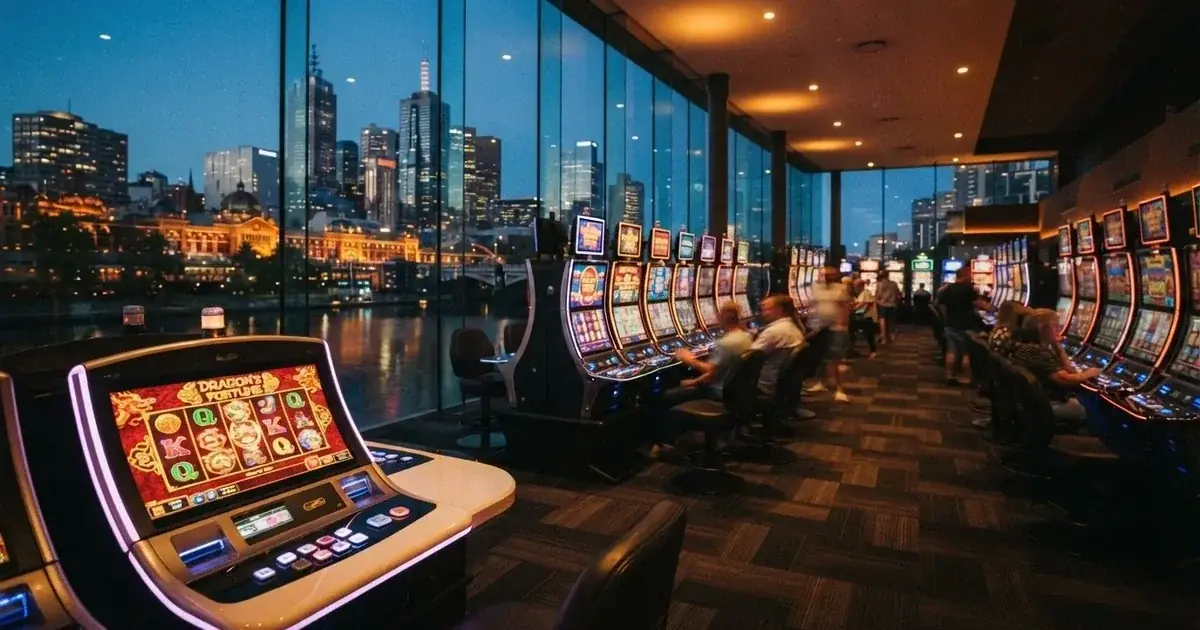
A Melburnian who wants to play a poker machine has a shorter, more boring list of options than an internet search for “best pokies in Melbourne” suggests. The lawful way to play is at a venue that the Victorian Gambling and Casino Control Commission has actually licensed — Crown Melbourne on the south bank of the Yarra, and roughly 488 pubs and clubs across the state holding gaming-machine entitlements. The other list, the one that runs on every “pokies near me” ad, is offshore online casinos. The Australian Communications and Media Authority has spent the last several years saying, in writing, that those are unlawful and blocking them.
This page is about that distinction. It walks through what Crown Melbourne and the suburban pub and club network actually offer in 2026, what the regulatory frame around them is, where the payout percentages sit, and why every “best online pokies Melbourne” search result points at sites the ACMA has acted against. The picture is shaped by a single fact: a real pokie in Melbourne is a machine in a building, not a thumbnail on a phone.
Table of Contents
- What “pokies” means in Melbourne, and why the offshore version isn’t equivalent
- Crown Melbourne: the pokies venue that defines the market
- The pub and club network: where most Melbourne pokies actually live
- Payout percentages, maximum payouts, and what “best paying” actually means
- The paytable mechanics that separate one Melbourne pokie from another
- Responsible gambling at Melbourne pokies venues
- Legality: the IGA frame and the ACMA’s record against offshore sites
- The blocking rate, in plain English
- How the offshore brands line up against the ACMA record
- Where the ACMA blocking rate leaves a Melbourne player
- Payments, deposits and withdrawals: what an onshore pokies venue looks like
- What the 2026 reform does and does not change
- What a reader comparing pokies in Melbourne should weigh
- Frequently asked questions
What “pokies” means in Melbourne, and why the offshore version isn’t equivalent
“Pokies” is the Australian term for electronic gaming machines — the slot-style games that sit in rows in pubs, clubs and casinos. The name comes from “poker machines”, a relic of when the early versions used poker-hand combinations. In Melbourne the machines are licensed under Victorian law, regulated by the Victorian Gambling and Casino Control Commission, and the revenue they generate runs into billions a year. Victorians lost a record A$3.318 billion on electronic gaming machines in 2025–26, according to the Victorian Local Governance Association — a figure that includes every machine in every pub, club and casino in the state.

“Online pokies”, by contrast, is a marketing phrase attached to offshore casino websites. The Interactive Gambling Act 2001, strengthened by the Interactive Gambling Amendment Act 2017, makes it an offence to provide online casino games — including online pokies — to a person physically in Australia. No state or territory licences that product. What is licensable is wagering on races and sport placed before the event, lotteries, and keno. The Northern Territory Racing and Wagering Commission regulates 52 of Australia’s online bookmakers — including Sportsbet, Bet365 and Ladbrokes — licensed in the Territory for tax reasons; the commission has no full-time staff and meets once a month in Darwin. Bookmaker, not casino. The slot-style game offered by an offshore site is not that licensed product, and the licence the site displays offshore does not change what it is doing under Australian law.
So when a search for “best pokies in Melbourne” returns a list of offshore casino brands with welcome bonuses, every one of those brands is either the subject of an ACMA formal warning or has been blocked at the ISP level. The match the reader wants — a pokie venue in Melbourne they can walk into — is not what those sites sell.
Crown Melbourne: the pokies venue that defines the market
Crown Melbourne sits on the south bank of the Yarra River in Southbank. It first opened temporarily on 30 June 1994 at the World Trade Centre on the Yarra’s north bank, then reopened on its current south-bank site on 8 May 1997. Its complex covers about 510,000 m² — roughly two city blocks — and is the largest casino resort in the Southern Hemisphere. The gaming floor spans about 20,000 m² and carries 540 licensed table games, including around 100 poker tables, alongside 2,500 poker machines. The resort itself adds 1,604 hotel rooms across three towers.
Crown Resorts has owned the venue since Publishing and Broadcasting Limited took over the operation from founder Lloyd Williams in 1999. The poker machines at Crown are licensed under Victorian law through the Victorian Gambling and Casino Control Commission, and Crown Melbourne is the only venue in Victoria allowed to operate gaming machines without the per-venue cap that applies to pubs and clubs — it is treated as the state casino, not as another licensed premises.
The venue is also the most consequential regulatory story in Melbourne pokies. Victoria’s Finkelstein Royal Commission into the Casino Operator and Licence concluded in October 2021, finding evidence of money laundering and strong ties to organised crime at Crown Melbourne. Crown kept its licence only for a two-year review period under a court-appointed Special Manager overseeing operations. The regulator then fined Crown A$80 million in June 2022 for processing A$164 million in illicit payments, and a further A$120 million in November 2022 for a decade of responsible-gambling breaches, including letting patrons gamble for more than 24 hours without a break. The Casino and Gambling Legislation Amendment Act 2021, passed after the Royal Commission, created the Victorian Gambling and Casino Control Commission as the new regulator and banned junket operations at Victorian casinos.
For a reader comparing pokies venues in Melbourne, Crown is the highest-stakes option in the literal sense. The machines, the table-game surrounds, the hotel, and the bars all sit in one building. It is also the only Melbourne venue that operates outside the state’s 30,000-machine cap on pub and club EGMs.
The pub and club network: where most Melbourne pokies actually live
Outside Crown, every poker machine in Victoria sits in a pub, club or, more rarely, a hotel. Victoria had 26,380 gaming machines outside Crown Casino in 488 venues in 2021–22, under a 30,000-machine statewide limit. That figure puts the pub and club share of the state’s EGM fleet at the great majority of the total. The “best pokies in Melbourne” question, applied to the network the average punter actually visits, is mostly a question about which pub or club in their suburb has machines and at what payout settings.
A few practical limits shape every venue in this network. The Victorian regulator caps the number of machines at each pub or club based on the venue’s size and the number of patrons it holds, and each machine’s maximum stake is fixed. South Australia — included here only because neighbouring-state readers often compare — sets a minimum gaming-machine return-to-player rate of 87.5% and a general maximum bet of A$5.00 outside the casino; Adelaide Casino itself has no maximum-bet limit. The equivalent Victorian settings are the Victorian Gambling and Casino Control Commission’s venue rules and the state’s machine-monitoring standards.
The practical consequence is that any pub or club pokies experience in Melbourne is broadly similar in return-to-player terms across the network, with small differences between venues. Differences in “best paying pokies in Melbourne” claims usually come down to which venue happens to have a particular machine model installed, not to a structural pricing difference. Payout percentage is set per machine and per game, not per venue.
Payout percentages, maximum payouts, and what “best paying” actually means
The phrase “best paying pokies in Melbourne” is doing a lot of work. Three different things sit underneath it, and they don’t all point in the same direction.
The first is return-to-player, or RTP. This is the percentage of money a machine returns to players across a very large number of spins. Australian pub and club machines generally sit in the high-80s to low-90s range, depending on the game. South Australia’s minimum is 87.5% outside the casino. Victoria does not publish a single statewide RTP figure the way South Australia does, but the floor is similar in practice, and the games themselves carry RTPs set by the manufacturer.
The second is the maximum cash payout a single machine will produce in one hit. State regulations cap this — typically at a few thousand dollars per machine, with venue staff paying larger wins manually. That cap is what limits the “big jackpot” stories even at the best-paying machines: a machine paying A$10,000 in one spin is unusual and usually means a venue payout, not a machine payout.
The third is the volume effect. A higher RTP does not mean a player wins more often. It means that, over millions of spins, the machine returns that percentage of what it takes in. For any individual session, the variance dominates. Someone playing a 90% RTP machine can still lose their entire bankroll in an hour; someone playing an 87% machine can still hit a feature and walk out ahead. The numbers matter at the population level — over the 26,000-plus machines in Victorian pubs and clubs and the billions of dollars that go through them every year — not at the session level.
A useful comparison comes from interstate. South Australian gaming-machine losses outside Adelaide Casino totalled about A$0.92 billion in 2022-23, equivalent to about A$497 per adult. That per-adult figure is the closest publicly available read on the difference between high-stake and low-stake regimes, and it sits beside the much larger Victorian numbers in the same general category of comparison.
The takeaway for a reader: “best paying pokies in Melbourne” is a phrase that points at RTP, but RTP is a long-run average. What changes between venues is the game catalogue and the maximum payout, not the structural edge.
The paytable mechanics that separate one Melbourne pokie from another
A pokies paytable is the table that lists what each symbol combination pays and what each bonus feature triggers. In Melbourne venues, the games come from a small number of large manufacturers — Aristocrat, IGT, Konami and a handful of others — and a venue’s paytable mix depends on which machines the venue owner has chosen to install.
Two paytable mechanics matter most for a player. The first is volatility, which describes how often the machine pays and how big the pays are when they hit. A low-volatility machine pays smaller amounts more often; a high-volatility machine pays larger amounts less often. The RTP can be identical between a low-volatility and a high-volatility game. The second is the bonus feature structure — free-spin rounds, hold-and-spin mechanics, wheel bonuses and similar. Bonus features are where the larger pays live; the base game is usually a steady, small-amount grind.
Crown Melbourne’s 2,500 machines include the full catalogue available to a major casino venue — high-denomination games, larger-payout machines and a wider mix of volatility profiles than the average pub can run. A suburban pub with 30 to 40 machines has a narrower mix, and is more likely to run the steady, low-volatility games that suit a venue with casual foot traffic.
The “best pokies in Melbourne” question, applied to game mechanics, usually resolves to “which game does this punter like”. That is a real preference, not a flaw in the question. But it is not the same as RTP, and it is not the same as payout percentage, and a reader who treats it as either of those is making a category error.
Responsible gambling at Melbourne pokies venues
The responsible-gambling support network in Melbourne is shaped by state and federal regulation rather than by individual venue choice. Every licensed pub, club and casino in Victoria is required to display responsible-gambling materials, offer self-exclusion, and let staff intervene where a patron is showing signs of harm.
The national backbone is BetStop, the National Self-Exclusion Register, live since August 2023. BetStop binds Australian-licensed online and phone wagering services, which means a patron who self-excludes through BetStop is blocked from licensed sports and race bookmakers but not from offshore casino sites or from in-venue play. For pokies specifically, the state-based self-exclusion schemes run separately, and a patron can register a venue exclusion at individual pubs and clubs as well.
The National Gambling Helpline is 1800 858 858 — free, 24/7, with chat at Gambling Help Online. Victoria’s own support line sits alongside the national one. For venue-level exclusion, the patron negotiates directly with the venue operator.
The asymmetry of the support system matters. A punter who wants to stop playing pokies at a Melbourne pub or club can register a self-exclusion at that venue and have it enforced. The same punter cannot register an exclusion at an offshore online casino because the offshore site is not connected to any Australian register, and may continue to accept deposits and bets while the punter’s self-exclusion is in force at every onshore venue they visit.
The other piece worth carrying forward is the payment-side protection that came in 2024. Credit cards, credit-related products and digital currency are banned as payment for licensed online wagering since 11 June 2024, with penalties up to $247,500 for operators. Legal deposit routes for licensed wagering are debit card, bank transfer, PayID, Osko and BPAY. A pokies site asking an Australian player for a credit card or a crypto deposit is operating outside the Australian rules on payment — not on game content alone.
Legality: the IGA frame and the ACMA’s record against offshore sites
The Interactive Gambling Act 2001 (IGA), as amended in 2017, makes it an offence to provide online casino games, online pokies and in-play betting to a person in Australia. The IGA targets the provider, not the individual player. A patron at home in Melbourne who opens an offshore casino site is not committing an offence; the operator is.
Enforcement runs through the ACMA, which investigates, issues formal warnings and directs Australian internet service providers to block illegal sites. According to the ACMA as reported in June 2026, a total of 1,751 illegal gambling and affiliate marketing websites had been blocked since the first blocking request in November 2019. More than 230 unlicensed gambling services had left the Australian market since enforcement was strengthened in 2017. In the round reported on 26 June 2026 alone, the ACMA asked ISPs to block another 12 sites: 7Signs, ChromaBet, Donbet, Duospin, Freshbet, Slots Gem, Jacks Club, Lucky Start, Pointsbetz, Spinrise, Vinyl Casino and Wildsino.
The formal-warning register sits beside the blocking record. The ACMA has issued formal warnings to Pulsup Ltd over Rocketplay (March 2026), to Dama N.V. over Bambet, Dazard, Level Up, Rocketplay, Wild Tornado and Cobra Casinos (May 2022), to Dama N.V. again over Woo Casino (March 2025) and Spirit Casino (May 2025), to Consolutetish S.R.L. over National Casino and Bizzo Casino (July 2025), to Bamboo Media over Ignition Casino (July 2025), to EOD Code SRL over Instant Casino (February 2025), to Ryker B.V. over Jackbit and CasinOK (April 2026), to Sterplay Holding Ltd over Casino Intense (April 2025), and to Hollycorn N.V. over Sky Crown and Blue Leo (September 2022).
The practical takeaway: an offshore site advertising “pokies” to an Australian reader either is, or has been, on the ACMA’s list. The blocking total grows every quarter. The first blocking request went out in November 2019; the running total was 1,751 by June 2026.
The blocking rate, in plain English
The arithmetic the page owes the reader is what the ACMA’s blocking record implies about how quickly the offshore market loses access in Australia. Between November 2019 — the first blocking request — and June 2026, the running total reached 1,751 blocked sites. That works out to roughly 215 sites blocked per year on average, or about 18 per month. The rate has not been steady. The early years carried fewer than the post-2017 figure suggests, and the 2026 rounds have run in batches of around a dozen per quarter.
The number a reader can use is the band: somewhere between 12 and 25 sites blocked per quarter over the last several rounds, against a starting base of zero in late 2019. A site that is not on the list today is likely to be on it within a year; a site that is already on it is functionally inaccessible from an Australian residential ISP without workarounds.
The figure assumes the ACMA’s enforcement continues at the pace it has run since 2017. It does not account for the new Interactive Gambling Amendment (Gambling Reform) Bill 2026, which passed Parliament on 19 August 2026 and whose advertising and inducement measures commence on 1 January 2027 — law with a start date, not yet in force on a 2026 page. When those measures come in, the enforcement base widens beyond blocking to include civil penalty regimes around inducements. The page treats that as a forward-looking note, not a current fact.
How the offshore brands line up against the ACMA record
The brand list below is not a ranking and not a recommendation. It is the set of brands the ACMA has named in formal warnings over offering prohibited online casino services to Australians, with the operator named in the warning and the date. Where research provided no usable subject support — no verifiable game, licence or payment data — the line is left as a gap rather than filled with speculation.
RocketPlay — ACMA action in March 2026
Pulsup Ltd was the subject of an ACMA formal warning in March 2026 over Rocketplay. The same brand had been the subject of an earlier formal warning to Dama N.V. in May 2022, and Rocketplay’s continued appearance on the warning register is the cleanest available signal that the formal-warning process alone has not stopped the site from accepting Australian players. The site’s subject support is not documented in the available sources, and the page carries that gap rather than guessing at catalogue or payout. For a Melburnian comparing options, the fact that matters is the dual-warning history, which puts Rocketplay further down the trust ladder than a single-warning brand.
Level Up Casino — ACMA action in May 2022
Dama N.V. was the subject of a formal warning in May 2022 covering six brands including Level Up Casino. The brand has stayed visible on affiliate listings despite the warning, and the listings are the only verifiable source for its catalogue. A punter comparing options should note that Level Up’s continued operation under an Australian-facing affiliate footprint sits in the same pattern as the rest of the Dama N.V. stable — the operator was warned once and the warning did not end the Australian-facing side of the business.
Woo Casino — ACMA action in March 2025
Dama N.V. was the subject of a further formal warning in March 2025 covering Woo Casino. The gap between the May 2022 warning and the March 2025 one is the cleanest available read on how long a brand can keep operating in the Australian-facing space after a first warning. Subject support is documented only through listings, which means the page cannot verify catalogue claims independently.
Spirit Casino — ACMA action in May 2025
Dama N.V. was warned again in May 2025, this time over Spirit Casino. No usable subject support was documented in the available sources, so the line stays as a gap. The fact that matters for comparison is the same one that applies to Woo Casino and Level Up Casino: Dama N.V. has now appeared on the ACMA register three times across three years, and the formal-warning track record is itself the available evidence.
National Casino — ACMA action in July 2025
Consolutetish S.R.L. was warned in July 2025 over National Casino. The brand had a verifiable footprint through listings and Australian-facing marketing; subject support is documented only through those listings, not independently. For a Melburnian, the relevant fact is that National Casino sits in the same July 2025 warning cohort as Bizzo Casino, Ignition Casino and Instant Casino, all of which carry similar subject-support gaps.
Bizzo Casino — ACMA action in July 2025
Consolutetish S.R.L. was also the subject of a July 2025 warning over Bizzo Casino, and the same brand had already been warned in 2022 over TechSolutions (CY) Group Limited and TechSolutions Group N.V. Bizzo is the clearest example on the list of a brand that has survived a first warning and reappeared on the ACMA register. With no verifiable independent catalogue or licence data available, the brand is included here as a name and a warning history.
Ignition Casino — ACMA action in July 2025
Bamboo Media was warned in July 2025 over Ignition Casino. The Australian-facing footprint is large enough that the warning was issued, but as no verifiable independent catalogue or licence data exists, the page carries no evidence beyond the ACMA action itself.
Instant Casino — ACMA action in February 2025
EOD Code SRL was warned in February 2025 over Instant Casino. Because no independent information on its catalogue or licences is available, the brand sits on the comparison as a name and a warning date. The 2025 timing makes Instant Casino one of the earlier cases in the post-2024 enforcement wave.
Jackbit — ACMA action in April 2026
Ryker B.V. was warned in April 2026 over Jackbit and CasinOK. Jackbit is the freshest name on the list. Since no verifiable catalogue or licence information could be sourced, the brand carries no independent data. For a 2026 reader, the relevant fact is the recency of the action — Jackbit is on the register at the start of the year, and the formal warning was issued in the same quarter.
Casino Intense — ACMA action in April 2025
Sterplay Holding Ltd was warned in April 2025 over Casino Intense. Subject support is documented only through listings, which the page carries without verification. The brand is the only one in the April 2025 cohort that has verifiable listing-level documentation, though that documentation is not the same as independent verification.
Sky Crown — ACMA action in September 2022
Hollycorn N.V. was warned in September 2022 over its Sky Crown and Blue Leo casino services. Sky Crown is the earliest warning on the page’s list and one of the clearest cases of a brand that has continued to advertise Australian-facing content more than three years after the formal warning. Subject support is documented only through listings, which the page carries without independent verification.
The pattern the list shows
Eleven brands, six operators behind them, formal warnings spanning 2022 to 2026. Three operators — Dama N.V., Consolutetish S.R.L. and Hollycorn N.V. — appear more than once on the register, which is the structural signal that a single formal warning has not, on its own, ended an offshore brand’s Australian-facing footprint. Five brands have no documented subject support at all, which is itself information: where a brand’s catalogue cannot be verified independently, the page carries that gap rather than the marketing claim.
Where the ACMA blocking rate leaves a Melbourne player
The blocking-rate arithmetic does not change what is or is not legal. The IGA’s prohibition on providing online casino games to Australians has not changed since 2017. What it changes is the practical experience of trying to reach an offshore site from an Australian residential connection. A site blocked at the ISP level is invisible to the average residential customer without technical workarounds; a site under formal warning but not yet blocked may still load. The 1,751-site blocking total by June 2026 — roughly 215 per year on average since November 2019 — is the read on how quickly that window closes.
For a Melbourne punter, the practical conclusion is that the offshore option is, at best, a temporary one. The site that loads today may be blocked next quarter. The withdrawal in flight when that happens may or may not complete, because the site is not connected to any Australian dispute-resolution body. And the balance left on a blocked site sits on the operator’s side of the transaction with no Australian recourse. The onshore option — Crown, the pub network — is regulated, supervised, and answerable to the Victorian Gambling and Casino Control Commission.
Payments, deposits and withdrawals: what an onshore pokies venue looks like
A pokies session at a Melbourne pub or club is cash-and-EFTPOS at the machine. The machine itself accepts notes and coins, prints a ticket when the player cashes out, and the ticket is redeemable at the bar or at a cashier terminal. There is no deposit, no bonus, no wagering requirement, and no withdrawal pending period. The money in and the money out are both at the venue.
Crown Melbourne operates the same cash-and-ticket model on its 2,500 machines, with the addition of the casino’s broader cashier and account-credit systems for table games. The payout ceiling on a single machine hit is determined by the machine’s own settings; a larger win is paid manually at the cashier and may require identification and tax documentation if it crosses reporting thresholds.
The “online pokies Melbourne no deposit bonus” phrase that appears in some search results points at offshore casinos and at bonus structures that do not exist in the licensed Australian market. No Australian-licensed venue offers a “no deposit bonus” on a poker machine. The phrase is a marker that the result is an offshore site, not an onshore venue, and the IGA prohibition applies.
What the 2026 reform does and does not change
The Interactive Gambling Amendment (Gambling Reform) Bill 2026 passed Parliament on 19 August 2026. Its advertising and inducement measures commence on 1 January 2027, which means the law is on the books at publication but is not yet in force. For a 2026 reader, the practical consequence is forward-looking: from 1 January 2027, the enforcement base widens beyond blocking to include civil penalty regimes around inducements — bonuses, “free spins” offers, and similar marketing structures aimed at Australian players.
The reform does not change the underlying prohibition, which has been in force since 2017. It adds an enforcement layer on top. The blocking record since 2019 — 1,751 sites by June 2026 — is what the prohibition has produced so far; the inducement regime is the layer that should produce faster action against the marketing structures around offshore sites.
What a reader comparing pokies in Melbourne should weigh
A real comparison runs along four axes that the available data actually supports.
The first is whether the venue is licensed at all. Crown Melbourne is licensed under Victorian law. The 488 pub and club venues are licensed under the same regime, with caps on machine numbers and stake sizes that the casino is exempt from. Every offshore site on the ACMA register is, by definition, not licensed for casino product in Australia.
The second is what the venue actually offers. Crown’s 2,500 machines, 540 table games and full hotel complex are a different proposition from a suburban pub’s 30 EGMs and a bar. The pub and club network carries the bulk of the state’s EGM footprint by venue count.
The third is what the payout mathematics looks like. RTP is set by the machine, not the venue; maximum payout is set by regulation; variance dominates any individual session. A reader who treats RTP as a session-level prediction is reading the wrong number.
The fourth is what recourse the venue offers. A Victorian-licensed venue answers to the Victorian Gambling and Casino Control Commission. An offshore site answers to no Australian regulator, sits outside the BetStop self-exclusion register, and may be blocked at the ISP level with a balance still on it.
That last axis is where the offshore list and the licensed venue list actually separate. The game catalogue, the bonus structure and the wagering requirements that an offshore site advertises are real differences in marketing terms — and irrelevant ones, because the venue they apply to is not accessible from a residential Australian connection without the risk of being cut off mid-session.
Frequently asked questions
Which venues in Melbourne are licensed to operate pokies?
Crown Melbourne on the south bank of the Yarra is the state casino, with about 2,500 machines. Outside Crown, roughly 488 pubs and clubs across Victoria hold gaming-machine entitlements, covering 26,380 machines under the state’s 30,000-machine cap in 2021–22. Every venue on that list is licensed by the Victorian Gambling and Casino Control Commission.
Are pokies in Melbourne available around the clock?
Opening hours depend on the venue. Crown Melbourne runs a 24-hour gaming floor on its main casino level; many suburban pubs and clubs close their gaming areas at the same time the venue closes, with closing times generally between midnight and 3 a.m. There is no statewide 24-hour rule; the rule is the venue’s own licence conditions.
What identification do venues in Melbourne require before letting someone play pokies?
All venues require the patron to be 18 or older, and most require photo identification on entry or on request. Crown Melbourne runs a formal membership system with mandatory ID for entry to the main gaming floor. Pubs and clubs typically ask for ID on the door during late trading and from any patron who appears to be underage.
Can visitors to Melbourne use self-exclusion schemes at local pokies venues?
Yes, and the schemes apply at the venue regardless of where the patron lives. A visitor can register a self-exclusion at a specific pub or club, and the exclusion applies for the period registered. BetStop, the National Self-Exclusion Register, binds Australian-licensed online and phone wagering services but does not extend to in-venue pokies or to offshore casino sites, so the venue-level exclusion is the right route for pokies specifically.
How does the payout percentage on Melbourne pokies compare with other Australian cities?
Victoria does not publish a single statewide RTP figure, but pub and club machines typically sit in the high-80s to low-90s range. South Australia publishes a minimum 87.5% RTP outside Adelaide Casino and has no cap on maximum bet inside the casino; the equivalent Victorian numbers are set per machine and per game. Differences between cities show up in maximum bet limits and in the per-venue machine cap rather than in the structural RTP of a typical game.
Is it legal for an online casino to advertise “pokies” in Melbourne the same way a pub or club does?
No. The Interactive Gambling Act 2001 makes it an offence to provide online casino games — including online pokies — to a person in Australia. The ACMA has issued formal warnings to eleven brands over this conduct since 2022 and has blocked 1,751 illegal sites since November 2019. An offshore casino’s advertisement of “pokies” to an Australian audience is the conduct that triggers the warning or the block, not a lawful alternative to a Melbourne pub or club.